


Blog Post
Web analytics

Nadine
Wolff
published on:

What changes are occurring in affiliate marketing after the GDPR?
Table of Contents

Under the GDPR, affiliate marketing is just one of many online marketing channels where a lot is set to change due to data privacy regulations.
The GDPR has now been in effect for nearly three months, and so far—despite a warning letter here and there—major chaos has failed to materialize. Or should we say, the chaos hasn't erupted YET? After all, the ePrivacy Regulation is still slated to follow the GDPR at the end of the year. But don't panic: this article offers an outlook on what matters in affiliate marketing post-GDPR and what advertisers and publishers should definitely keep in mind right now.
May 25, 2018 arrived, and hardly anyone really knew what was in store. Am I still allowed to track anything at all? Can I continue to scale my business? In conversations we had with many industry experts leading up to May 2018, it became clear time and time again that nobody truly knew what was going to happen. Online marketers did their best to follow the initial instructions of their data protection officers, even if they weren't 100 percent sure whether the measures were actually relevant.
Law firms specializing in internet law have been fully booked all year long. Public institutions offering training for data protection officers are enjoying almost consistently sold-out classrooms. The industry has been shaken up quite a bit.
We took a look at the relevance of the topics "data privacy" and "GDPR" using Google Trends and similarweb, and we definitely see a trend:
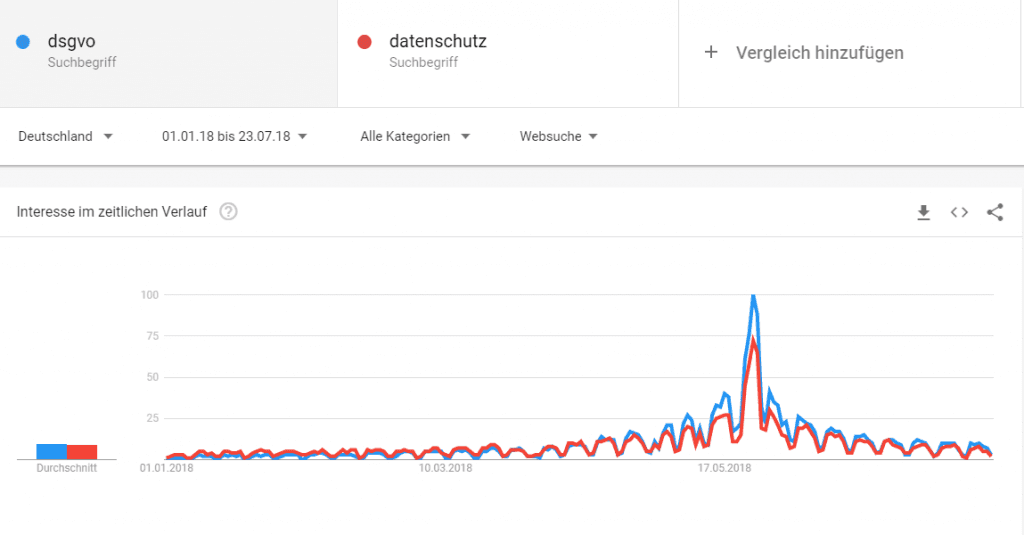
Fig. 2 Comparison of GDPR and data privacy in Google Trends
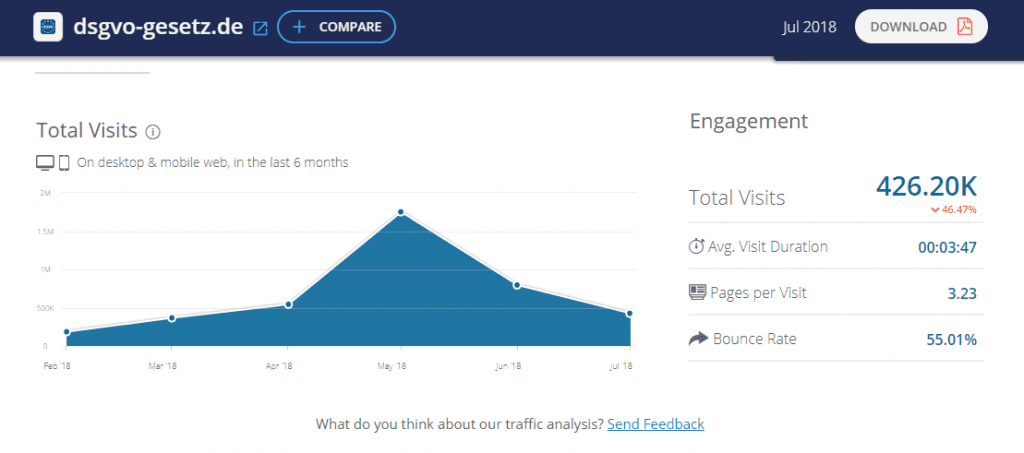
Fig. 3 Traffic Overview for dsgvo.gesetz.de as of July 2018
We can see that in Q1 2018, almost no one was really engaging with topics related to the GDPR. Was the scope of the GDPR underestimated as a result? We don't think so, since preparing for the GDPR at the beginning of the year wouldn't have helped much when it wasn't even finalized until May 25. The European Union itself made last-minute adjustments to the directive just days before the GDPR took effect.
Now, however, interest is noticeably waning, even though just as many questions on the topic remain. Thanks to the GDPR, alongside the use and storage of personal data, the documentation of data and the retention period of data storage are now much better regulated across all EU member states.
The GDPR stipulates that data storage must be based on a minimal volume and that data must be deleted after a specified period. This grants consumers greater transparency and self-determination over their own data in online interactions.
Personal Data in Affiliate Marketing?
In fact, it is still not fully settled which personal data actually applies to affiliate marketing. In addition to a consumer's master data, it involves reading their IP address, device tracking, and cookie IDs, which can now essentially only be traced back to a specific individual if there is a legitimate interest.
Lead generation in affiliate marketing is still permitted. However, prior to "entering into a contract," it must be ensured—even in the case of a free prize draw or other free offers where users ultimately pay with their data—that this exact situation is clearly communicated to users and that data can be deleted. Only then can participation (in a sweepstakes) be considered valid consent (opt-in). Here, too, attention must be paid to the legal data retention period.
The prohibition of coupling consent under Section 4a (1) sentence 1 of the BDSG (Federal Data Protection Act) remains in place under the GDPR. Furthermore, the right to object and the right to data erasure under the GDPR are new for consumers.
What Publishers Should Keep in Mind Moving Forward
Publishers, together with the affiliate network, are considered data processors when promotional material is integrated onto publisher websites via an affiliate network and data tracking takes place. Publishers can still integrate promotional material independently on their websites without having to coordinate with advertisers. However, they will have to expect that advertisers will look even more closely when reviewing new applications to see whether publisher sites comply with current data privacy guidelines. Here is a summary of what publishers should keep in mind:
Fundamentally essential: A website with an HTTPS certificate!
Updating your privacy policy page
Is there a complete legal notice (impressum) in place?
Ensure transparency when informing users about data collection, storage, and deletion
Refrain from aggressive targeting
Consult with affiliate networks and service providers regarding data privacy and tracking
Include a note on your own website about collaborating with an affiliate network, including a link to their privacy policy
Use consent tools
Clearly label advertising in social media posts
One publisher that has implemented this well, for example, is gutscheinpony.de. Here, you can clearly see just how comprehensive a privacy policy page can and must be today.
Even before the GDPR, it was necessary to obtain user consent for any kind of cookie tracking. So this isn't something brand new that arrived with the GDPR. Anyone who hasn't implemented this yet has simply been operating sloppily for quite a while.
At the very least, users should be provided with an opt-out option for tracking within the privacy policy page. The extent to which an opt-in under Art. 6 (1) of the GDPR is also required will only be determined with the ePrivacy Regulation (although there are already indications that explicit consent from the user is already necessary now).
Unfortunately, the topic of the GDPR remains relatively opaque—especially in affiliate marketing.
If you want to play it safe and opt for an opt-in right now, you can find a plug-and-play consent tool with the AWIN network, for instance: a banner that publishers can embed on their website to collect user consent.
Other networks like Conversant & CJ Affiliate also offer handy solutions nowadays. How this works is explained in more detail here.
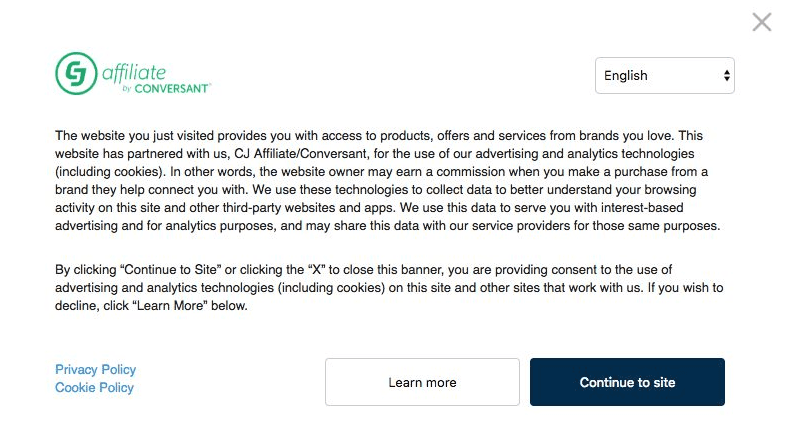
Fig. 4 Example of a consent tool from Conversant & CJ Affiliate
What Advertisers Should Keep in Mind
The following overview doesn't necessarily apply equally to every advertiser. Affiliate networks don't automatically store personal data and IP addresses. It should therefore be noted that advertisers must decide individually whether and which affiliate marketing measures are relevant for them under the GDPR.
Here are some action items that might be coming your way:
Fundamentally essential: Your website should have an HTTPS certificate
Update your privacy policy page
Do you use Facebook, Google Maps, or Google Analytics? Make sure to mention this accordingly!
Do you use a public or private affiliate network? Mention this accordingly!
Review your cookie policies and adjust them if necessary
Appoint an internal data protection officer
Check existing sets of personal data for legal compliance
Pay close attention to data minimization and data deletion
Draft a Data Processing Agreement (DPA) with your affiliate network & external service providers
For profiling/retargeting campaigns, tracking switches & 3rd-party providers: use opt-in & consent solutions
Impact of the GDPR on Small and Medium-Sized Businesses
Affiliate marketing is especially appealing to companies because ads don't primarily have to be placed on a pay-per-click basis; instead, money is spent mainly when the target action—a conversion—has actually occurred. Regardless of company size, affiliate marketing has become an integral part of the online marketing mix for e-commerce shops of all kinds. That makes it all the more important that this channel remains compliant with data privacy laws and stays profitable after the GDPR.
At our industry conference held in Berlin this past June, it became clear that our agency's focus lies in strengthening small and medium-sized enterprises (SMEs) through tailored online marketing strategies. Naturally, we also guide our clients through data privacy matters as far as possible, though we cannot provide legally binding advice.
Originally, a standardized data privacy regulation was intended to make data misuse and mass data storage much more difficult or impossible for global players like Google, Amazon, and Facebook.
What we're seeing now is that small and medium-sized enterprises in particular are bearing the brunt of penalties and the extra burden of data-related bureaucracy. They face a significantly bigger challenge when it comes to implementing the GDPR guidelines.
It is precisely these small and medium-sized businesses that, purely due to their financial disadvantage compared to the likes of Facebook, are unable to easily manage the massive project that is the GDPR, which lends a certain tragic note to the whole situation.
If opt-in consent truly becomes mandatory for all publishers in the future, it could lead to massive performance drops in affiliate marketing. We've already seen in other projects that opt-in requirements come with a significant loss of traffic, and we know that for the affiliate industry—a channel typically found near the end of the customer journey—reliable tracking would then be virtually impossible.

Fig. 5: Is the Internet of Things being slowed down by the GDPR?
Here lies the problem: There is a lack of comprehensive templates for guidance that could make the general implementation of the GDPR practical, for instance with regard to affiliate marketing. This was simply neglected during the GDPR's two-year transition period. And how could it have been smoothly implemented anyway when, as mentioned earlier, the EU was still making changes and stirring up uncertainty just days before the regulation took effect?
The reality is that, with the way GDPR implementation is currently unfolding for SMEs, small businesses in particular are struggling with what feels like a step backward in digital progress. Better advocacy and lobbying for small and medium-sized enterprises will certainly be necessary to prevent negative fallout from data minimization and data deletion in the future.
Not Every Advertiser Will Face an Immediate Warning Letter
Even though it hasn't been completely resolved how the GDPR—and soon the ePrivacy Regulation—will impact the internet industry as a whole, we'd still like to offer some reassurance.
Over the past few weeks, more and more information has emerged from relevant industry associations and policymakers. We expect clear structures for handling the new data privacy framework to take shape by the end of the year. Regular dialogue between agencies, publishers, advertisers, and affiliate networks can also help smaller businesses become increasingly comfortable with the topic.
By the way: Don't immediately worry about major cease-and-desist warnings or multimillion-dollar lawsuits. Even legal experts don't yet fully know the exact boundaries within which warning letters are legally airtight. Only those who act with gross negligence and haven't engaged with the GDPR at all run the risk of receiving a warning and ultimately causing the feared chaos.
Generally speaking, a massive wave of warning letters won't materialize if all website operators—on both the advertiser and publisher sides, as well as at the agency level and across affiliate networks—implement feasible adjustments within their scope, stay in touch, and work together to find a practical approach for the future that works not just for themselves, but above all for their customers.
How can we help you?
Are you looking for a full-service agency to manage your affiliate marketing? We’d be delighted to support you and advise you with an integrated online marketing strategy. Feel free to get in touch. We look forward to hearing from you!
Nadine
Wolff
As a long-time expert in SEO (and web analytics), Nadine Wolff has been working with internetwarriors since 2015. She leads the SEO & Web Analytics team and is passionate about all the (sometimes quirky) innovations from Google and the other major search engines. In the SEO field, Nadine has published articles in Website Boosting and looks forward to professional workshops and sustainable organic exchanges.
