

Blog Post
Search Engine Advertising (SEA)

John
Stable
published on:
What exactly is SEA? A definition of search engine advertising
Table of Contents
What exactly is SEA? For the commercial success of many businesses today, it is essential to be present and visible to potential customers on search engines through SEA/SEM ads.
The major search engines Google, Yahoo, and Bing serve as the primary interface for researching information, products, and services.
Through search engine marketing (or Search Engine Marketing), advertisers try to achieve better placement for their website within the search engine results pages.
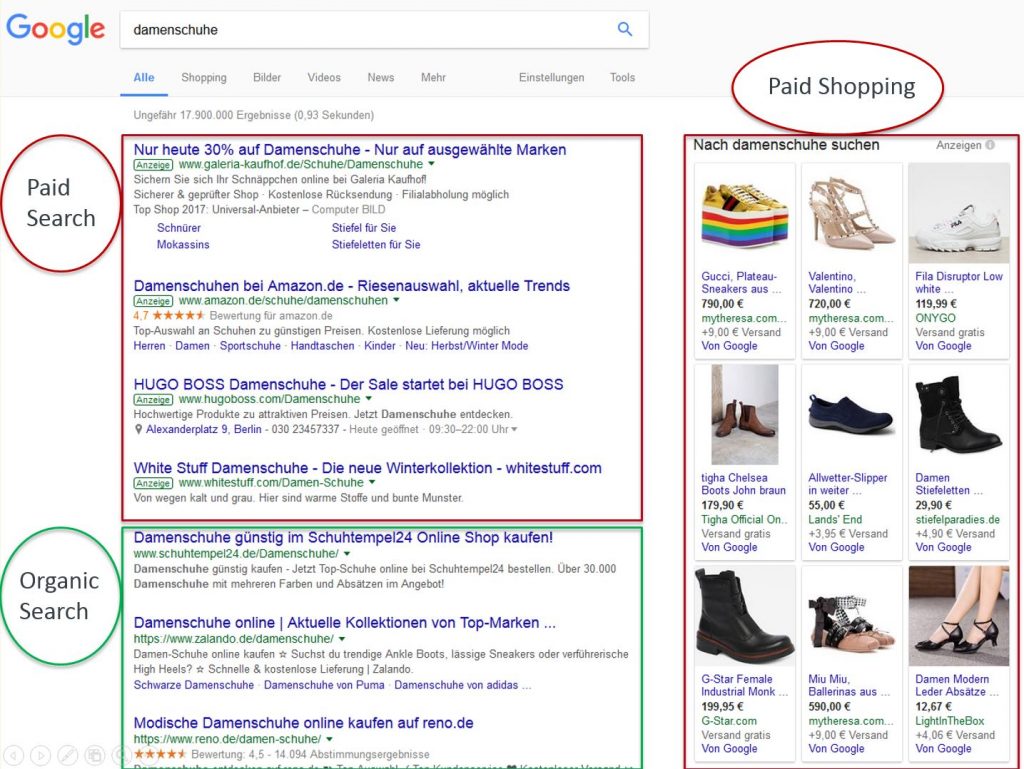
Fig. 1: Google's Search Engine Results Page (SERP) featuring Paid Search, Organic Search, and Paid Shopping
On results pages, a distinction must be made between organic and paid listings. Search Engine Advertising (SEA) covers all activities related to paid search engine listings. The term SEO, on the other hand, refers to the optimization of organic listings.
The acronym SEM (Search Engine Marketing) is typically used as an umbrella term for both disciplines: SEA / Search Engine Advertising and SEO / Search Engine Optimization. In German, SEA is usually translated as "Suchmaschinenwerbung." Many users may not even explicitly distinguish between organic and paid listings themselves.
However, the way results work and are put together is vastly different in both areas.
In SEO, rankings are based on the Google algorithm, which evaluates all indexed websites. Paid placements, on the other hand, can only be achieved through SEA campaigns (see also Figure 2: The difference between SEO and SEA).
On Google, these can be managed using the Google AdWords advertising platform; for Bing and Yahoo, there is Bing Ads. With a 95% market share, however, Google clearly dominates the search engine market in Germany.
New innovations in search engine advertising usually originate from the Google AdWords platform and are subsequently adopted by other competitors (Shopping campaigns, Enhanced Text ad format, etc.).
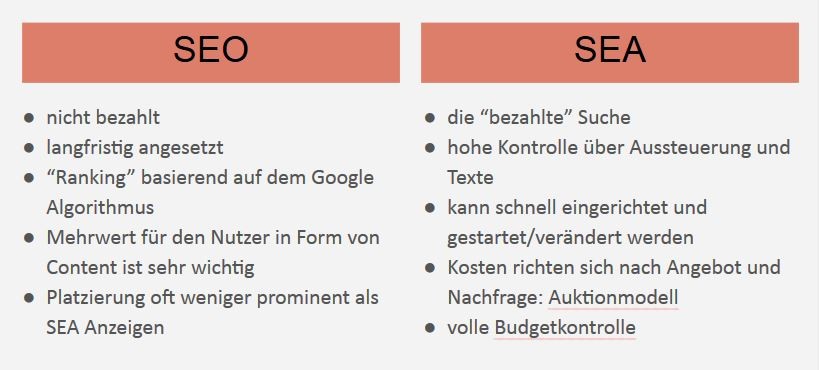
Fig. 2: The difference between SEO and SEA
Benefits of SEA Marketing
In the battle for maximum visibility, traffic is the ultimate prize. On Google alone, around 64,000 search queries are submitted every second worldwide. If you provide the right content, you have a great chance to reach potential customers through this channel. While getting listed in organic search results doesn't cost anything directly, optimizing a website for SEO and creating relevant content often requires significant effort.
Positive results usually take some time to show up. This is where AdWords campaigns can provide a handy solution. The marketing budget you invest can be managed individually, and SEA campaigns can be activated or paused at any time.
Search engine advertising delivers immediate impact in the form of extra traffic to your website. It's especially effective for promoting limited-time offers or driving short-term spikes in demand. Thanks to the creative text options AdWords offers for search campaigns, you can also craft highly relevant ads that deliver real value to users.
SEA marketing gives you the opportunity to connect with potential customers right where they are most valuable to your business: the exact moment they are searching for your product or service.
How SEA Works
Search engine advertising operates on an auction model driven by supply and demand. In this case, supply is the maximum search volume for a keyword. Depending on user search behavior, this volume can fluctuate significantly, as shown, for example, in the chart for the keyword "gifts."
Available ad placements in search results are also limited. The top four spots are particularly sought after, as the likelihood of getting a click is much higher there. This creates competition shaped both by user search habits and the number of advertisers bidding on the keywords.
Just like in an auction house, ad spaces on Google's search results pages are auctioned off to advertisers. The higher the competition and the maximum bids, the higher the price for a listing.
How the Auction Model Works
When it comes to search engine advertising, Google places great emphasis on relevant search results. Ads should offer genuine value to users, match their search terms, and not just feel like pure advertising. To ensure this, Google introduced the Quality Score in AdWords, designed to evaluate the quality of text ads for users.
In addition to the ad copy—which should match the entered search term—Google also assesses the landing page experience, meaning the page users arrive at after clicking the text ad. This means relevance is evaluated not just between text and keywords, but across the ad copy, keyword, and landing page together. Another key metric is the click-through rate (CTR), which is the ratio of ad impressions to clicks.
So, the more frequently an ad is clicked, the higher its CTR. A high CTR tells Google that users find the ad genuinely relevant.
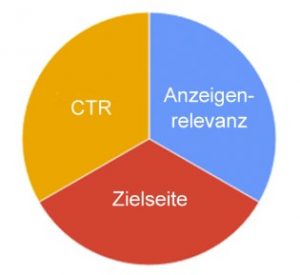
Fig. 3: The three criteria used to calculate Quality Score
Alongside quality and relevance, your advertising budget plays a major role. Since search campaigns in AdWords are billed per click (rather than per impression), advertisers submit a maximum Cost-Per-Click bid (max. CPC). This defines the maximum amount you're willing to pay for a single click.
As mentioned earlier, Google doesn't just look at this bid when auctioning off ad space; it also evaluates the Quality Score for each keyword.
This means that if you optimize your SEA campaigns in AdWords and improve your Quality Scores, you'll gain an edge over other bidders in the auction. An ad's rank in an auction is calculated using the following formula:
Ad Rank = Max. CPC x Quality Score
An example helps illustrate this relationship (see Figure 4: Calculating Ad Rank). If three competitors all bid on the same keyword (in reality, there are usually many more) with the respective CPC bids and Quality Scores shown in Figure 4, Competitor C would win the top position—even though they submitted the lowest Cost-Per-Click bid.
Competitor A even drops to 3rd place due to a poor Quality Score. It definitely pays off to put some work into SEA optimization.
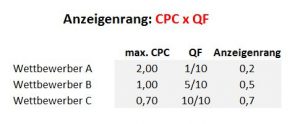
Figure 4: Calculating Ad Rank
Keyword Targeting and Additional Targeting Options: In search engine advertising, everything naturally revolves around keywords. They allow you to control which search queries trigger your text ads. It's important to distinguish between a search query and a keyword. A search query refers to the exact text users type into the search engine's search box. A keyword, on the other hand, doesn't necessarily have to match that input word-for-word. Just as crucial as your choice of keyword is its match type. With different match type options, you can control how closely user search queries must align with your targeted SEA keywords. For instance, if you choose the keyword "online marketing agency" with the "Exact Match" type, ads will only show if a user searches for that exact phrase (or a close variant like "online marketing agencies"). With the "Broad Match" type, this scope is much wider.
Your text ad could then also appear for queries like "online marketing podcast," "search engine marketing agency," and so on. Google and Bing offer four different match types in total, allowing you to fine-tune this level of precision.
Beyond primary keyword targeting, additional settings are also available for SEA campaigns. Ads can be targeted very precisely by geography. For example, you can set up different campaigns for specific major cities and address users there with tailored ad copy. You can also restrict ad delivery to specific days of the week or times of day. This is particularly useful in the B2B sector, where running ads on weekends is well known to be less effective. Search campaigns can even be optimized by age group and gender. To do this, Google or Bing analyzes user behavior to determine demographic alignment based on statistical probability. Last but not least, retargeting (known as remarketing in Google AdWords) plays a key role in SEA campaigns.
AdWords remarketing lists can be easily paired with search campaigns. For instance, ads can be shown exclusively to users who have already visited the advertiser's website. The very same principle can also be used in Bing.
Ad Copy
In spring 2017, Google and Bing updated their guidelines for text ad design. With the new Expanded Text Ads (ETA) format, you can finally run more comprehensive ad copy. A text ad is made up of several text blocks (Headline 1, Headline 2, Description, etc.) that can be configured in AdWords or Bing Ads. Each block comes with a maximum character limit.
Headlines are limited to 30 characters each, while descriptions can run up to 80 characters. Combined with the final URL (the landing page users reach after clicking) and the display URL, you get the complete text ad (see Figure 5).

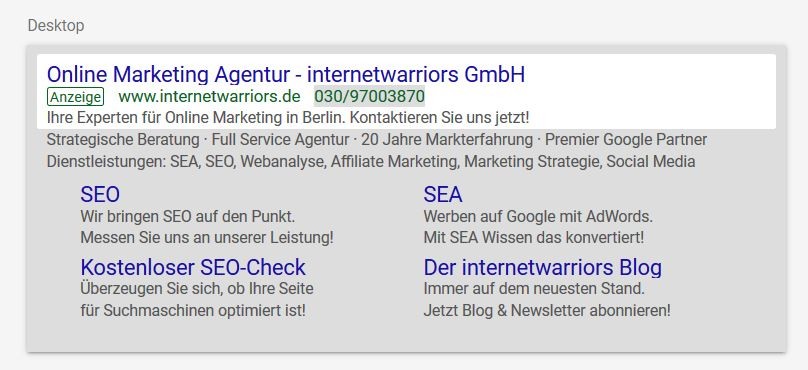
Figure 5: The AdWords text ad including corresponding ad extensions
Text ads can be enriched with extra details by using various ad extensions. "Callout extensions" are great for highlighting your website's key USPs.
"Sitelink extensions" are ideal for linking to subpages, allowing users to navigate directly to what they need. Google AdWords continually rolls out new extension types to make ads even more relevant and engaging.
Other ad extensions include: structured snippet extensions, call extensions, message extensions, location extensions, price extensions, app extensions, review extensions, and promotion extensions.
Google automatically decides whether extensions are displayed alongside the basic text ad, which depends on factors like the specific search term. As a rule, ads ranking lower than position four are not eligible for extensions. However, ads with high click-through rates have a strong chance of displaying multiple extensions at once.
With extensions included, an ad can take up significantly more visual space than a standard ad could on its own. This, in turn, delivers a noticeable boost to the ad's click-through rate.
Conclusion
Grasping the fundamentals of SEA marketing is straightforward. Beyond your marketing budget, success comes down to achieving optimal relevance between your keyword, ad copy, and landing page. Of course, even with perfectly configured SEA campaigns, clicks still cost money.
However, you can significantly reduce your cost per click this way. Many advertisers have also found that traffic from Google and other search engines is absolutely vital for digital business success.
Relying solely on organic search results (SEO optimization) for your online marketing is usually not enough to drive sufficient traffic. Paid ads are displayed much more prominently (positions 1–4).
Thanks to versatile ad formatting options and precise targeting capabilities, search campaigns are both essential and powerful performance drivers. Because ads are triggered directly by what users search for, you can reach potential customers at the exact moment they're actively looking for a product or service.
In that moment, the likelihood of a purchase or conversion is at its absolute highest.
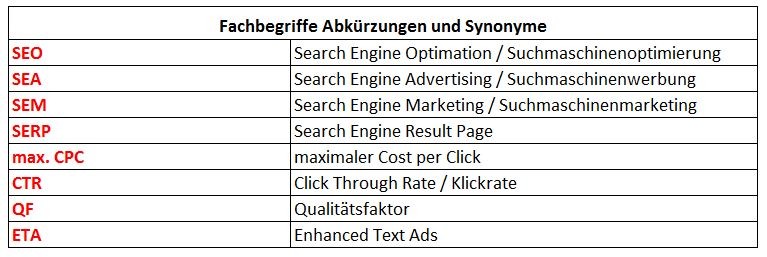
Fig. 6: Glossary of SEA Terms
Looking for an SEA Agency in Berlin?
We'd love to help you build an SEA campaign tailored to your needs. Feel free to get in touch. We look forward to hearing from you!
