

Blog Post
Growth Marketing

Nadine
Wolff
published on:

What is Inbound Marketing
Table of Contents
Inbound marketing is an acquisition strategy where your "dream customers" come to you voluntarily—via social media, search engines, or blogs. The core idea is to inspire and engage the customer. You can achieve this by reaching potential customers at just the right moment with truly valuable information. To do so, you have various marketing channels and methods at your disposal that, when smartly connected, can be extremely successful.
In this article, you will learn how inbound marketing helps you build sustainable customer relationships, win returning customers, and turn clients into active promoters of your brand.
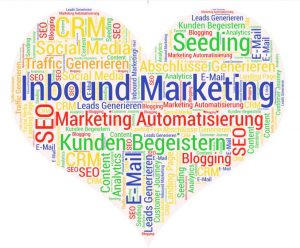
Fig. 1: Inbound Marketing Wordle
The Advantages of Inbound Marketing over Outbound Marketing
In inbound marketing, customers are provided with useful information about a product or service they already need or are interested in. The goal is to build a brand that users love to interact with. By contrast, outbound marketing often takes a direct advertising approach to raise awareness for a brand or product the user hasn't previously shown interest in. Both inbound and outbound marketing are used in online and offline marketing for acquisition and customer retention. CRM tools help bridge the gap and effectively connect inbound and outbound campaigns.
Outbound marketing uses tactics aimed at directly reaching large audiences (push marketing). Messages are widely scattered via radio and TV ads, flyers, direct mailings, mass emails, and telemarketing to connect with as many potential customers as possible.
Television advertising, for example, tries to direct the viewer's attention to a specific product. In theory, a small percentage reacts to these interruptions and converts into customers. Continuous data analysis, smart ad placement, and A/B testing help boost the likelihood of a response. However, purely promotional messages and one-sided corporate communication are increasingly rejected and tuned out by consumers.
On the one hand, this is due to the disruptive nature and sheer volume of ads everyone is exposed to daily. Many everyday examples show that people tend to react negatively to traditional direct marketing:
People switch channels during commercial breaks
Promotional mail ends up straight in the recycling bin unopened
Websites are abandoned due to intrusive ads
Promotional emails land directly in the spam folder
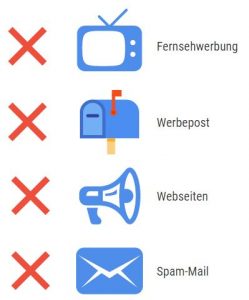
Fig. 2: Direct Marketing
Additionally, purchasing decisions today are made quite differently than they were just a few years ago. Customers are far better informed about the products they are interested in. Thanks to the internet, gathering information has never been easier. Even in B2B, a pre-selection is made through online research long before asking for a price quote. Whoever manages to provide the exact information the customer is searching for will naturally be found more easily. This significantly increases the chances of the customer reaching out to the company on their own.
High-quality content such as white papers, e-books, podcasts, case studies, or infographics can elevate the perception of products and services. To address users' individual search behaviors, content is distributed across various touchpoints. You can share your content on social media platforms, through blog posts, and via many other methods. The goal is to attract potential customers through relevant content and meet them in the right place, at the right time, with the right products. Choose topics that convince customers by genuinely solving a problem. This allows your expertise to shine while creating real added value for your audience. In doing so, you lay the foundation for ongoing dialogue, win potential customers over as new clients, and build lasting relationships.
Through inbound marketing strategies, you generate long-term value for your prospective clients. Once created, the content belongs to you—whereas in outbound marketing campaigns, potential customers are only reached as long as your ad budget keeps flowing.
Distinction: Inbound Marketing vs. Content Marketing
When comparing their substantive aspects, inbound and content marketing are quite similar. However, inbound marketing places a stronger focus on conversion in the form of leads, contacts, and closed deals. Inbound marketing also describes a multi-phase process that is planned and implemented in structured campaigns. Content marketing, on the other hand, tends to pursue longer-term goals such as brand building and search engine visibility. High-quality content creation is simply an integral component of any well-rounded inbound marketing campaign.
The Inbound Marketing Strategy in Four Phases
The inbound marketing process can be mapped along the customer journey in four stages: generate traffic, generate leads, close deals, and delight customers. In each of these phases, the user interacts differently with your business as they gradually build trust in your product or service. From phase one to four, you continuously gather insights about your customers. This allows you to tailor your marketing tools to their specific needs and reach out to them at the ideal moment. Depending on your target audience, the best channels to use are those where your customers already enjoy communicating.
Phase 1: Generate Traffic
First, grab the attention of potential customers with high-quality content. Focusing on a clearly defined target audience is crucial here. This ensures that your content is tailored perfectly to their specific needs and pain points. Next, it's all about distributing the content so prospective clients find it naturally during their research process. For instance, you could write an insightful expert article and publish it in a renowned online magazine or on your company blog. When a user searches for this topic in the magazine's database or on Google and finds your article, they become aware of you. Search engine optimization helps your article achieve strong rankings. You can place your content wherever your potential customers are looking for answers—both online and offline.
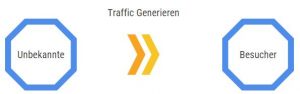
Fig. 3: Generate Traffic
Defining the Target Audience
The term "target audience" includes all the people you want to reach with your marketing campaign. In your target audience analysis, you can select a specific segment of the overall market. Three main models are particularly useful for this:
Socio-demographic
B2C: Occupation, age, gender, family size, income, location, education level
B2B: Company size, location, industry, revenue
Purchasing behavior:
B2C: Brand preferences and choice of shopping venues
B2B: Order volume, first-time buyer, returning buyer
Psychographic:
e.g., lifestyle, social class, and product perception
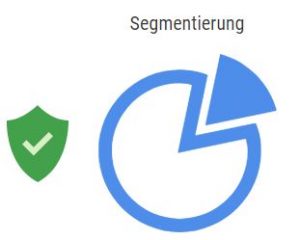
Fig. 4: Target Audience Segmentation
Another effective way to segment your audience is by creating buyer personas that represent an ideal customer. These personas are assigned distinct personality traits. Looking at things from their perspective allows you to develop rules of thumb reflecting the behavior of the entire segment. For example, you can discover whether a specific customer group prioritizes premium quality or rapid availability.
As a result, your marketing activities can be finely tuned to customer needs. Existing landing pages can be optimized using these insights, and fitting content can be crafted accordingly.
Fig. 5: Defining Buyer Personas
Content Creation
Once your target audience is defined, the next step is content planning. This involves developing topic clusters specifically tailored to your audience. Potential topics for your articles can be uncovered through keyword research. Customer questions and common inquiries also serve as fantastic inspiration for content creation. Additionally, providing customized problem-solving offers tremendous value for your target groups. Gather your ideas, organize them, and prioritize them by relevance. Finally, produce the content in formats such as white papers, videos, landing pages, blog posts, case studies, or podcasts.

Fig. 6: Content Creation
Content Distribution
Once the topics are selected and the content is written, it needs to get out into the world. In marketing terminology, distributing content is often referred to as seeding. Influencer marketing and guest posts are particularly effective here, as they help spread your content organically through word-of-mouth. It can also be published as blog posts, specialist articles, or in books and magazines. Genuine enthusiasm is the key to inspiring users to share your content on social media platforms or link to it on their own blogs.
It's equally important to optimize your content for search engines so it can be discovered more easily. Use your top keywords in headings, structure your text clearly, and ensure seamless internal linking. You should also make sure your source code is implemented correctly and give each page an engaging title and meta description.
Phase 2: Generate Leads
The goal of the second phase is to obtain user contact details. To achieve this, you introduce touchpoints that encourage visitor interaction. Storytelling plays a vital role here. By connecting complementary pieces of content, you can tell an engaging story that draws the customer in. Step by step, they are guided toward conversion with the right marketing messages. In exchange for their contact details, you can offer valuable content like e-books or white papers. If they opt in, you can be confident they have a genuine interest in what you offer—after all, only prospective clients who find real value in your proposal will share their contact information voluntarily.
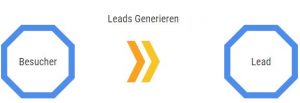
Fig. 7: Generate Leads
To encourage visitors to exchange their information for your offer, you have a range of effective tools available:
Calls to Action (CTAs) are buttons or links that prompt users to take a specific action (e.g., Buy, Read, Download). A great call to action uses the imperative mood, catches the eye, stands out clearly from the background, and is placed prominently.
A landing page is a dedicated web page a user is directed to after clicking a CTA button, an advertisement, or a search engine result. It can be tailored dynamically to specific buying interests and guides the user along the shortest possible path to the goal—such as signing up for a newsletter.
Through newsletters, you can keep users engaged with targeted, relevant information. Showcase the specific products and services they have already expressed an interest in.
Call buttons enable direct communication with your customers. You can address their unique needs personally and present perfectly matched offers.
Forms make it much easier to tailor an offer directly to the customer. This is especially advantageous for complex, consultative services.
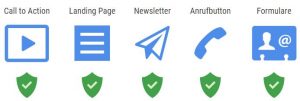
Fig. 8: Lead Generation Tactics
Phase 3: Close Deals
In the third phase, the focus shifts to qualifying the generated leads and turning them into paying customers. A concrete inquiry signals genuine interest and, ideally, a solid foundation of trust. The closing phase is the only stage in inbound marketing where you should actively reach out to your prospective client directly. Closing a deal can take place across multiple touchpoints, and various marketing tools can help nurture those leads step by step toward a successful sale.
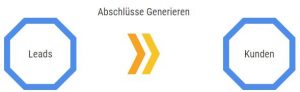
Fig. 9: Close Deals
Tactics for Driving Sales
Email Marketing: With a series of genuinely helpful emails, you can continue building trust with potential customers and encourage them to make a purchase. Writing these emails requires the same strategic mindset as your overall content planning.
Display Advertising: Through banner ads, you can retarget the exact users who subscribed to your newsletter or submitted a contact form (provided they aren't using an ad blocker). The key prerequisite here is having proper conversion tracking in place.
Phone: If a customer submitted an inquiry along with their phone number, give them a friendly call. This gives you the opportunity to address their specific questions and advise them on your solutions. The big advantage: these are "warm leads" who are already familiar with your brand.
Print: If you have your potential customers' postal addresses, you can send them targeted print materials. This allows you to provide them with further valuable insights and present attractive offers directly.
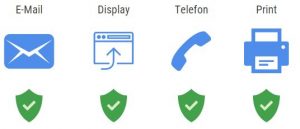
Fig. 10: Sales Generation Tactics
Marketing Automation
Automated workflows can streamline and optimize both customer acquisition and retention. For example, you can set up autoresponders that automatically send helpful, tailored emails after a purchase or based on user activity after a set number of days.
Data from all your marketing campaigns and your CRM tool can be brought together in a marketing automation platform. The software shows you exactly where a customer stands in their buying journey and what interests them most. You get precisely the information you need to qualify your leads further—shortening the sales cycle, boosting conversion rates, and improving your marketing ROI.
Phase 4: Delight Customers
Once a prospect becomes a customer, the final phase of an inbound marketing strategy is all about delighting them. You can achieve this by continuing to provide engaging content and relevant offers on a regular basis. This fosters long-term loyalty to your product or service, encouraging repeat business. Loyal customers are often open to premium offerings because they trust your quality, while occasional special discounts can serve as an extra incentive to buy. Up-selling and cross-selling naturally increase revenue per customer. When you consistently delight clients with your products and services, they are far more likely to recommend you to others. A loyal customer can easily become an enthusiastic brand advocate who attracts new prospects—who will then move through phases 2 to 4, starting the virtuous cycle all over again.
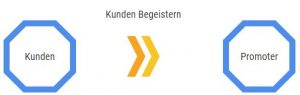
Fig. 11: Delight Customers
The following tools will help you foster strong, ongoing engagement with your customers:
Calls to action that present products tailored specifically to your existing customers or point them toward high-value content.
Social media allows you to keep customers engaged with real-time updates. You can share ongoing activities or give sneak peeks into new product developments. Through shares, likes, and comments, customers can easily interact with you and share their enthusiasm. High engagement strengthens your brand image and builds valuable social proof. Social media buttons on your website are a great way to showcase your happy community, which works wonders for reassuring prospective clients.
Through email campaigns, you can provide existing customers with content that matters to them and offer personalized support. You might even help them reach their own goals along the way! Where appropriate, personalization adds a wonderful extra touch.
Integrating an RSS feed into your website is a simple way to let customers know when there's fresh news. For instance, they can be notified whenever you publish a new blog post, release a podcast episode, or upload a video.
Surveys are fantastic for collecting qualitative feedback, which you can use to optimize your active campaigns. At the same time, asking for input sends a clear signal that you genuinely care about your customers. You will also pick up valuable feedback during phone calls and social media interactions, all of which is well worth considering.
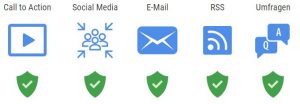
Fig. 12: Tactics to Delight Customers
Milestones for the Four Phases of Inbound Marketing
Before you begin driving traffic to your website, you should define clear, measurable milestones. For new visitors, indicators such as a long session duration, high page views per session, a low bounce rate, backlinks, leads, or social shares all signal genuine interest. Next, decide how many inquiries via forms or newsletters you aim to collect and how many sales you want to close from them. Comparing your goals against real-world data will make it much easier to evaluate campaign performance. This empowers you to react quickly to incoming metrics and make smart decisions aligned with your targets.
New Challenges for Modern Marketers
To roll out an inbound marketing campaign successfully, marketers need a well-rounded skill set. A fundamental component of any winning inbound strategy is thoroughly understanding the customer's buying and decision-making journey. It also involves crafting a smart content strategy as well as producing and distributing high-caliber material. Alongside core digital channels—email, social media, SEA, SEO, and content marketing—successful campaigns also rely heavily on web analytics, lead management, and customer relationship management. All channels should be viewed holistically, with projects built upon this integrated perspective.
Another major challenge is the growing technological complexity in marketing. Marketing automation is a massive advantage for any sophisticated inbound strategy. It allows you to pick up user signals in real time and send out tailored offers based on behavior. For example, if a user lands on a product detail page via a search engine, you could automatically send them an invitation for a free consultation. You can also gather helpful behavioral data, such as which PDFs were downloaded and which categories were browsed. Testing and ongoing data analysis will quickly reveal which marketing messages resonate best at what time.
Ultimately, a great overall strategy always harmonizes the unique strengths of both inbound and outbound marketing.
Conclusion
Marketing continues to evolve right alongside the internet. Changing user habits directly impact research, purchasing behavior, and how people interact with your brand. At the same time, technological advancements open up fantastic opportunities. You can personalize your marketing campaigns and dynamically adapt your web pages and emails to meet each customer's unique needs.
Inbound marketing earns customer attention by delivering genuine value. Over the long run, it is remarkably profitable because it transforms everyday buyers into loyal brand ambassadors. Delighted customers have a significantly higher lifetime value and continually attract new prospects by recommending your products to friends. Creating and maintaining this content does require a dedicated budget and plenty of creativity, of course. Making sure your content is well-optimized for search engines is just as critical. The bottom line is simple: your marketing strategy will truly thrive on top-tier content—that's how you genuinely earn the attention of your target audience.
Looking for an Online Marketing Agency in Berlin?
We'd love to help you design an online marketing campaign tailored perfectly to your goals. Feel free to get in touch with us. We look forward to hearing from you!
Nadine
Wolff
As a long-time expert in SEO (and web analytics), Nadine Wolff has been working with internetwarriors since 2015. She leads the SEO & Web Analytics team and is passionate about all the (sometimes quirky) innovations from Google and the other major search engines. In the SEO field, Nadine has published articles in Website Boosting and looks forward to professional workshops and sustainable organic exchanges.
