

Blog Post
Search Engine Optimization

Julien
Moritz
published on:
Online Store - SEO Tips for High Visibility
Table of Contents
Your products are top-notch, but what about the visibility of your online store? Technical and content optimization for search engines also plays a crucial role. How can your visitors' shopping experience be enhanced through targeted online store SEO measures? From efficiently fixing 404 errors and leveraging seasonal events to designing category and product pages—we share key SEO tips covering various aspects that influence your online store ranking.
404 Errors: A Better Shopping Experience Through Online Store SEO
Are there internal links in your store that might lead potential visitors to an empty or non-existent page? Then you should take action as soon as possible. Fixing 404 errors is one of the most important steps in successful search engine optimization for online stores. Nothing is more frustrating for visitors than clicking on an advertised product in search results and landing on an error page. This inevitably leads to frustration, and these visitors will likely leave your site early and head back to the search results. This increases your bounce rate, which can be seen as a negative signal. Dwell time on a page is considered one of many indicators of satisfaction with a search result. To prevent this from happening and to offer your visitors the best shopping experience, you should keep the number of broken pages as low as possible.
Identifying Broken Links
Manually check whether your most important products are still accessible. Using Google Search Console, you can go to Settings -> Crawl stats -> By response -> Not found (404) to list all broken pages that currently exist or have existed in the past. When evaluating the data, pay close attention to the date. You'll also find information on where these pages are linked from. External links pointing to an incorrect or non-existent URL are also displayed. Especially with active online campaigns, it's frustrating when visitors are directed to a landing URL that no longer exists.
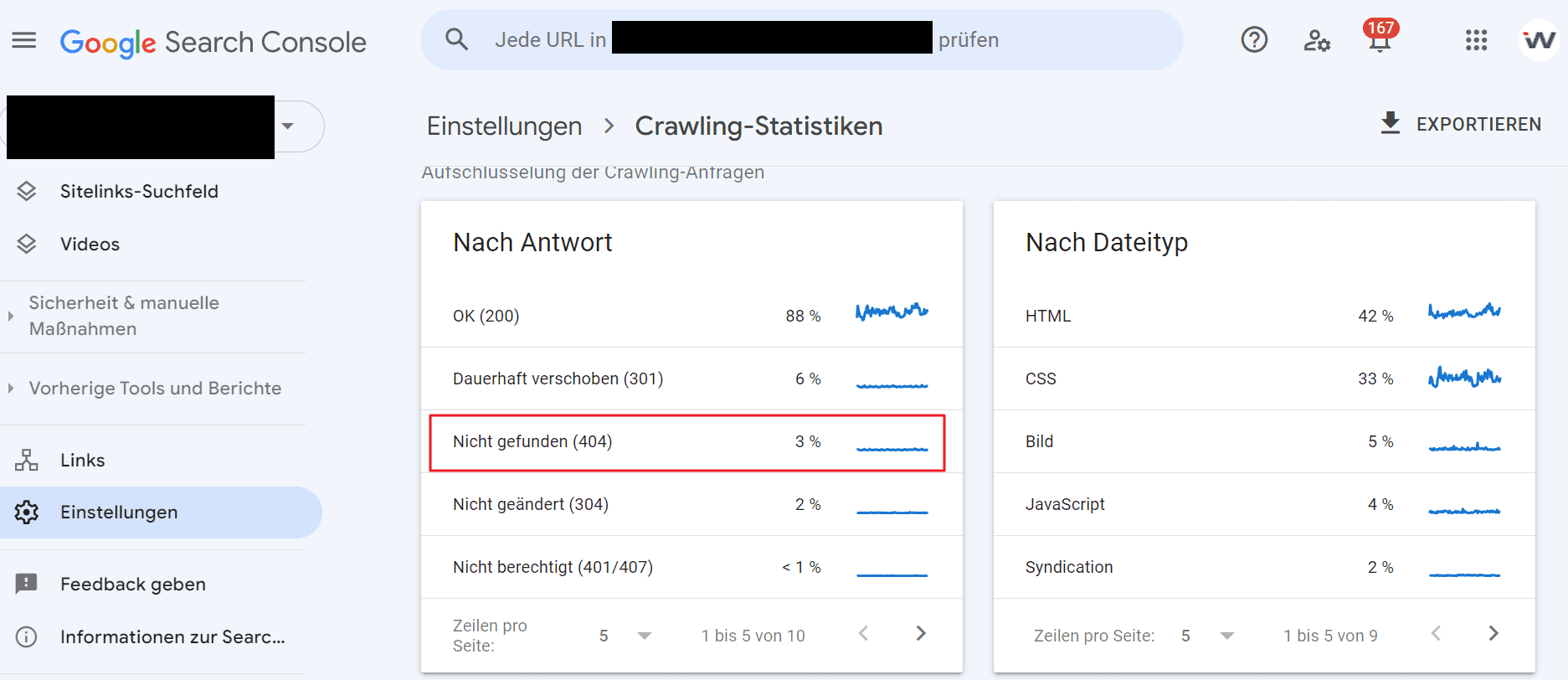
Figure 1: Excerpt from Google Search Console - Pages not found
Creating a 404 Error Page
If users do happen to land on a 404 page, there's still a chance to keep them on your website. To do this, you should create an optimized 404 error page. This page is displayed when the requested content is unavailable and is essential for any store aiming for top-tier on-page SEO. Users should enjoy a clear, user-friendly experience here. They should be informed that the requested page cannot be found to avoid confusion. A well-designed 404 error page gives you the opportunity to redirect visitors to other relevant content in your store or offer alternatives, such as popular products. A user-friendly 404 page helps boost user satisfaction and lowers your bounce rate, ultimately leading to better online store SEO rankings. You can see a best-practice example in the following image:
Online Store Events – Relevance for SEO
Seasonal events and holidays are especially important for online stores. They hold tremendous sales potential that shouldn't be overlooked. Start planning and preparing early to achieve the best results. Essential events throughout the year include Christmas, Black Friday, Easter, and back-to-school season. Depending on your industry, shopper behavior varies. That's why you should analyze your target audience and focus on the key events that offer the greatest potential for your online store. To make the most of them, your SEO efforts should begin at least three months in advance. Optimize your content for matching products so you're ranking for important keywords in search results right on time.
Seasonal Landing Pages
Creating seasonal landing pages can significantly boost traffic to your website. We recommend the following approach:
First, thorough keyword research is essential to rank for relevant search queries. Your page content should then be optimized based on these keywords. A clear goal and a strong call-to-action element are also vital. Once created, the landing page is best linked prominently on your homepage. After the event wraps up, keep your seasonal landing pages live and indexed, as they may still hold strong rankings for high-traffic search terms. This way, you can benefit from them again the following year—provided the pages remain accessible to search engine crawlers. External links like shares, likes, and mentions can also point to the page, providing a positive boost to your ranking.
You can even set yourself up for a future ranking advantage right when creating seasonal URLs: avoid including the year in the URL. That way, you only need to build the landing pages once and can reuse them year after year. Once the holiday rush is over, for example, you no longer need to link the landing page as prominently. Instead, link to it from a relevant category or topic page so search engine crawlers can still find it and your hard-earned rankings won't be lost.
Mobile Online Stores: Key SEO Adjustments
For many shoppers, smartphones have become the go-to device for online shopping. Google, as the leading search engine, has also adapted its indexing method accordingly. The transition to Mobile-First indexing was completed in October 2023. Since then, websites have been crawled exclusively with the mobile Googlebot. To stay competitive, having an online store with an optimized mobile view is simply essential. It also helps you keep bounce rates and cart abandonment low. To significantly improve user-friendliness, keep these three SEO tips in mind:
We recommend a responsive web design. This ensures content automatically adapts to the screen size, scaling and arranging elements appropriately to guarantee great readability and usability. Beyond design, we consider two technical criteria especially crucial for successful online store SEO. To minimize cart abandonment, make sure to offer popular mobile payment options, such as PayPal, Apple Pay, and Google Pay. Nothing is more frustrating than interested shoppers dropping out of the checkout process because their preferred payment method is missing. Additionally, you should definitely avoid pop-up windows. Especially on mobile versions of online stores, pop-ups lead to slower loading times, failed Core Web Vitals, and ultimately lower rankings in search engine results.
Successful SEO for Online Stores: Balancing Crawlability and Usability
The most important prerequisite for solid on-page SEO is ensuring that all relevant content on your domain can be fully crawled and indexed by Googlebot—for both desktop and mobile versions. Take another look at your robots.txt file for any directives that might accidentally block certain directories or product pages from search engine crawlers. Furthermore, both search engine bots and your site visitors should be able to navigate your website smoothly and intuitively. Sitemaps are a great help for crawlers and should be optimized for efficient crawling as well. You can learn what a perfect sitemap looks like in our blog post, for example. For users, the link structure should be designed to be as natural and user-friendly as possible.
A particularly important aspect is contextually relevant linking, often referred to as siloing (see Figure 3). According to this principle, visitors on a product detail page for soccer cleats shouldn't be shown links to products in categories like "T-shirts" or "Pants." These are most likely not relevant to them at that moment. Instead, it makes sense to provide a link to soccer cleats from another brand, since the user is clearly interested in that specific type of product. Internal linking should therefore be focused within the category the user is currently browsing, linking out only to the top-level pages of other categories.
Figure 3: Overview of optimal internal linking between URL subfolders
On-Page SEO for Your Store: Category and Product Pages
When it comes to content optimization across your pages, there are several key SEO tips to keep in mind. For an online store, the goal is to get your category and product pages ranking as high as possible in search results for your main keywords.
A common mistake is treating category pages as simple product listings. To ensure successful SEO for your store, you need unique, engaging content on these pages as well. We recommend around 400–500 words, with a brief introductory section (about 50 words) placed above the products and the longer text positioned below. Content quality plays a major role here. Google evaluates content based on its E-E-A-T guidelines, which stand for Experience, Expertise, Authoritativeness, and Trustworthiness. Make sure your category page copy delivers real value to your visitors.
You can also optimize individual product pages. On one hand, this increases the likelihood of ranking directly for the specific product name; on the other, it helps you avoid the pitfall of thin content. Google defines thin content as low-quality URLs, which can lead to demotions and poorer rankings in search results. The same applies to duplicate content. For similar products, it's especially critical that the copy remains unique. That's also why you should never simply copy the manufacturer's descriptions. If other online stores take the same shortcut, duplicate content is created fast. A much better alternative is crafting your product descriptions with a focus on specific keywords you want to rank for—without compromising readability or usability. To keep product pages clear and easy to scan, use bullet points and headings to create a solid structure. A well-structured page is vital for on-page SEO, and your primary keyword should always be included in the H1 tag.
Conclusion: SEO Tips for Your Online Store
SEO is essential for online stores looking to attract a steady, long-term flow of organic visitors. In the world of e-commerce, your store's visibility is just as important as the quality of your products.
Our SEO tips cover everything from efficiently resolving 404 errors to designing seasonal landing pages. To ensure your store enjoys high traffic over the long haul, we also recommend mobile optimization along with top-tier crawlability and user-friendliness. Put these SEO tips into practice to set yourself up for lasting e-commerce success.
We'd love to help you with your optimization journey! As part of an SEO analysis, our experts will uncover the untapped potential in your online store. We can then work together to implement tailored strategies for maximum impact.
Contact us today for a free, no-obligation quote or if you have any questions—we're here to help!
Julien
Moritz
Since October 2023, Julien Moritz has been bringing fresh energy to the internetwarriors' SEO team. With his strong interest in online marketing and passion for SEO strategies, he helps businesses enhance their digital presence. His determined and solution-oriented approach enables internetwarriors' clients to achieve their goals.
Comments on the post
no comments yet
Write a comment
Your email address will not be published. Required fields are marked with *
