

Blog Post
Web analytics

Nadine
Wolff
published on:

How to Exclude PayPal & Co. in Google Analytics
Table of Contents
Online store owners using Google Analytics have recently been facing a common issue: conversions are being credited to payment providers like PayPal instead of the actual marketing channel, such as Google AdWords. Since it is quite unlikely that a customer first learned about your online store on a third-party payment provider's website, these referrals distort your data. Naturally, this can be frustrating.
Studies show that offering a wide variety of payment options is essential for online retailers. For every second online shopper, the available payment methods play a decisive role when choosing a store. Doing without e-payment providers is therefore not a realistic option for store owners.
How attribution works in Google Analytics
Attribution in Google Analytics is based on the "last-cookie" model. This means that conversion credit is given solely to the most recent touchpoint. The issue here is that this model fails to properly reflect the customer journey, as most transactions involve multiple interactions beforehand. Depending on the type of product, a purchase decision can take several days or even weeks and span multiple channels (organic search, AdWords, social media).
Most store operators offer their customers several payment options, including direct debit, credit card payments, online banking, and payment systems like PayPal.
When customers pay via PayPal or another payment service, they leave the retailer's website. Once the payment is complete, they are redirected back to the online store and land on the order confirmation page, where the e-commerce tracking code is typically installed. From the perspective of Google Analytics, it was PayPal that ultimately convinced the customer to buy by referring them back to the destination page. As a result, the payment provider is reported as the conversion source.
How to permanently exclude external payment providers in Google Analytics
Here's the good news: you can easily and permanently exclude payment providers as referral sources at the account level in Google Analytics, ensuring that conversions are attributed to the correct source. However, you will need administrator privileges to do this. First, make sure you have the necessary permissions for the relevant account. Next, click on the "Admin" menu item. In the middle column, you will find the "Tracking Info" link with the sub-item "Referral Exclusion List." Click on it.
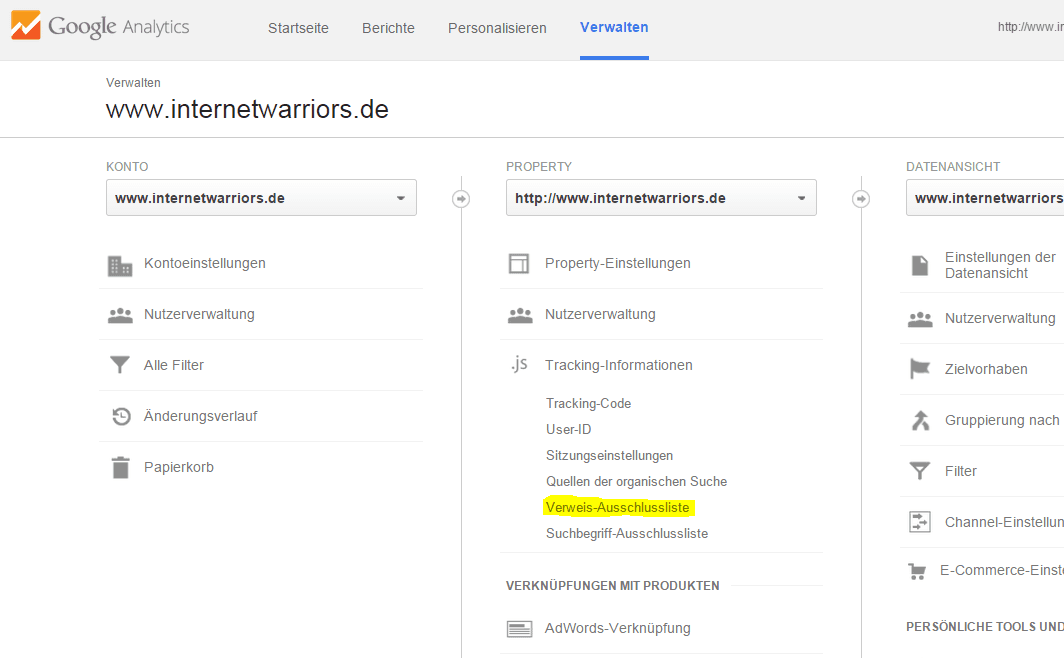
Using the red "+Add Referral Exclusion" button, you can now exclude the relevant payment providers by entering their domain (paypal.com, paymill.com, sofort.com, etc.) into the field. Click on "Create," and you're all set.
Once excluded, conversions will no longer be attributed to the payment provider, but rather to the last actual marketing channel. Please note, however, that retroactive exclusions are not possible. Exclusions only apply moving forward from the moment they are created. This is because Google Analytics generally does not modify historical data. It also means you cannot restore referral data for the exclusion period later on. For this reason, always use the referral exclusion list with care.
Don't be surprised if you still spot payment providers here and there after setting up the exclusion. This happens due to varying cookie expiration times, which can range from a few hours to several months depending on the cookie. PayPal, for instance, states that it uses both session cookies and persistent cookies, though it doesn't specify their maximum lifespan. The payment service sofort.com uses a cookie that stays active for 30 days for conversion tracking, while partner cookies can remain active for up to 90 days. While users can clear their cookies and cache at any time, experience shows that only a small fraction actually does so. Store owners just need to be a little patient until all external payment providers are fully phased out of Google Analytics.
If you have any further questions or comments, feel free to leave us a message in the comments below! Or contact us for free!
Nadine
Wolff
As a long-time expert in SEO (and web analytics), Nadine Wolff has been working with internetwarriors since 2015. She leads the SEO & Web Analytics team and is passionate about all the (sometimes quirky) innovations from Google and the other major search engines. In the SEO field, Nadine has published articles in Website Boosting and looks forward to professional workshops and sustainable organic exchanges.
