

Blog Post
Search Engine Advertising (SEA)

Josephine
Treuter
published on:

ChatGPT Ads in Germany: How this new advertising channel works
Table of Contents
The most important things in a nutshell
Since August 24, 2026, ChatGPT Ads have been served in Germany, as part of an expansion into 31 European markets.
Since the end of August 2026, self-service access in the Ads Manager has also been open to European advertisers.
Ads are only seen by users of the Free and Go plans. Plus, Pro, Business, Enterprise, and Edu remain ad-free, and accounts belonging to users under 18 do not receive ads.
Instead of keywords, advertisers provide context clues. Delivery is based on the context and intent of the ongoing conversation.
Advertising in a chat window was a thought experiment for a long time. Since the end of August 2026, it has become a reality in Germany: OpenAI is serving ads in ChatGPT, and companies can set up campaigns themselves in the Ads Manager. For performance teams, this is the first genuinely new advertising channel in years. The question is therefore less about whether to test it, and more about how to test it without burning budget in a still-developing system.
What ChatGPT Ads are and where they appear
ChatGPT Ads are paid placements within ChatGPT. They appear below a response, are marked as an ad, and are visually separated from the answer. According to OpenAI, advertising does not influence the response ChatGPT provides. An ad consists of a company name, logo or favicon, headline, ad copy, image, and landing page. We recommend 16 to 24 characters for the headline and 32 to 48 characters for the text; the headline and text should offer different benefit arguments.
The decisive difference from Google Ads is not the format, but the situation. In classic search, people type two to four words. In ChatGPT, they describe their starting point, their requirements, and their concerns. The ad therefore lands right in the middle of an ongoing decision-making process.
Who you reach with it—and who you don't
The reach figures for ChatGPT are impressive, but they do not represent the advertising-reachable target audience. Ads are exclusively served to users of the free version and the Go plan. Anyone using Plus, Pro, Business, Enterprise, or Edu will not see any ads.
This is particularly relevant for B2B: anyone using ChatGPT via a company account is excluded from the target group. In B2B, the channel is therefore more of an additional touchpoint for decision-makers doing research privately or with a free account, rather than a channel to fully cover a target audience. For B2C offers, the reachable base is significantly broader at launch.
Context clues instead of keywords
Exact-match keywords do not exist in ChatGPT Ads. At the ad group level, advertisers define so-called context clues, which describe what an offer does, who it helps, and in which situation it is useful. OpenAI explicitly clarifies that these clues are not rigid targeting rules. Delivery is based on conversation context and intent, ad content, and landing page.
In practice, this means: a term like "running shoes" does little, while a clue that connects need and usage situation does a lot. Ad groups are therefore structured around needs, themes, or product categories, not keyword lists. Offers with different messages or landing pages should be kept separate. Additionally, campaigns can be targeted to the iOS app, the Android app, or the web version, and there is geographic targeting with granularity that varies by market. For local campaigns, it's worth checking the location options before launching.
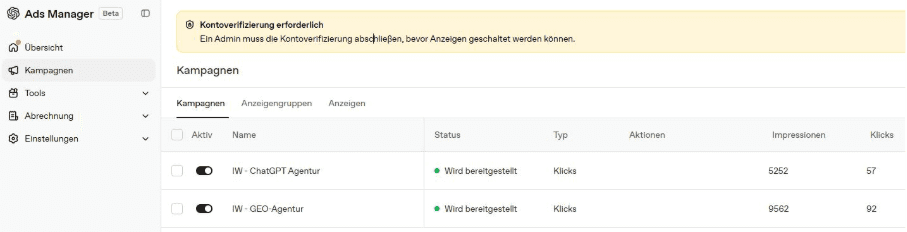
1. Campaign Manager Overview
Budget, bidding, and billing
OpenAI supports three billing models: CPM for reach, CPC for traffic, and oCPC, where billing is per click but delivery is optimized for a conversion event. For CPC campaigns, OpenAI currently recommends a starting maximum bid of $3 to $5, while the minimum daily budget for Euro accounts is €15 per campaign. In addition to manual maximum bids, there is the automatic strategy "Maximize Results", which, however, does not guarantee fixed efficiency targets such as target CPA or target ROAS.
Two points are important for budget planning. First, the daily budget is treated as an average over seven days: on individual days, up to twice the amount can be spent, up to a maximum of seven times the daily budget over the seven-day period. Second, the technical minimum budget is not a practical test budget. A reliable evaluation requires enough impressions, clicks, and ideally conversions.
Tracking and data privacy
For measurement, the OpenAI Pixel and a Conversions API are available, and both can be combined. If identical conversions are sent via both pathways, the same Event ID should be used for deduplication. OpenAI appends a click reference called "oppref" to the landing page URL on ad clicks, which the Pixel can store in a first-party cookie. Additionally, UTM parameters can be set to make the traffic visible in your web analytics tool. Reporting in the Ads Manager shows impressions, clicks, cost, CTR, average CPC and CPM, as well as conversions.
Advertisers do not get access to chats, chat histories, memories, or personal data; OpenAI only provides aggregated performance data. However, anyone using Pixel, Conversions API, or Advanced Matching and transferring first-party data in the process must verify the privacy compliance and the required consent themselves. This belongs in the setup and not on the list of things to figure out later.
Which industries are currently a good fit for this channel
In the launch phase, OpenAI is focusing on consumer goods and lifestyle, homeware, local services, travel and experiences, as well as digital products and educational offerings. The channel is particularly interesting for e-commerce, as product feed-based campaigns are already supported, including Multi-Product Carousel and reporting at the level of individual product cards.
In contrast, more is excluded than many might expect: financial and health services are currently not permitted outside the US, nor is legal advice. Individual job postings and individual real estate listings may not be advertised, though general platforms can be. Political advertising, gambling, alcohol, and tobacco are also excluded. Checking the advertising guidelines should therefore be the very first step in planning.
How to start a controlled test
1. Create an Ads Manager account and set up company details, billing, payment method, and team access.
2. Check landing pages. OAI-AdsBot and OAI-SearchBot must not be blocked, and the page should lead directly to the offer, not to the homepage.
3. Structure campaigns by needs and use cases, and write context clues in natural language.
4. Prepare several clearly distinguishable creative variations per offer.
5. Set up tracking before launching media: Pixel or Conversions API, UTM parameters, and consent check.
6. Start with a dedicated learning budget and evaluate based on leads, registrations, or purchases, not clicks.
Conclusion: its own channel with its own logic
ChatGPT Ads are not Google Search in a chat window, nor are they a replacement for existing search, social, or shopping campaigns. They are a channel of their own, where situation and need are the planning metrics. At the same time, the system is young: personalization is missing in the European Economic Area, Germany benchmarks are also lacking, and features are added almost weekly. This is exactly where the advantage lies for early testers. Those who start now with clear use cases, clean landing pages, and robust tracking will build a learning curve before the competition discovers the channel. Want to find out if ChatGPT Ads fit your business model? We at internetwarriors support the channel from strategy to conversion tracking. Feel free to contact us.
FAQ on ChatGPT Ads in Germany
Since when have ChatGPT Ads been available in Germany?
Ads have been served in Germany since August 24, 2026. OpenAI announced the European rollout on August 18, and self-service access followed at the end of August.
Can I book ChatGPT Ads myself?
Yes. The Ads Manager is available to European advertisers as a self-service tool. Campaigns can be created, managed, and analyzed there, and now even using natural language via an Ads Manager plugin in ChatGPT.
How much do ChatGPT Ads cost?
Billing is based on CPM, CPC, or oCPC. For CPC, OpenAI currently recommends a starting maximum bid of $3 to $5, while the minimum daily budget for Euro accounts is €15 per campaign. Germany-specific average values for CPC, CPM, or conversion costs are not yet available.
Are there keywords in ChatGPT Ads?
Not in the traditional sense. Advertisers provide context clues regarding topics, needs, and usage situations. These help with matching but do not guarantee delivery for specific words.
Do advertisers get access to the chats?
No. Chats, chat histories, memories, and personal details remain inaccessible. OpenAI only provides aggregated performance data, such as impressions and clicks.
Josephine
Treuter
Since May 2025, she has been part of the agency, initially starting in the Paid Ads sector, where numbers, strategies, and performance take center stage. Over time, her focus has expanded: Today, she supports the team with editorial contributions and blog articles. Here, she can fully harness her passion for language and topics that resonate with people. Writing allows her to blend analytical thinking with creativity, crafting content that not only informs but also inspires.
Comments on the post
no comments yet
Write a comment
Your email address will not be published. Required fields are marked with *
