


Blog Post
Search Engine Advertising (SEA)

Nadine
Wolff
published on:
Google AdWords – A Checklist for Your Account Review
Table of Contents
Google AdWords offers comprehensive features to promote your products or services. For SEA managers, this means there are ever more elements to consider when optimizing a campaign.
Through our experience managing a wide variety of AdWords accounts, several best practices have emerged that we'd love to share with you. To help you out, we've put together this checklist so you can quickly see whether your campaigns are set up for success.
Campaign Settings
Ad Networks: Are Search Network partners enabled?
We recommend enabling "Search partners" to expand your reach. You can analyze the performance of these sites using "Segments" and then decide whether to leave them on or disable them. Click-through rates for search partner sites are usually lower than on Google Search itself, but this doesn't impact your Quality Score. If you notice that the CTR is too low and the extra reach isn't bringing in conversions, it's generally best to disable search partners.
Best Practice:
For campaigns targeting regions outside of Germany, search partner performance is often disappointing. In these cases, we recommend keeping a particularly close eye on their results.
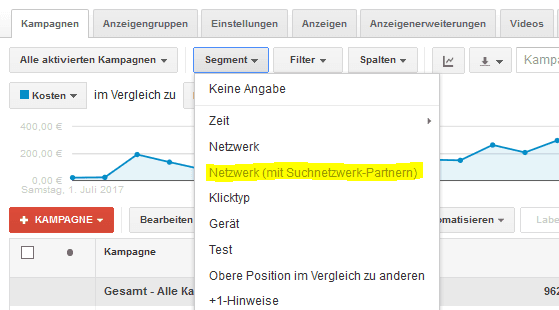
Fig. 1: Screenshot from AdWords / Search Network Partners
Locations: Are your settings correct?
Select your target region(s). You can run ads across all of Germany, for example, or focus solely on specific cities that are most relevant to your business.
Location options allow you to fine-tune your targeting even further. Do you only want to reach people who are physically in your target location, or also those who show interest in it?
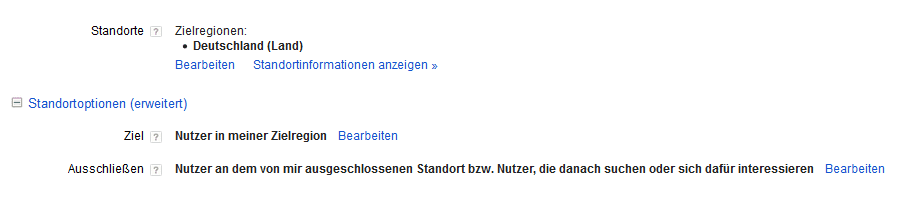
Fig. 2: Location settings in AdWords
Best Practice:
Choose the option "People in my targeted location" to help achieve a higher click-through rate.
Language: What language do your potential customers speak?
Best Practice:
Select all languages for a Search Network campaign. Your ads will only be shown to users who enter a search query matching the language of your text ads.
This ensures you don't exclude users who live and shop in Germany but have their browser set to another language.
Bid Strategy and Budget
Define the maximum amount you'd like to spend per day and decide whether you want to optimize manually or use an automated bid strategy.
The following bidding strategies are available to you:
Maximize Clicks
Target Search Page Location
Target Outranking Share
Target CPA
Enhanced CPC
Target ROAS
Maximize Conversions
These bidding strategies will help you reach your specific goals. To effectively use Target CPA, Enhanced CPC, Target ROAS, and Maximize Conversions, you'll need a certain number of conversions so the system can optimize properly. Keep in mind that the system needs to learn first before it can set your bids optimally. This learning phase can take a few days or weeks, depending on how quickly the required data accumulates in your account.
You can find more information about the different types of automated bid settings here.Best Practice:
Once you've gathered enough data and conversions, we recommend trying out an automated bid strategy—Google's algorithm can process far more factors than the human brain!
With the "Maximize Clicks" strategy, setting a bid limit is strongly recommended, as CPCs can otherwise get quite high. We suggest using this bidding strategy (especially on the Display Network) ONLY if your campaign is "limited by budget."
Other third-party tools can also be used to automatically optimize your bids, such as intelliad, Refine Ads, or DoubleClick. If you'd like more information about these tools, feel free to get in touch with us.
Ad Delivery
We recommend having multiple text ads in each ad group so you can test different messaging, USPs, and calls to action.
To determine how your ads are served, choose one of the following options:
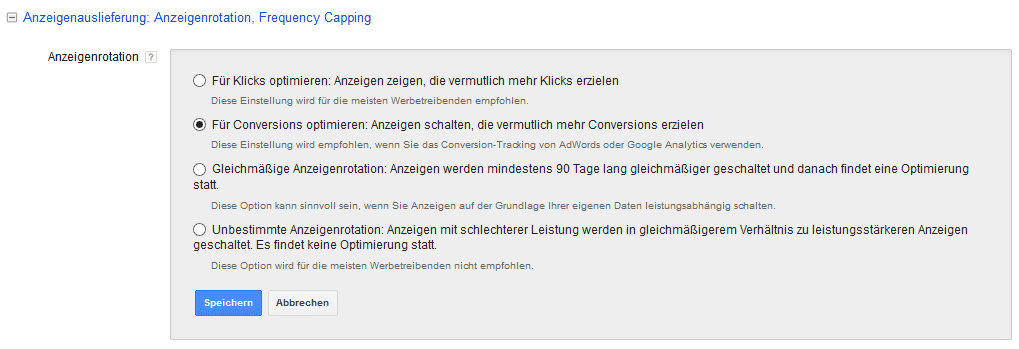
Fig. 3: Ad Rotation
Best Practice:
If you're tracking conversions, we recommend selecting "Optimize for conversions" to help boost your conversion rate. If not, go with "Optimize for clicks."
Bid Adjustments
Under "Settings," you can increase or decrease your bids for specific locations, days, times of day, or devices.
Locations - Analyze which country, state, city, or postal code generates the most sales for your products, and increase your bid accordingly.
Ad Schedule - See which days and times your products sell best, and adjust your bids upward. Conversely, lower your bids on days that don't bring in conversions.
Devices - Look at the performance (CTR, CPC, conversion rate, revenue, ROI) of your campaigns by device (computers, tablets, mobile devices) and adjust your bids to match.
Ad Extensions
Ad extensions allow you to share extra information with users directly in your text ads. They also help improve your click-through rate and Quality Score.
There are now 11 ad extensions available:
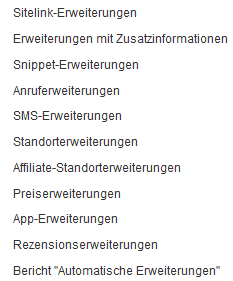
Fig. 4: Ad Extensions
Best Practice:
Try to add as many relevant extensions to your ads as possible.
Here you will find detailed information about the individual ad extensions.
More information about the different types of automated bid settings can be found
Remarketing Lists
Check whether you've added remarketing lists to all your Search and Shopping campaigns. Increase your bids for your top-performing audiences (like shopping cart abandoners).
Set up a standard or dynamic remarketing campaign to re-engage your website visitors across the Display Network.
Creative assets can be designed right in the Ad Gallery.
You can find more information about remarketing lists here.
How We Can Help
If you're looking for support with AdWords, reach out to us. Our certified AdWords specialists are always happy to help!
Nadine
Wolff
As a long-time expert in SEO (and web analytics), Nadine Wolff has been working with internetwarriors since 2015. She leads the SEO & Web Analytics team and is passionate about all the (sometimes quirky) innovations from Google and the other major search engines. In the SEO field, Nadine has published articles in Website Boosting and looks forward to professional workshops and sustainable organic exchanges.
