

Blog Post
Search Engine Advertising (SEA)

Markus
Brook
published on:

Display campaigns are being discontinued – Here's what it means for your Google Ads strategy
Table of Contents
At a glance: The key takeaways
End of an era: Google is phasing out standalone Display campaigns as a separate campaign type. The layout shift and full migration to Demand Gen will be wrapping up by 2027.
GDN is here to stay: The Google Display Network (GDN) isn't going away. Instead, it will serve purely as an inventory placement within Demand Gen, and you can still target it exclusively if you prefer.
A holistic approach: Demand Gen brings GDN, YouTube (In-Stream & Shorts), Discover, Gmail, and Google Maps together under one unified technological roof.
Performance boost: According to Google's data, advertisers using GDN through Demand Gen see an average ROI increase of 9.5%.
Action required: Google is launching an upgrade tool starting June 2026. However, advertisers should proactively manage the transition rather than waiting for the automatic migration.
If you've been relying on classic Display campaigns in Google Ads for years, it's time to shift gears: Google has officially announced the end of standalone Display campaigns. The migration will be fully completed by 2027. All Display activities are moving permanently into the Demand Gen campaign type, which was introduced in 2023.
There is much more to this than just cosmetic renaming. It marks the final step in a strategic realignment: moving away from the rigid, silo-based management of individual channels and heading toward AI-powered, cross-platform steering of visual assets.
The Timeline: What happens when?
The transition is happening in phases to give advertisers plenty of time to test and adapt:
Starting June 2026: Google will gradually roll out an integrated migration tool in accounts. Eligible advertisers will be able to easily move existing Display campaigns directly into Demand Gen structures.
Moving forward: The option to create completely new, standalone Display campaigns will be deactivated. Future updates and new features will be developed exclusively for Demand Gen.
By 2027: The automatic migration pipeline will be completed, and any remaining Display campaigns will be migrated automatically by Google's systems.
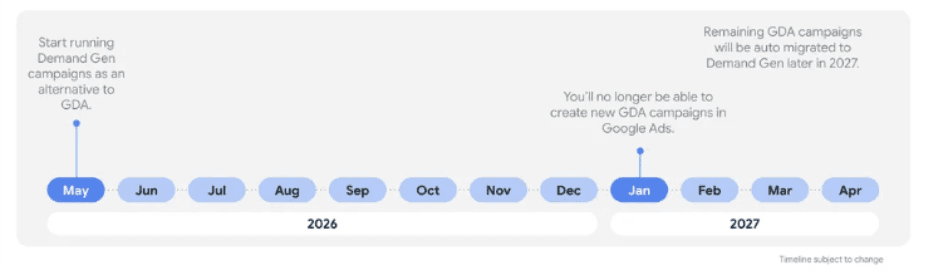
Source: Google - https://blog.google/products/ads-commerce/google-display-ads-demand-gen/
Google's reasoning behind this step matches the reality of modern e-commerce: customer journeys are no longer linear. Potential customers bounce between YouTube Shorts, Discover feeds, Gmail, and traditional blogs in a matter of minutes. Demand Gen was built precisely to connect these touchpoints seamlessly.
What is Demand Gen, and what happens to GDN?
Briefly put: Demand Gen is designed to actively generate demand (mid and upper funnel) in contrast to just capturing existing search volume. Ads are served across Google's highest-reaching and most visually prominent surfaces: YouTube, Discover, Gmail, Google Maps, and the Google Display Network.
Good news for pure Display strategies: if you prefer to advertise exclusively on the Google Display Network (GDN) for budget or branding reasons, you can still keep that control. Advanced channel controls within Demand Gen let you limit delivery purely to the GDN if needed. That means the migration doesn't force you into producing video or using YouTube; it simply opens those doors as powerful options.
Key changes for advertisers
This consolidation brings some structural shifts to daily campaign management:
Algorithms over micromanagement
Classic Display campaigns often allowed for very granular, manual targeting at the placement or ad group level. Demand Gen shifts that focus: AI takes over most of the real-time optimization. Because of this, the advertiser's leverage shifts heavily from technical settings to strategic audience targeting and creative supply.
Brand safety and exclusions
A critical point in any automated transition is brand safety. Google guarantees that existing content exclusions and brand safety settings will be preserved when migrating with the official tool. Even so, it's highly recommended to manually verify all exclusions in your new setup after the upgrade.
Reporting and data logic
The isolated reporting level for pure Display data is going away. While you can still filter channel-specific data within Demand Gen reports, the attribution and analysis logic follows Google's holistic multi-channel approach.
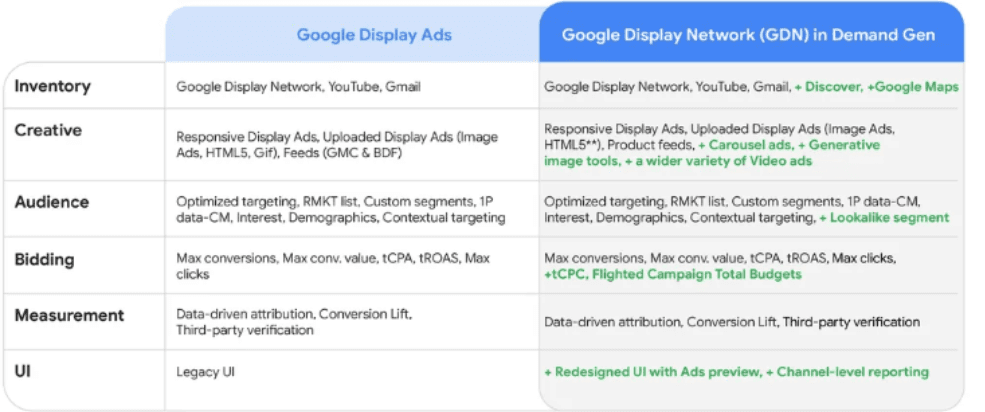
Source: Google - https://blog.google/products/ads-commerce/google-display-ads-demand-gen/
Is the switch worth it? A look at the numbers
The first performance data released by Google shows highly promising trends: advertisers enjoy an average of 9.5% more ROI when using GDN inside Demand Gen. In a global case study with food delivery service GoFood, the combined setup led to a 24% lower CPA alongside a 19% increase in conversions.
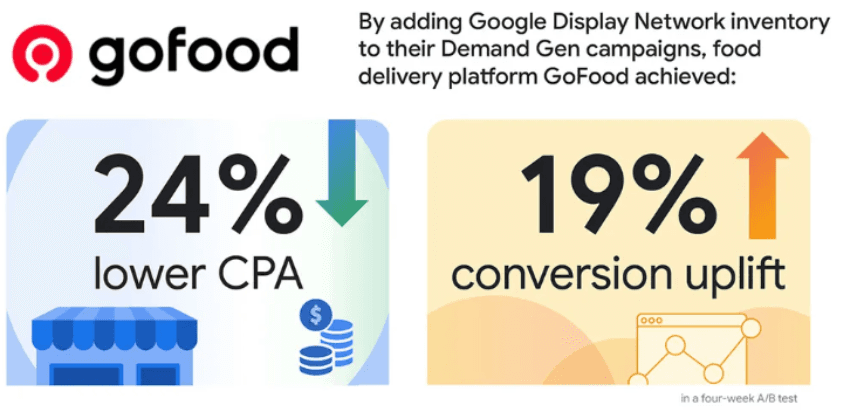
Source: Google - https://blog.google/products/ads-commerce/google-display-ads-demand-gen/
Even though studies from platforms themselves always reflect ideal conditions, real-world practice confirms: Demand Gen rewards first-party data and high-quality visual assets. Advertisers with clean customer lists (Customer Match) and tailored lookalike audiences will see noticeable performance benefits from AI-powered delivery.
Strategic Roadmap: What you should do now
Waiting for the forced, automatic migration means missing out on valuable optimization time and losing control over your historical data. We recommend taking the following steps:
Audit your current setup: Analyze your current Display campaigns. Which ones are serving retargeting, and which ones are purely for brand awareness? This clustering will shape your future Demand Gen setup.
Strengthen your audience infrastructure: Since Demand Gen relies heavily on Google's audience intelligence, make sure your custom segments, Customer Match lists, and lookalike structures are flawlessly implemented.
Ramp up asset production: While static banners will do for a start, Demand Gen truly shines when combined with video (such as Shorts). Use this time to build short, visually engaging video assets.
Run parallel tests: Set up your own Demand Gen campaigns alongside your core Display campaigns early on to help the algorithms learn and to draw direct performance comparisons.
The Verdict
The end of standalone Display campaigns marks the end of manual banner management in Google Ads. However, the Google Display Network isn't dying; it is simply moving into a modern, AI-driven ecosystem that is much better equipped for today's fragmented user paths. Planning your transition strategically and updating your creatives now will give you a noticeable competitive advantage early on.
Need help with the migration or want to future-proof your Google Ads setup? Get in touch with our Paid Ads team for a data-driven migration strategy without losing search or placement reach.
FAQ – Frequently Asked Questions about the Display Migration
When exactly will Display campaigns be discontinued?
The entire process is set to wrap up by 2027. Google will provide a migration tool in the interface starting June 2026, and the creation of new standalone Display campaigns will be disabled step-by-step moving forward.
Should I wait for Google's automatic tool?
While the tool simplifies the technical transfer of budgets and smart signals, it is still highly recommended to manage the transition manually or with professional support. This ensures your target groups and creatives are perfectly aligned with Demand Gen's requirements from day one.
Can I still advertise exclusively on the GDN within Demand Gen?
Yes, you can. By using advanced channel controls, you can specifically restrict ad delivery to the Google Display Network, so you aren't forced to serve ads on YouTube or Gmail inventory.
What happens to my previous exclusions and target audiences?
When using the official upgrade tool, your existing settings and historical signals are carried over to the new campaign structure. However, double-checking your brand safety guidelines manually right after the switch is highly recommended.
Is Demand Gen worth it for small daily budgets?
Yes, though AI-assisted campaigns like Demand Gen do need a certain amount of data to successfully complete their learning phase. With very small budgets, you should give the learning phase a bit more time and avoid analyzing performance too early.
Where can I find official details about the change?
Google regularly publishes updates, best practices, and detailed migration guides on the official Google Ads Help Center as well as the Google Products Blog.
Markus
Brook
Markus Beck is a Senior Online Marketing Manager and team lead for the entire PPC world at Internetwarriors. With his deep understanding of search engine algorithms and his extensive experience in online marketing, he helps clients improve their online presence and increase their revenue. At the same time, he is an important point of contact for his team and passionately shares his knowledge with the agency's trainees.
Comments on the post
no comments yet
Write a comment
Your email address will not be published. Required fields are marked with *
