
DE
EN


- Blog Posts
- Moritz is a software and internet geek at heart - Secretly, he enjoys accounting and controlling - Not great at tennis, but he loves it 🎾


- Blog Posts
- Moritz is a software and internet geek at heart - Secretly, he enjoys accounting and controlling - Not great at tennis, but he loves it 🎾

- Blog Posts
- Moritz is a software and internet geek at heart - Secretly, he enjoys accounting and controlling - Not great at tennis, but he loves it 🎾
All Categories
SEO
SEA
Social Media
Web Analytics
Growth Marketing
Artificial Intelligence
Success Stories
Inside internetwarriors
Agentic Commerce & Agentic Shopping 2026: Why AI Shopping Agents are Rewriting Commerce
Mar 30, 2026
Moritz
Klussmann
Category:
Artificial Intelligence

The world of online marketing is moving faster today than ever before. While we at internetwarriors have been fighting for clicks and conversions since 2001, we are currently experiencing the most radical shift in our history. The catalyst: Agentic Commerce . We are in the middle of a transition from pure information search to task-oriented execution. Today, users no longer just ask for products—they instruct an AI shopping agent to handle the entire purchasing process autonomously. In this article, I'll show you why the failure of OpenAI's "Instant Checkout" isn't the end of the hype, but rather the starting gun for a new technical infrastructure that you, as a merchant, need to understand right now. The OpenAI Pivot: From Shopping Cart to Discovery Platform In March 2026, OpenAI pulled the plug on its "Instant Checkout"—sparking one of the most intensely debated topics in e-commerce. Failure or strategy? Here's what's really behind the pivot and what it means for merchants. What was Instant Checkout? In September 2025, OpenAI launched the Agentic Commerce Protocol (ACP) alongside Stripe, introducing "Instant Checkout" to ChatGPT. The vision: users discover a product in the chat and buy it right then and there without ever leaving the platform. Etsy, Walmart, and Shopify were the first partners—Shopify President Harley Finkelstein called it a "new frontier" for online retail. Why Direct Checkout Failed In early March 2026, OpenAI pulled the emergency brake. While critics quickly dismissed it as the failure of agentic commerce, a closer look reveals a strategic pivot we can learn a lot from. OpenAI underestimated the immense complexity of global commerce. Three deal-breakers made direct checkout inside the chatbot practically impossible: The three technical deal-breakers: 1. Lack of real-time synchronization: Inventory data from millions of merchants couldn't be matched at the required speed—outdated prices and stock levels instantly eroded user trust. 2. Compliance hurdles: There was a lack of systems for automated calculation of regional taxes (thousands of local tax jurisdictions in the US alone) and compliance with local laws, such as the Price Indication Ordinance (PAngV) in Europe. 3. Fraud prevention: Agentic transactions demand entirely new security architectures to prevent automated abuse. Another factor barely mentioned in the news: the retreat came right after Amazon's $50 billion investment in OpenAI. Amazon controls 40 percent of US e-commerce and is building its own AI shopping tool with Rufus . Whether coincidence or strategic calculation—the timing is remarkable. 🟢 Update: March 25, 2026 Alongside the checkout rollback, OpenAI launched a completely revamped shopping experience: visual product browsing, side-by-side price comparisons, and image uploads for product searches. Seven major US retailers—including Target, Sephora, Nordstrom, and Best Buy—are already live via ACP. Walmart runs its own in-ChatGPT app complete with loyalty integration and native Walmart payment. This isn't a retreat—it's a pivot. The new reality: OpenAI is using the ACP primarily to focus on Product Discovery . The checkout moves back to the merchant—yet the decision of which merchant wins the sale is increasingly made by the agent. Agentic Shopping Works—Just Not in the West Yet Anyone who thinks the failure of Instant Checkout proves that Agentic Shopping is just hype is missing the big picture. Alibaba's Qwen app is already handling food delivery orders, travel bookings, and product purchases completely within a single conversation—and at scale. The crucial difference: Alibaba owns the AI model, the marketplace, the payment infrastructure, and the logistics under one roof. OpenAI tried to replicate this without owning the stack. Structurally, it was set up to fail. Google UCP: The New Operating System for Commerce While OpenAI adjusts course, Google is establishing facts on the ground with the Universal Commerce Protocol (UCP) . Unlike closed systems, UCP is an open standard that allows AI agents to communicate directly with merchants' backends—from discovery and checkout all the way to post-purchase management. For you as a merchant, this means your Google Merchant Center (GMC) becomes the critical interface for AI in e-commerce . Google has rolled out new attributes to make your products machine-readable: · product_faq – questions and answers for AI agents that can be extracted directly from your feed · product_use_cases – specific scenarios where your product offers the best solution · native_commerce – a toggle indicating whether your product is ready for autonomous checkout The advantage for Germany: Google Merchant Center and Google AI Mode are already active across the DACH region. Merchants who optimize their feeds now will secure a genuine head start. SEO Alone Is No Longer Enough: Welcome to the Era of GEO Our analysis of German e-commerce shops reveals a clear trend: a top ranking in classic search does not guarantee visibility in AI answers. Over 60 percent of URLs linked in AI overviews don't even rank in the top 50 of classic Google Search. The rules have changed. This is where Generative Engine Optimization (GEO) comes into play—the discipline of optimizing content not for human clicks, but for extraction by AI systems. Check out our study now to learn more about the topic! Feature Traditional SEO Generative Engine Optimization (GEO) Target Audience Human users AI agents & Large Language Models Primary KPI Click-through rate (CTR) & rankings Mention rate & citation authority Content Logic Keywords & readability Semantic depth & factual density Technical Foundation Crawlability & page speed Structured data & API integration Measuring Success Google Search Console (rankings) Brand mentions in LLM answers Warrior Insight: In Germany, AI Overviews already appear in 33 percent of all search queries. If you don't focus on GEO now, you'll become invisible to the "agent customer"—before they even set foot on a website. Strategic Warrior Knowledge: Brand Power and the 95:5 Rule In the agentic web, it's no longer just about the keyword—it's about your brand's authority as an "entity": how a Large Language Model understands, categorizes, and recommends your brand. The 95:5 Rule in B2B Only 5 percent of your target audience is currently ready to buy (in-market). The remaining 95 percent must be reached over time through thought leadership and trust-building. AI agents favor brands that are established as expert entities in the knowledge graphs of Large Language Models. If you only optimize for transactional keywords, you'll lose the majority of your potential customers before they're even ready to buy. Want to learn more? Check out our article on the topic here ! Preferred Sources: The Democratization of the Algorithm Google now allows users to actively mark their preferred sources. These "Preferred Sources" receive a permanent visibility boost—regardless of algorithm updates. This fundamentally changes the game: trust is the new currency. You need to encourage users to actively choose your brand as trustworthy—not just rank well. Checklist: How to Make Your Shop Agent-Ready Right Now For German merchants: the foundational work begins today, even if fully autonomous agentic shopping is still 12 to 24 months away in DACH. Product data excellence in Merchant Center: Maintain GTINs, precise attributes, and the new UCP fields (product_faq, product_use_cases). An incomplete feed is the single biggest barrier to AI visibility that you can control yourself. Technical infrastructure for AI agents: Implement an llms.txt file (the robots.txt for AI crawlers) and consistently use JSON-LD—specifically the Product, FAQPage, and Article schemas. These are the signals that AI agents prioritize when extracting data. API-first strategy: Ensure inventory and pricing can be queried via APIs in milliseconds. Outdated data was the main reason OpenAI's checkout failed—and that same mistake will cost merchants dearly once agents start booking autonomously. Semantic enrichment via Query Fan-Out: Answer the questions an AI asks when comparing products on behalf of a customer: What are the best use cases for this product? What alternatives exist? What are common purchasing hurdles? This level of depth is what separates cited content from ignored content. Build a GEO strategy and brand authority: Make sure your shop is recognized as an expert entity in relevant categories—across ChatGPT, Perplexity, and Google AI Mode. Find out more in our GEO Audit → Secure DACH compliance early: Regulations like PAngV and GDPR also apply to AI-mediated purchases. Price reductions must clearly state the lowest price from the last 30 days as a reference point—and that must be machine-readable. Clarify this early with your legal counsel. Conclusion: Become a Leader in the New Era Agentic Commerce is no longer a science-fiction scenario—it's today's technological reality, still developing, but unstoppable. What OpenAI left behind with Instant Checkout was a specific business model: the chatbot acting as a transactional middleman between merchant and customer. What remains very much alive—and accelerating quickly—is the underlying logic: AI shopping agents handle discovery, filter options, and set up buying decisions. This is already happening, every day, for millions of users. The question for merchants is no longer if , but whether they will be visible when the agent makes the call . The businesses that lead the pack in two years won't necessarily be the ones with the biggest budgets. They will be the ones with the best data, the strongest GEO presence, and the clearest understanding of how to use artificial intelligence in e-commerce as leverage rather than seeing it as a threat. Frequently Asked Questions About Agentic Commerce What is the difference between agentic commerce and traditional e-commerce? Traditional e-commerce runs on the principle of Search & Click : the user actively searches, compares manually, and completes the purchase themselves. Agentic commerce runs on the principle of Ask & Done : an AI shopping agent handles product search, price comparison, stock verification, and—when authorized—the final purchase completely autonomously. What is agentic shopping? Agentic shopping is the practical application of agentic commerce: a user defines a specific goal—such as "Order printer cartridge XYZ at the best price by tomorrow"—and an AI shopping agent carries out every step on its own: search, comparison, purchase. Why did OpenAI shut down Instant Checkout? OpenAI ran into three major technical barriers: a lack of real-time inventory synchronization across millions of merchants, no system for tax collection, and no fraud prevention framework for agent-driven transactions. OpenAI is now pivoting to product discovery—leaving checkout in the hands of the merchant. What is the difference between SEO and GEO? SEO (Search Engine Optimization) optimizes content for Google's search algorithm and human users—the goal is getting the click. GEO (Generative Engine Optimization) optimizes for AI systems and Large Language Models that extract content and deliver it as a direct answer—without requiring the user to click through to a website. Both disciplines complement and build upon each other. Is my shop legally compliant for AI purchases in Germany? In the DACH region, you need to pay close attention to the GDPR and the German Price Indication Ordinance (PAngV). Any discounted prices must reference the lowest price offered in the past 30 days—and this must be machine-readable for AI agents. Be sure to consult with your legal advisor early on before integrating into agentic commerce protocols. When is agentic commerce coming to Germany? ACP and the new ChatGPT shopping hub are currently US-first. However, Google Merchant Center and Google AI Mode are already active in DACH—AI Overviews are already appearing for 33 percent of all German search queries. Experts estimate that AI agents could capture a 20–30 percent market share in European e-commerce within two to three years. Getting ready starts now. Is your shop ready for AI shopping agents? We'll analyze your GEO visibility and product feed to show you where you're currently invisible to AI agents—and how to fix it. Request a GEO analysis now → Sources & Further Reading: CNBC, March 2026: "OpenAI revamps shopping experience in ChatGPT after struggling with Instant Checkout" – cnbc.com Forrester Research: ConsumerVoices Market Research Survey, March 2026 Gartner: Bob Hetu, Analyst, speaking to CNBC, March 2026 The Information, March 2026: Initial report on the Instant Checkout rollback OpenAI Blog, March 2026: Official statement on Instant Checkout and the new shopping experience Google: Universal Commerce Protocol – Announcement January 2026

Google AI Mode: New Rules for Visibility – Empirical Study 11/2025
Nov 24, 2025
Moritz
Klussmann
Category:
Search Engine Optimization
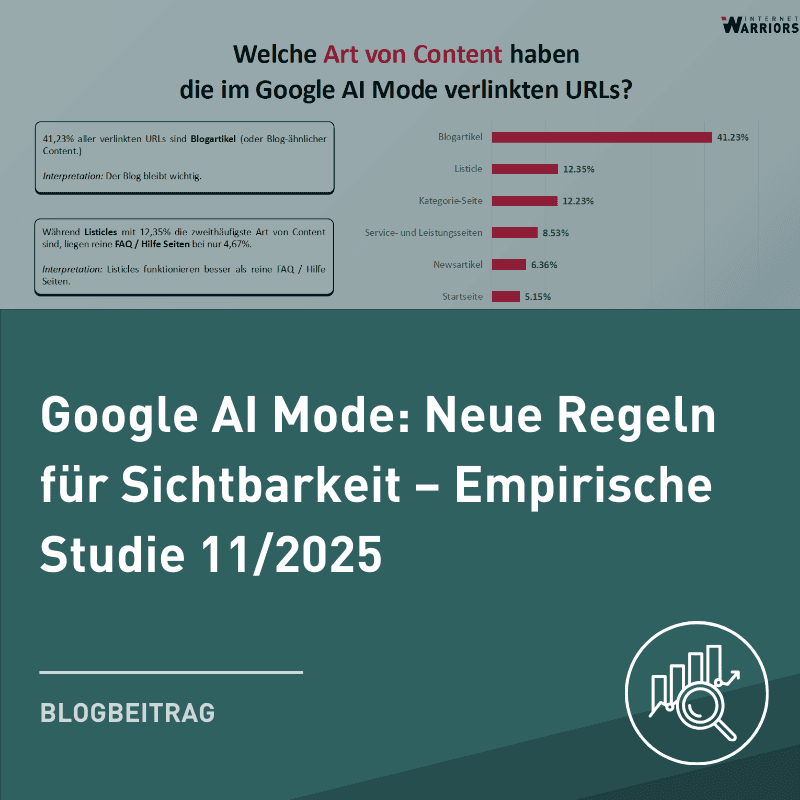
There are moments in digital marketing when the rules of the game aren't just slightly adjusted, but completely rewritten. We find ourselves in exactly such a moment right now. Since October 2025, Google AI Mode has been available in Germany, serving as Google's answer to ChatGPT. Many marketers and SEOs have been waiting for it, but the reality is hitting many harder than expected. Introduction: The SEO earthquake we saw coming For years, the mantra was: "Optimize for the top 3, and the traffic is yours." But our latest empirical study at internetwarriors paints a different picture. It's a picture that might be unsettling for traditional SEO strategies, but full of opportunities for adaptable businesses. The key takeaway right up front: A top ranking in traditional Google search is no longer a guarantee of being featured in Large Language Models (LLMs). In fact, our data analysis shows that over 60% of the sources cited by AI Mode don't even appear in the top 50 of organic search results. What does this mean for your visibility on Google ? It means we need to rethink SEO. In this article, we take a deep dive into our analysis of over 3,000 URLs and show you how to adapt your strategy so you don't become invisible in the era of AI Search . The Study: A look under the AI's hood Before diving into the strategic implications, it's important to understand the underlying data. We didn't want to rely on gut feelings, but rather establish empirical facts. Our study setup: We conducted a comprehensive analysis covering the following parameters: Scope: 240 different prompts (search queries). Diversity: 12 different industries, ranging from e-commerce and pharma to finance and energy. Database: A total of 3,109 URLs cited by Google AI as sources were identified and analyzed. Goal: We wanted to find out which types of websites get linked, which content formats win, and how significant the overlap is with traditional search. Methodology overview of our study This database provides our clearest view yet of how Google selects and presents information in AI Mode . The shock for traditional SEO: The 60% gap This is where we need to be completely honest with ourselves: The traditional SEO playbook is of limited help when it comes to boosting visibility in AI Mode. Our quantitative analyses brought to light a statistic that should make every SEO manager sit up and take notice: "Over 60% of citations in AI Mode are NOT found in Google's top 50 traditional search results." Let's let that sink in for a moment. Even if you've invested a huge budget and countless hours to rank on page 1, 2, or 3 for a keyword—the AI ignores you in more than half of all cases in favor of other sources. It gets even more dramatic when we look at the absolute top tier: Only 21.97% of the URLs linked in AI Mode are also found in the top 10 results of traditional Google search. What does this mean for "improving Google rankings"? It means that the algorithms determining organic rankings (backlinks, technical SEO, Core Web Vitals) don't align with the selection criteria used by LLMs (Large Language Models). The AI looks for different signals. It searches for semantic relevance, information density, and context —not necessarily the domain with the highest authority score. Anyone focusing solely on traditional Google ranking optimization today is missing out on the future. We are witnessing a decoupling of the two search modes. Overlap of AI Mode links with organic top 10 results Our data also reveals exciting differences between the various AI engines. While Google AI Mode and Perplexity still overlap by nearly 30%, ChatGPT selects completely different sources (less than 10% overlap). The "winner-takes-all" principle of the old SEO world, where position #1 wins everywhere, is officially over. Who are the winners in AI Mode? (Websites & Content) If traditional top rankings are no longer the deciding factor, who benefits? Our analysis of website types provides clear answers on how you should align your AI content strategy . Brand websites and e-commerce: The foundation holds strong The good news for brands: Brand websites (44.26%) and e-commerce stores (10.57%) together account for more than half of all links. This means that Google continues to favor trustworthy brand sources in AI Mode as well. But—and it's a big but—it all depends on which subpages are being linked. Digital PR is the new link building The rise of news/journalism sites (10.19%) and comparison portals (10.29%) is particularly striking. Together, they make up over 20% of the sources. The takeaway: AI validates information through third parties. When your brand or product is mentioned in a reputable news article or an independent comparison portal, the likelihood skyrockets that the AI will pick up that information and cite you as a source. Digital PR is therefore becoming more important than traditional, technical link building. Forums are (still) overrated Contrary to the hype surrounding "Reddit SEO," our data shows that forums and community sites account for less than 3% of the mentioned links. A strategy relying purely on user-generated content simply falls short. Types of websites linked in AI Mode. Content metamorphosis: Moving away from selling, toward guidance Perhaps the most critical insight from the study concerns the type of content . This is where businesses need to shift their mindset the fastest. Pure sales copy is losing relevance. The AI understands search intent on a much more granular level. When users turn to AI Mode, they are often looking for summaries, explanations, or comparisons—not necessarily a "Buy Now" button right away. Our data speaks loud and clear: Blog posts dominate: 41.23% of all linked URLs are blog articles or blog-like content. Listicles work: At 12.35%, lists (e.g., "The 10 Best...") are the second most common format. Help centers lose ground: Standalone FAQ or help pages make up just 4.67%. Why is that? Listicles and well-structured blog articles provide the AI with "bite-sized," easily digestible information. They offer orientation and structure that the language model can easily extract and reassemble. A pure product page often lacks sufficient context. A dry FAQ page is often too niche and fails to provide the comprehensive context that the AI needs to generate a complete answer. Type of content The bottom line for your content strategy: Content that provides guidance wins. Businesses need to transition away from pure sales content and move toward informative, user-centric content that answers questions thoroughly. GEO (Generative Engine Optimization): The new era of optimizing for Google We need to stop just saying "SEO" when we actually mean visibility across AI systems. The industry term emerging here is GEO (Generative Engine Optimization) . Based on our study, here are concrete action steps for GEO: On-page GEO is a major lever: Since brand websites are so heavily represented, you are in control. Optimize your informative sections. Make sure your blog articles feature clear structures, lists, and concise summaries. Informational over transactional: With informational search queries, your chances of appearing in AI Mode with good rankings are much higher. Invest in high-level content that explains concepts rather than just pitching products. Expand your PR efforts: Make sure you're featured on news sites and comparison portals. The AI trusts these sources. Your brand needs to be present wherever opinions are formed. Diversify your sources: Don't rely on your Google ranking to save the day. Since over 60% of AI links come out of "nowhere" (outside the top 50), you have the opportunity to capture niches dominated by major players in traditional SEO using highly specific, top-tier content. Conclusion: Act now to secure your edge The integration of AI into search and the use of LLMs will only continue to accelerate. We are just at the beginning of this journey. The fact that AI Mode often picks different sources than the traditional algorithm is both daunting and liberating. It means the deck is being reshuffled. Smaller players with outstanding content can outperform giants that simply rest on their domain authority. Businesses that take action now and evolve their strategy from pure SEO to a hybrid SEO/GEO approach will secure a decisive competitive advantage. Don't wait for your traffic to plummet. Use the insights from our study to make your content ready for the AI search engine . Want to dive deeper into the data? Our study contains plenty more details, industry breakdowns, and dedicated analyses for Perplexity and ChatGPT. Download the full Google AI Mode Study now and discover in detail how to optimize your SEO / GEO strategy for the future. 🔗 Free download of the Google AI Mode Study Transparency note: This article is based on the empirical study "Google AI Mode: New Rules for Visibility" conducted by internetwarriors in November 2025.
The 8 feed attributes that decide your visibility in AI search
Nov 11, 2026

Markus
Brook
Category:
Search Engine Advertising (SEA)

Key Takeaways at a Glance Google has introduced six new Conversational Attributes in Merchant Center, combining them with two existing attributes to create an eight-part toolkit for AI-powered search. The new fields are Variant Option, Item Group Title, Related Product, Q&A, Document Link, and Popularity Rank. Product Highlight and Product Detail were already available, but they carry much more weight when used alongside the new attributes. None of these attributes are mandatory, and none will affect the approval of your existing products. A structured rollout focused on your top sellers will get you to your goal much faster than overhauling your entire feed all at once. In our article on Agentic Commerce in Google Ads , we highlighted why your feed makes or breaks your visibility. Now, things are getting concrete. Google has upgraded the Merchant Center feed technically so that AI systems can answer long, complex questions. Eight attributes are especially crucial here: two existing ones that are gaining new importance, and six brand-new additions. Understanding these eight fields and filling them out cleanly gives you a clear competitive edge over rivals who still only maintain basic titles and descriptions. Why Google Is Stepping Up Right Now The reason lies in how people search today: using complete sentences instead of isolated keywords. Queries in Google AI Mode are, on average, three times longer than traditional keyword searches. A standard feed with just a title, description, and a few basic attributes often falls short for these types of questions. Google itself describes the new attributes as a structured foundation, not a replacement for titles, descriptions, and images. That means you're building on top of what you have, not replacing it. The 8 Attributes at a Glance First, here's an overview, followed by a detailed look at each attribute: what it does, what a feed entry looks like, and what to keep in mind when filling it out. For Product Detail, Variant Option, Related Product, and Popularity Rank, the notation reflects the format used in text feeds; the remaining examples have been simplified for better readability. Attribute Feed Field Name Status Key Limits Product Highlight product_highlight Existing 2 to 100 highlights, 150 characters each Product Detail product_detail Existing Section, attribute name, and value Item Group Title item_group_title New Max. 150 characters Variant Option variant_option New Up to 30 options, name and value 250 characters each Related Product related_product New Up to 30 links, 6 relationship types Q&A question_and_answer New Up to 30 pairs, 1,000 characters each, max. 10,000 total Document Link document_link New Up to 5 PDFs, max. 50 MB each Popularity Rank popularity_rank New Value from 0 to 100, one decimal place Product Highlight [product_highlight] Existing attribute. Short selling points that help your product stand out from similar offerings at a single glance. Up to 150 characters per highlight, with between two and 100 highlights allowed. In practice, four to six strong highlights are usually plenty. Example: Cordless Lawn Mower product_highlight: Mows up to 400 m² on a single battery charge product_highlight: Foldable handle fits into any garden shed product_highlight: 6-position cutting height adjustment from 25 to 75 mm product_highlight: Battery compatible with all tools in the 36V series Pro tip: Numbers beat adjectives. "Mows up to 400 m²" directly answers the question, "Is this enough for my yard?" Saying it's "powerful" doesn't say much at all. Product Detail [product_detail] Existing attribute. Structured technical specifications organized into section, attribute name, and value. This allows AI to answer specific detail-oriented questions about runtime, dimensions, or weight. Example: The same cordless lawn mower product_detail: Performance:Battery life:45 minutes product_detail: Performance:Charging time:90 minutes product_detail: Dimensions:Cutting width:37 cm product_detail: Features:Grass catcher:40 liters With this data, the AI can instantly answer a query like "cordless lawn mower with at least 40 minutes of battery life and a 40-liter grass catcher" without having to parse through a lengthy description. Pro tip: Keep hard facts in Product Detail, and leave benefits and use cases for the description. Avoid repeating the same information in multiple places, or you risk contradictory values during your next update. Item Group Title [item_group_title] New attribute. The overarching name for an entire product series under which individual variants are grouped. Maximum of 150 characters, used in conjunction with the Item Group ID. Example: Office chair with multiple variations item_group_id: ERGO500 item_group_title: ErgoLine 500 Ergonomic Office Chair title: ErgoLine 500 Office Chair, Black Mesh Back, with Headrest Pro tip: Keep colors, sizes, or specific features out of the group title. Otherwise, the AI won't be able to tell what belongs to the broader series versus what's specific to an individual variant. Variant Option [variant_option] New attribute. Describes what sets a specific variant apart from other products in its group. Name and value can each be up to 250 characters long, with up to 30 options supported per product. Example: Two variants of the ErgoLine 500 ERGO500-NS-K variant_option: Backrest:Mesh,Color:Black,Headrest:Included ERGO500-SG variant_option: Backrest:Fabric,Color:Gray,Headrest:None If someone searches for an "office chair with headrest and breathable mesh back," the AI will pinpoint the exact first variant rather than the fabric version without a headrest. Color belongs here too, even though it has its own standard attribute: Google recommends populating both if color distinguishes your variants. Pro tip: All variants in a group must use identical attribute names, and each combination of values must be unique. If one variant uses "Color" and the next uses "Fabric Color," the group falls out of sync. Only use this attribute for true variants, not for products that are merely similar. Related Product [related_product] New attribute. Connects related products via their ID or GTIN. Supports up to 30 links per product, categorized into one of six relationship types: Relationship Type Field Value Meaning Cordless Lawn Mower Example Part of a set part_of_set Belongs to the same series or product line String trimmer and hedge trimmer in the same 36V series Required component required_part Product cannot function without this part Battery and charger for the tool-only variant Frequently bought together often_bought_with Commonly purchased as a pair or set Lawn fertilizer, grass shears Substitute product substitute Can replace the product functionally Comparable cordless lawn mower from another manufacturer Different brand different_brand Identical product sold under a different brand Identical model sold under an affordable private label Accessory accessory Optional add-on Mulching kit, wall mount Here is how this looks in the feed for the tool-only variant related_product: required_part:id:BATTERY36 4AH,required_part:id:CHARGER36,accessory:id:MULCH37 Pro tip: For tool-only products, required_part is the most critical type. If this link is missing, the AI might recommend a tool that leaves customers stranded without a battery. Remember to create a separate entry for each linked product. Q&A [question_and_answer] New attribute. An FAQ catalog covering your product and brand that the Business Agent can use directly in chat. Supports up to 30 Q&A pairs, with questions and answers capped at 1,000 characters each and a maximum total of 10,000 characters per product. Example: Car seat with ISOFIX Question: Does this seat fit in a VW Golf 8? Answer: Yes. The seat is approved for vehicles with ISOFIX, including the Golf 8. You can find all compatible models in the vehicle application list. Question: Can I wash the cover? Answer: Yes, the cover is removable and machine washable at 30°C. Question: Can I install the seat using only the seat belt, without ISOFIX? Answer: No, the seat must be installed using ISOFIX and the support leg. Pro tip: Your customer support team and product reviews are the best sources for genuine questions, not your marketing copy. Don't include prices, promotions, or dates, avoid keyword stuffing, and skip anything already covered in Product Detail or the description. It's a great idea to test this attribute using a supplemental feed before updating your main feed. Document Link [document_link] New attribute. Links to publicly accessible PDFs, such as user manuals or spec sheets. Up to five PDFs per product, with a maximum file size of 50 MB each. Example: Wood-burning stove document_link: https://www.exampleshop.com/pdf/k8-installation-manual.pdf document_link: https://www.exampleshop.com/pdf/k8-datasheet.pdf document_link: https://www.exampleshop.com/pdf/k8-declaration-of-performance.pdf Questions like "What is the required wall clearance for the K8?" are answered right in the installation manual. The AI can pull this answer directly, saving your customer support team a phone call. Pro tip: PDFs must be searchable and accessible without a login. Scanned pages without a text layer are almost impossible for AI to parse. Plus, if information is already in the PDF, you don't need to duplicate it in your Q&A—Google will pull answers straight from the document. Popularity Rank [popularity_rank] New attribute. A self-assigned score between 0 and 100 with one decimal place. It reflects how in-demand a product is across your catalog. Example: Garden watering catalog Pro Hose Reel 60 m popularity_rank: 96.5 Basic Sprinkler Set popularity_rank: 54.0 Smart Watering Timer Pro popularity_rank: 12.5 Pro tip: Base this value on recent sales data and only compare products within the same category. For example, sort all watering products by unit sales over the past month and convert their position into a percentile. Rank 3 out of 80 comes out to roughly 96.3 in the feed. Update the value whenever sales trends shift noticeably—a supplemental feed makes this easy. If every product is set to 100, the signal becomes useless. Common Mistakes to Avoid Duplicating content. If information already exists in the description, Product Highlight, or Product Detail, there's no need to repeat it in the Q&A. Encoding issues in Product Highlight. Commas in CSV files can easily break your formatting. Using tab-delimited files or proper quoting will save you headaches. Inflating the Popularity Rank. If every product is ranked 100, the data offers zero value to the AI. Overhauling the whole feed at once. Doing everything at once increases error risks and makes it tough to track which specific tweak drove which result. A 3-Phase Rollout Plan Audit your assets. Gather existing FAQs, manuals, and known product variants before uploading anything. Start with top sellers. Implement Product Highlight, Q&A, and Popularity Rank first for your highest-revenue items. Expand catalog-wide. Roll out Related Product and Document Link once initial tests confirm everything is running smoothly. What This Means for Your Bottom Line A well-maintained feed delivers more than just better visibility—it gives you greater control. The custom labels you use to segment your inventory by margin and performance rely on the exact same underlying data as these Conversational Attributes. We'll dive into how to set up this strategic control in an upcoming article. Conclusion Eight attributes might sound like a lot of work at first glance. In reality, starting small and testing with your most important products is all it takes. Laying this groundwork now ensures you're ready whenever Google rolls out its next update—and chances are, this won't be the last one. Get in touch with us! We'll help you determine which of the eight attributes will make the biggest impact for your catalog. Conversational Attributes FAQ Do I need to fill out all eight attributes for my feed to work? No. All eight fields are optional and won't affect whether your products get approved. However, they significantly boost your chances of being surfaced for complex queries. Product Highlight and Q&A are great starting points since you can usually pull from materials you already have. How does Related Product differ from Product Highlight? Product Highlight showcases the strengths of a single product. Related Product connects multiple products together, such as for cross-selling. The two complement each other without overlapping. How much effort goes into the Q&A attribute? It depends on your catalog. If you already have an FAQ page or documented customer service questions, you can usually repurpose that content right away. Using a supplemental feed to test a handful of products keeps the initial effort very manageable. Does an inaccurate Popularity Rank hurt performance? An unrealistic value won't penalize product approval, but it renders the signal meaningless. For instance, if you set all products to 100, the AI can't determine a meaningful ranking order and will likely just ignore the data. Should I use my primary feed or a supplemental feed first? A supplemental feed is ideal for newer, less-tested attributes like Q&A. It lets you test without touching your main feed. Once you're confident in the formatting, you can easily roll it into your primary feed.
Agentic Commerce in Google Ads: Why your product feed is now more important than your ad
Nov 10, 2026
Markus
Brook
Category:
Search Engine Advertising (SEA)

Key Takeaways at a Glance AI agents in Google AI Mode, Gemini, and similar platforms don't look at your ad copy at all. They pull their product recommendations directly from the structured data in your feed. According to Google, Google AI Mode has over 1 billion monthly active users (as of May 2026). Queries there are, on average, three times longer than a traditional keyword search. With the Universal Commerce Protocol, Business Agent, and Direct Offers, Google is actively building the infrastructure for automated shopping. This isn't just a future concept—it's already happening. If you want to stay visible in Shopping and AI Mode, treat your Merchant Center feed as your primary visibility lever and feed it as much high-quality data as possible. “Find me the best air fryer under $500 that also fits into a small kitchen.” That's what queries in Google AI Mode look like these days. Hardly anyone just types three simple words into the search bar anymore. The responding agent doesn't click around through ads, either. It pulls price, availability, dimensions, and specs directly from product feeds, compares a few options, and recommends one or two of them in the end. So if you manage a Google Ads account, there's one very practical question you need to ask: Is your product even in the running when the machine makes its pick? What Agentic Commerce Means for Your Google Ads Account The new buying journey takes place in three steps. Someone enters a prompt. An AI agent searches for matching products and compares their data. Then the agent either recommends a product or buys it directly—often without anyone ever clicking on an ad. And this isn't just happening on ChatGPT. Google is rolling this out natively: AI Mode and the new Business Agent answer shopping queries directly in Google Search, using the exact product data you're already uploading to Merchant Center. Graphic: Agentic Commerce in three steps. Compared to classic Google Shopping, this shifts the playing field quite a bit. Previously, your keyword simply had to match the search query. Today, the agent matches a long, complex prompt against the attributes in your feed. If a value is missing or vague, your product gets dropped from the comparison. At that point, it doesn't matter how great your ad copy is. Why Keywords Alone Are No Longer Enough The numbers clearly show how fast things are shifting. Google AI Mode now has over one billion monthly active users, and searches there are about three times longer than traditional queries. If you type in “air fryer reviews,” you get a list of links. But if you describe what you need in a full sentence, you get an immediate answer—and that answer is built on structured data. This isn't just a single feature; there's a real strategy behind it. With the Universal Commerce Protocol—developed by Google alongside Shopify, Etsy, Target, and Walmart—an open standard is emerging that lets AI agents shop across different platforms. Through the Business Agent, customers can chat with a brand directly within Google Search, much like talking to a sales associate. And with Direct Offers, Google is testing ways to automatically surface discounts right when an agent is about to make a purchase. All of this relies on one single source of truth: your product feed. In Agentic Commerce, Your Feed Calls the Shots And that brings us to the core point: Your feed is where your product catalog meets AI. It used to be that an ad with great copy and the right bidding strategy won the auction. Today, the product with the most complete, clean, and up-to-date data wins. Two stores can sell the exact same item at the exact same price and still see completely different visibility levels. The deciding factor comes down purely to feed management. What You Can Do Right Now: 6 Actionable Steps Put the most important details first. Brand, product type, model, and key attributes belong right at the beginning of your title and description. Shoppers scan text this way, and AI models also place heavier weight on the beginning. Fill in attributes and GTINs completely. Brand, color, size, material, gender: Every empty field gives the agent a reason to pick your competitor's product instead. Keep descriptions factual rather than promotional. Lead with facts in a clear structure. People appreciate reading clear specs, and AI can process them much more reliably. Use custom labels to steer profitability. By tagging your products according to margin and performance, you can channel visibility directly toward what truly drives profit, rather than treating your entire catalog the same. Keep price and availability up to date. Agents place heavy emphasis on data accuracy. Outdated stock information won't just cost you a click—it could cost you the entire recommendation. Audit your feed regularly. Set up automated checks for disapproved products and missing required fields so you can catch issues before items drop out of comparisons. None of this is overly complicated from a technical standpoint. But together, these points determine whether the AI even gets to see your catalog at all. What's Next: New Attributes in the Feed Relying solely on the basics won't cut it for much longer. In the summer of 2026, Google introduced six new conversational attributes, ranging from Q&A catalogs to product relationship links. These are designed specifically for long, conversational queries. To learn how to populate these new fields effectively and avoid common pitfalls, check out our guide on the 8 Feed Attributes for AI Search. Bottom Line: Start Optimizing Your Feed Now Agentic commerce doesn't change what you sell—it changes how your products are discovered. And you have full control over the quality of your feed. If you tidy it up in Merchant Center today, you'll be set to benefit from every new AI feature Google launches, rather than constantly playing catch-up. Get in touch with us! We'd love to take a look at your feed together and make sure you're ready for Google AI Mode and Agentic Commerce. FAQ on Agentic Commerce in Google Ads Do I need to completely rebuild my Shopping campaigns? Not at all. You don't need to change your campaign structure right away. What matters most is the quality of the data in the feed behind it. A well-maintained feed benefits your traditional Shopping ads just as much as your visibility in AI Mode. Is Google Ads losing its relevance because of Agentic Commerce? Not really. With the Universal Commerce Protocol, Business Agent, and Direct Offers, Google is simply creating new touchpoints within its ecosystem. Ads are here to stay—they're just getting new company. However, the competition for visibility is moving much more to the data layer. When should I start optimizing my feed? The sooner, the better. Changes in Merchant Center take a few crawl and indexing cycles to take full effect. Start by reviewing the six points above for your top-selling products, and then work your way through the rest of your catalog. Do I absolutely need the new conversational attributes? Not right away, but you definitely will over the medium term. Complete standard attributes, clean descriptions, and real-time pricing are already boosting your AI visibility today. New attributes like Q&A or related products are simply the next step, especially for conversational, detailed queries.
Two phases aren't enough: Why GEO prompts need to map the customer journey in three stages
Nov 4, 2026

Two Stages Aren’t Enough: Why GEO Prompts Must Map the Customer Journey in Three Steps If you want to measure a brand's visibility in ChatGPT, Perplexity, or Google AI Mode, you need a prompt set that reflects the customer journey across at least three distinct phases: Awareness, Consideration, and Decision (often called Acquisition or Transactional in performance marketing). Two phases simply aren't enough. And that's not just marketing theory being pedantic—it's because that missing middle stage is precisely where modern AI systems recommend, compare, and filter out providers. The Debate That Comes Up in Every Single GEO Audit Every GEO audit kicks off with the same question: Which prompts are we actually measuring? Unlike traditional keywords, there are no search volumes, no steady rankings, and no static results. That makes your prompt set the single most important methodological choice of the entire audit—it determines what can even show up on your radar in the first place. Our team recently had an open discussion about this. The suggestion on the table was to simplify things down to just two phases: Awareness (informational) and Acquisition (transactional). It’s an honest, understandable point. Drawing sharp lines between stages is genuinely tricky in day-to-day practice, and filling two buckets is naturally faster than managing three or four. Anyone who has ever tried neatly sorting a hundred prompts knows all about the borderline cases. The counter-argument, however: Simpler and faster still has to be just as effective. And with only two phases, it simply isn't. This article explores why search intent research has recognized a middle tier for over 20 years, why consumer behavior studies pinpoint it as the sweet spot for brand building, and why fresh data from AI search confirms both. To wrap things up, we’ll share a practical classification rule to help you easily solve that categorization challenge. What Does Search Intent Research Say About the Number of Stages? Search intent research has recognized three core types since 2002, expanding in practice to four around 2015. A simple binary split between informational and transactional has never existed in the literature. Andrei Broder, then CTO of AltaVista, laid the foundation with his Taxonomy of Web Search . He demonstrated that behind a query lies not just a need for information, but often the desire to reach a specific site (navigational) or perform an action (transactional). Building on this in 2008, Jansen, Booth, and Spink developed a three-level hierarchical classification , discovering that over 80 percent of all web queries were informational, while navigational and transactional each accounted for roughly 10 percent. Modern SEO practice eventually rounded out this taxonomy with a fourth category: Commercial Investigation. Today, tools like Semrush, Ahrefs, and Sistrix consistently classify keywords into informational, navigational, commercial, and transactional. The reason is empirical. Between "What is X" and "Buy X now" sits a massive block of queries comparing solutions, criteria, and vendors: "best method for," "X vs. Y," "reviews of," "providers for." These queries aren't pure informational questions, nor are they finalized transactions. They represent the exact moment a shortlist is formed. A quick note on precision: Google itself uses the primary categories Know (with the subcategory Know Simple), Do, Website, and Visit-in-person in its Quality Rater Guidelines. The term Commercial Investigation actually comes from SEO tools, not Google. In practice, however, both systems describe the exact same reality: There is an intermediate step between knowing and doing, and it is substantial enough to warrant its own category. This taxonomy is the ideal benchmark for prompt sets, because a prompt is essentially a natural-language search intent. Cutting out the middle isn't just departing from academic convention—it means moving away from the very model that has best described search behavior for over two decades. What Does Behavioral Research Say: Where Is Brand Preference Actually Formed? Brand preference is built in the middle of the journey, not at the finish line. Three independent lines of research consistently prove this. Google’s Messy Middle (2020). Google's consumer insights team, led by Alistair Rennie and Jonny Protheroe, partnered with behavioral economists to analyze what really happens between the initial trigger and the ultimate purchase. What they found wasn't a neat, linear funnel, but a loop. Users continually bounce between two mental modes: exploration as an expansive activity and evaluation as a reductive one , cycling through both until they’re ready to decide. Google dubbed this space the "Messy Middle," calling it the place where customers are won or lost. A two-phase model completely erases this space. Bain’s Day 1 List (2022 and 2026). When it comes to B2B decisions, Bain & Company has observed the same pattern for years. Somewhere between 80 and 90 percent of procurement projects begin with a vendor shortlist the decision-maker already has in mind. About 90 percent ultimately buy from a vendor on that initial Day 1 List . A study by Bain and LinkedIn surveying 750 procurement leaders (February 2026) reinforces this 90 percent figure, while revealing that hidden influencers within the buying center drive half the impact on this list. Bain puts it bluntly: If you aren't on the Day 1 List, you've lost before the sales process even starts. And brands don't earn a spot on that list during the transaction phase—they earn it during the research leading up to it. Gartner and 6sense on Independent Research. For complex B2B purchases, Gartner found that buying teams spend only a tiny fraction of their time interacting with vendors, dedicating the lion's share to independent research. 6sense estimates that around 70 percent of the journey is completed before the first vendor contact ever occurs. This research is pure, unadulterated Consideration—and it is migrating rapidly into AI systems. All three research perspectives arrive at the same truth: If your brand only shows up in the Decision phase, statistically, you're already too late. A prompt set that doesn't measure this middle phase separately leaves the audit's most crucial question unanswered: Is our client already being mentioned during the research phase, before the user ever explicitly asks for vendor recommendations? Why Not Just Stick with AIDA or Kotler's 5A Framework? Models like AIDA and the 5As are hierarchy-of-effects frameworks, not intent frameworks. They describe a person's psychological state and how marketing communication influences them. A prompt set, on the other hand, models expressed intent—the actual words someone types into a search bar. Because these serve different purposes, the search intent taxonomy provides a far better fit. You can clearly see this in the earliest stages. AIDA separates Attention and Interest. But when someone consults a search engine or an AI tool, they already have both attention and interest. When searching, those two initial steps merge into one: Awareness, in the sense of "I want to understand what my issue is." Consolidating the early stages makes total theoretical sense. The real flaw of the two-phase approach isn't at the beginning; it's right in the middle, where AIDA’s Desire and the 5A’s Ask represent the very stage that got cut. The fifth stage of the 5As (Advocate) and the Loyalty phase of many journey frameworks certainly exist in AI search as well. Prompts like "How do I cancel X?" or "How do I properly use product Y?" reflect real, everyday queries. But for an audit aimed at measuring new customer acquisition, that phase works best as an optional add-on rather than part of the core set. More on that in a moment. The clean takeaway: AIDA and the 5As give us the logic that a journey has multiple distinct steps. Broder and modern search intent research provide the stages we can actually observe in search queries. Both viewpoints naturally converge on three clear phases for acquisition: Awareness, Consideration, and Decision. What Are LLMs Doing in the Middle of the Funnel? The Data from 2025 and 2026 AI systems have essentially taken over the Consideration phase. In traditional Google searches, users in this stage had to sift through ten blue links, build comparison tables, and weigh criteria themselves. ChatGPT, Perplexity, and Google AI Mode take on all that cognitive heavy lifting. Four data points bring this to light. 1. Awareness prompts usually end without a click and without brand mentions. In early 2025, Bain & Company found that roughly 60 percent of search queries ended without a click to a destination website, with 80 percent of users relying on AI summaries for at least 40 percent of their searches. For pure informational questions ("What is the difference between brownout and burnout?"), AI models rarely mention specific service providers or brands in the response. If your audit only checks Awareness and Acquisition, your phase-one measurements will be dominated by prompts where brand mentions are practically impossible by design. 2. AI answers heavily dominate evaluation prompts. Peec AI analyzed 500,000 business prompts in April 2026. Google AI Overviews surfaced for 86.7 percent of all queries showing purchase or evaluation intent, up from 56.9 percent in April 2025. For Decision-stage prompts, that figure rose to 88.5 percent. Coverage also climbed alongside prompt length: from 64.6 percent for two-word queries to about 89 percent for prompts spanning 11 to 15 words. These longer, consultative prompts are almost exclusively Consideration queries. Context matters here: This dataset focuses on commercial queries, so the percentage doesn't apply to all of Google Search, but specifically to the high-value segment marketers care about. In the EU, the rate hit 76 percent. 3. Comparison content earns disproportionate citations, but formats are evolving. Peec AI's Citation Benchmarks , drawn from over a million citations, show that 52 percent of listicles achieve a high citation rate on ChatGPT, even though they represent under a fifth of all cited URLs. This clearly signals that AI actively seeks out comparative and evaluative content when users are weighing options. At the same time, the data reveals that format preferences aren't set in stone. Following the GPT-5.6 update in early August 2026 (based on Peec AI's before-and-after comparison of identical prompts), listicles' share of ChatGPT citations dropped from 15.8 to 7.8 percent, and comparison sites fell from 9.1 to 6.2 percent, while product pages gained ground. The takeaway isn't that Consideration is losing relevance, but rather that it is shifting away from generic lists toward substantive, standalone answers. Without measuring this phase separately, you'll miss these dynamics entirely. 4. AI traffic converts better because the consultation already happened. Adobe Digital Insights has been tracking AI-referred traffic to US retail sites since October 2024. By March 2026, AI visitors were converting 42 percent better than non-AI traffic—a dramatic turnaround from a year prior, when they converted 38 percent worse. By May 2026 , that advantage grew to 54 percent, accompanied by 53 percent longer session times and 23 percent more pages viewed per visit. Adobe's take: These users have already completed their research right in the chat and arrive pre-qualified. The entire Consideration phase played out in their conversation with the AI. While it's true that AI referrals still make up a modest share of total traffic, their high intent is clear proof of the value created in that middle stage. A Real-World Example: A Managing Director Asks ChatGPT A two-phase model quickly breaks down when faced with a realistic, three-step conversation. Picture a managing director of a mid-sized company in Germany's Lower Rhine region noticing a sharp dip in team morale. Their journey through AI search typically looks something like this: Step 1: Awareness. They ask: "What is the difference between brownout and burnout, and what symptoms do employees show?" The AI responds with occupational health definitions, symptom checklists, and maybe a note on leadership habits. It won't recommend a boutique consultancy in their local area. A consulting firm's visibility score here will almost certainly be zero for brand mentions, with informational articles serving as sources at best. Step 2: Consideration. They follow up: "What measures effectively counter brownout and 'quiet quitting' in mid-sized businesses? Is external organizational consulting worth it, or should we focus on internal leadership coaching?" Now, the AI acts as an advisor. It compares methods, outlines selection criteria for consultants, references proven frameworks, and cites consulting firms that have published whitepapers or case studies on this exact topic. The AI casually brings up brands as real-world examples, study authors, or methodology pioneers. This is where the user leans toward a specific type of solution, and this is where that mental Day 1 List takes shape—well before they ever search for specific vendors. Step 3: Decision. Finally, they ask: "Which management consultancies in the Lower Rhine region specialize in quiet quitting, brownout prevention, and executive development?" The AI serves up a local shortlist of three to five providers along with their positioning and contact channels, pulling from service pages, business directories, review sites, and PR coverage. In the world of LLMs, this is the equivalent of Transactional Intent: People rarely book a high-touch consulting engagement directly in a chat, but they do ask for that final list of vendors to contact. In a two-phase model, Step 2 gets awkwardly shoehorned into either Awareness (diluting the zero-brand baseline of definition queries) or Acquisition (mixing it with local vendor queries that rely on completely different sources and tactics). Either way, the audit fails to evaluate whether the client's website is recognized by the AI as an authoritative methodological resource. And that is precisely the factor that decides who makes the shortlist. Interestingly, the two-phase approach often cites prompts like "Who consults companies on quiet quitting in the Lower Rhine?" as examples of Acquisition. For LLMs, that classification actually makes sense, since direct transaction prompts ("book now," "order") are rare, making the provider shortlist the final touchpoint in the chat. The real issue lies elsewhere: Between the informational query in Step 1 and the vendor query in Step 3, a two-phase model leaves zero room for Step 2. Yet that exact question—"consulting vs. coaching, and what criteria matter"—is where the user's shortlist of memorable brands is decided. How Do You Solve the Boundary Issue Between Phases? Blurred lines between phases are completely normal, but the solution isn't having fewer phases—it's having a clear, operational classification rule. Trimming down to two stages doesn't eliminate edge cases; it just leaves you with one boundary instead of two, and that single line runs right through your most critical cluster of prompts. The most effective method is focusing on the expected response type. Don't ask: Which phase is the user in? Instead, ask: What is the AI expected to deliver? Phase The User Expects Typical Prompt Patterns What the AI Cites Awareness An explanation What is, how does it work, why, difference between Encyclopedias, industry portals, guides Consideration A list, comparison, or set of criteria Which options, what to look for, is it worth it, X vs. Y, best method for Comparisons, case studies, trade articles, forums Decision A specific provider or actionable next step Which provider in, who offers, pricing for, contact for, buy Service pages, directories, reviews Using this simple guideline, roughly 90 percent of prompts can be categorized in seconds. For any remaining edge cases, simply assign a primary phase and move forward. The goal isn't absolute, debate-free perfection for every single prompt; it's consistent categorization that yields clear, actionable insights for each segment. Two best practices from daily tracking workflows are worth keeping in mind. First, branded prompts—queries containing your client's brand name—should always be tracked separately. Once a brand is explicitly named in the prompt, visibility is practically guaranteed, which will heavily skew your general category benchmarks. Second, avoid blending everything into a single, combined visibility score. Mixing 50 broad Awareness prompts with 10 Decision prompts washes out the nuance and hides what's happening right near the point of purchase. What Does a Solid Prompt Set for a GEO Audit Look Like? A robust prompt set is structured as a matrix combining the three phases with the client's core offerings, keeping branded prompts in their own distinct group. Industry practice is steadily aligning around this setup: SE Ranking, Semrush, Search Atlas, and the default setups of several tracking platforms actively use Awareness, Consideration, and Decision, while Peec AI's prompt discovery defaults to a 25/50/25 distribution across informational, commercial, and transactional intent. Element Recommendation Rationale Phases Awareness, Consideration, Decision Rooted in search intent research and the Messy Middle Second Dimension One column per product or service Visibility often varies dramatically across different offerings Weighting Roughly 30%, 50%, and 20% Slightly favors Awareness compared to the 25/50/25 baseline, reflecting fewer direct transaction prompts in LLMs Scope 15 to 20 prompts per core service, 50 to 150 for a full business audit Using only a single prompt per phase leaves findings vulnerable to normal LLM response variance Branded Prompts Dedicated block, around 10% to 20% Prevents category scores from becoming artificially inflated Reporting Evaluated per phase, never as a single blended score Blended metrics conceal critical performance bottlenecks The real beauty of using three phases becomes evident during analysis: Each phase uncovers distinct issues and points to clear, tailored solutions. Underperforming in Awareness? The client likely lacks glossaries, research studies, clear definitions, and educational foundational content. The primary goal here is earning source citations rather than direct brand mentions. Underperforming in Consideration? The client needs stronger method comparisons, real-world case studies, practical checklists, buyer's guides, and solution frameworks. The goal here is securing brand mentions in an advisory context—establishing the brand as a capable solution provider well before someone asks for vendor recommendations. This is what puts a client on that coveted Day 1 List. Underperforming in Decision? The client probably lacks dedicated service pages, local entity signals, structured data markup, verified customer reviews, and listings in reputable directories. The goal here is winning direct recommendations. This structured approach shows why the "two phases are faster" mindset is a false economy. Any time saved during initial setup is paid back tenfold in confusing reporting, as strategic questions and local vendor lookups get lumped together, resulting in vague recommendations. An audit that can't pinpoint whether the root issue lies in informational content or entity authority simply misses the mark. Does a GEO Audit Need a Loyalty Stage Too? For a purely acquisition-focused audit, no. But for clients with subscription or recurring-revenue models, it serves as a valuable fourth module. Post-purchase prompts are common in everyday AI interactions: "How do I configure product X?", "How do I cancel service Y?", "Is upgrading to plan Z worth it?" These queries directly impact churn, support overhead, and advocacy. That said, they don't belong in the core prompt set because they answer an entirely different question. An acquisition audit evaluates how easily new customers can discover your brand. A loyalty module assesses whether current customers are getting accurate, helpful support. Both questions are valuable, but they call for different prompts, distinct benchmarks, and usually different stakeholders on the client side. The key is to clarify this scope explicitly in the audit rather than simply skipping the phase without comment. A quick note does the trick: "This audit focuses on the three stages of new customer acquisition; post-purchase prompts can easily be incorporated as an additional module." Frequently Asked Questions About Customer Journey Prompts How many stages does a GEO prompt set need? Three for net-new customer acquisition: Awareness, Consideration, and Decision. This aligns with search intent literature dating back to Broder (2002), the four-part framework commonly used by SEO platforms (setting aside navigational queries, which rarely apply to LLMs), and Google's Messy Middle concept. A fourth stage for existing customers can be added as needed. Why aren't two stages enough? Because that omitted middle stage is precisely where AI systems evaluate providers and construct shortlists. Pure informational queries rarely prompt AI to recommend brands, and direct transaction queries often lead users out of the chat. Genuine brand preference is built right in between. How do I categorize a prompt into the right stage? Focus on the expected response. If the user expects an explanation, it belongs in Awareness. If they're looking for a comparison, a list, or criteria, it's Consideration. If they want a specific vendor recommendation or an actionable next step, it's Decision. How many prompts should a GEO audit track? Aim for 15 to 20 prompts per core service and target market, balanced across all three stages with extra weight on Consideration, accompanied by a dedicated block of branded prompts. For a company with a handful of core services, that totals roughly 50 to 150 prompts. Using fewer makes it difficult to account for normal variations in AI responses. Is AIDA the wrong model for prompt design? AIDA is a behavioral model designed to capture human psychological states. Prompts, on the other hand, reflect articulated intent. That makes search intent taxonomy a much better fit for the job. Still, both models arrive at the same conclusion: There is a critical, influential stage between knowing and doing. What is the difference between Commercial and Transactional Intent in LLMs? Commercial intent revolves around exploring options, criteria, and comparisons ("Is external consulting or internal coaching the better investment?"). Transactional intent focuses on finding a specific provider or taking action ("Find consultancies near me"). In conversational LLMs, commercial queries appear far more frequently than purely transactional ones. Bottom Line: Simpler Still Needs to Be Just as Good Collapsing your framework into two phases might save an hour during prompt setup. But in exchange, you lose the ability to answer the most important question of the audit: Is your brand being recommended by AI while prospective buyers are weighing their options—before they ever ask for a list of vendors? Using three phases isn't academic perfectionism. It's the standard model recognized by search intent research since 2002, proven empirically by Google's Messy Middle research, demonstrated in B2B by Bain's Day 1 List findings, and affirmed by recent AI search data from Peec AI and Adobe. You can easily solve the classification challenge with a simple rule based on the expected answer type. And breaking down your analysis by stage gives clients clear, diagnostic insights they can immediately put into practice. If you're serious about GEO, you need to measure where choices are actually made. And those choices happen right in the middle. Sources Broder, A. (2002): A Taxonomy of Web Search , SIGIR Forum 36(2) Jansen, B. J., Booth, D. L., Spink, A. (2008): Determining the informational, navigational, and transactional intent of Web queries , Information Processing & Management Google, Rennie, A., Protheroe, J. (2020): Decoding Decisions: Navigating purchase behavior and decision making Bain & Company (2026): Raising the Odds on a Deal: How Likelihood to Buy Rewires B2B Growth Bain & Company (2025): Goodbye Clicks, Hello AI: Zero-Click Search Redefines Marketing Peec AI (2026): AI Overviews is the most undertracked AI search: 500,000 prompts show why Peec AI (2026): What Does a Good Citation Rate Look Like? Benchmarks From Over 1 Million AI Citations Search Engine Journal (2026): Google AI Overview Data Looks Different For Commercial Queries Digital Commerce 360 (2026): Adobe: AI-referred traffic to retail sites doubles in a year SE Ranking (2026): How to find and choose the right prompts to track for AI search visibility Semrush (2026): How to decide which AI search prompts to track Search Engine Land (2026): How to map AI search prompts to every stage of the sales funnel Kotler, P., Kartajaya, H., Setiawan, I. (2017): Marketing 4.0. Moving from Traditional to Digital, Wiley (5A Framework) Gartner: The B2B Buying Journey (Proportion of time buying groups spend with providers) 6sense: Buyer Experience Report (Portion of the journey completed before initial vendor contact)
What Online Shops Can Learn from the Mail-Order Pharmacy E-Prescription Boom
Sep 29, 2026

Quick summary: Medications are the fastest-growing product category in German e-commerce: up 13.9 percent to 547 million euros in the second quarter of 2026. Brick-and-mortar pharmacies grew nominally by 3.2 percent over the same period. The key driver is the e-prescription, which has been mandatory since January 2024. Online pharmacies are winning with four strategies that any online shop can adopt: visible trust, an easy checkout despite regulations, automated reorders, and connecting online and local experiences. Whenever someone asks me which industry in German e-commerce is doing the most things right at the moment, my answer is: mail-order pharmacies. That surprises a lot of people, because hardly any market is so strictly regulated. But that’s exactly what makes it so insightful. If you can successfully sell prescription drugs via a smartphone, you’ve solved problems that retailers in other industries often don’t even dare tackle. Why are online pharmacies growing so rapidly? Because the e-prescription removed the biggest hurdle that ever existed for buying medications online: the paper prescription that had to be mailed in by post. Since January 1, 2024, e-prescriptions have been mandatory for individuals with statutory health insurance, and on October 17, 2025, the one-billionth prescription was redeemed. The difference between the channels is remarkable. Online pharmacies generated 547 million euros in revenue from medications in the second quarter of 2026—13.9 percent more than the previous year. According to the bevh, that's the strongest growth since the introduction of the e-prescription. Meanwhile, brick-and-mortar pharmacies grew nominally by 3.2 percent and by 1.6 percent in real terms over the same period, according to Destatis. That means online is growing more than four times as fast. Which product categories are seeing the strongest online growth? Product category Online revenue Q2 2026 Year-over-year growth Medications €547M +13.9% Drugstore & personal care €974M +11.7% DIY & flowers €1,176M +10.9% Pet supplies €641M +9.8% Groceries €1,155M +8.9% Furniture, lighting & decor €1,366M -2.1% Source: bevh, Q2 2026 The pattern is obvious: everyday essentials are moving online. When it comes to major purchases like furniture, people are holding back. If you sell essential consumer goods, you've got strong tailwinds right now—though you should also expect shoppers to compare options very carefully. How do online pharmacies build trust? They make trust verifiable. For Google, medications fall under the most sensitive category of all: YMYL topics ("Your Money or Your Life"). Here, Google evaluates content with particular rigor based on Experience, Expertise, Authoritativeness, and Trustworthiness—or E-E-A-T. AI systems use these exact same signals when deciding which health sources to quote. Mail-order pharmacies must be registered in the BfArM mail-order register and show the EU safety logo on every page where medicines are offered. A single click takes users straight to the official registry entry. On top of that, you'll find guidebooks and articles signed off by licensed pharmacists, as well as automatic checks for potential drug interactions right within the checkout process. What other online shops can learn from this: Place trust badges, certificates, product origins, and expert names right where the buying decision happens—not tucked away in the footer. Any claim customers can verify for themselves lowers drop-off rates. Plus, it boosts the chances that ChatGPT or Google AI Mode will cite you as a trusted source. How do you make a complex process simple? Pharmacies have translated a heavily regulated process into multiple smooth digital paths. Online, an e-prescription can be redeemed using the official gematik app, via CardLink in the mail-order pharmacy's own app, or by scanning a printed prescription code. With CardLink, customers simply hold their electronic health card against their smartphone, and the rest happens seamlessly in the background. Something very similar is happening with payments in grocery retail. Since July 2025, Rewe has combined loyalty points and payments in a single app; Edeka offers Payback Pay, and Lidl features in-app payments with Lidl Plus. Cash now accounts for only about a third of total revenue in food retail, and in discount supermarkets, the share of cash payments has plummeted from 56 to 35 percent since 2019. The takeaway for any online store is straightforward, yet surprisingly underutilized: every unnecessary form field eats into your revenue. When Apple Pay, Google Pay, or PayPal already provide the shipping address, there's no reason to make customers type it out again. And by combining payment, account access, and loyalty perks in one go, you make the second purchase even easier than the first. How do you turn a one-time purchase into repeat business? Online pharmacies have streamlined routine purchases. Anyone on ongoing medication receives a timely reminder before their supply runs out and can reorder with a single click. In fact, follow-up prescriptions within the same quarter can now be handled without needing another doctor's visit. This concept translates brilliantly to many other products. Whether it's cosmetics, pet food, coffee beans, water filters, or printer toner, you can calculate the ideal reorder date pretty accurately: pack size divided by average consumption. An automated, well-timed reminder via email or app is easily one of the most effective ways to boost customer lifetime value. The Hello Again Loyalty Report 2026 confirms that loyalty pays off: loyalty program members spend 30 percent more on average, and 80 percent expect perks they can redeem instantly. How are top performers bridging online and local? Submitting a prescription digitally, then receiving the medication by courier or picking it up at the corner pharmacy—it works because online convenience and local access complement each other. Grocery retailers are taking the exact same route. Rewe offers Click & Collect at more than 2,000 stores and reports reaching 98 percent of households with its delivery and pickup services. Since March 2026, Rewe has also been piloting "Drive & Go," bringing orders straight to the car in under three minutes. For retailers with brick-and-mortar locations, the message is clear: show what's available locally. The right tools for this include an up-to-date Google Business Profile, a local inventory feed in Google Merchant Center to power Local Inventory Ads, and structured data on local store pages. When shoppers need something right away, they'll buy from whoever can get it to them fastest. What to keep in mind when dealing with health topics A quick note that's worth keeping in mind: advertising for medicines and health-related claims is subject to the German Therapeutic Products Advertising Act (Heilmittelwerbegesetz). A catchy, playful slogan that works fine for coffee beans could easily trigger a formal warning or legal notice when applied to supplements or medical devices. Always have claims like these legally vetted before going live. The takeaway Thanks to the e-prescription, mail-order pharmacies have become the fastest-growing category in German e-commerce, outperforming brick-and-mortar growth by a factor of four. This success has less to do with pharmaceuticals and everything to do with great e-commerce: verifiable trust, a completely friction-free checkout, almost effortless repeat orders, and a smart bridge between online and local retail. Any online shop that takes these four principles to heart will improve conversions, boost customer loyalty, and enhance visibility across both traditional search engines and AI answers. Frequently asked questions How do I redeem an e-prescription at an online pharmacy? You can do it using the official gematik e-prescription app, via CardLink in the online pharmacy's app, or by scanning the code on a printed prescription. Inserting your health card into a physical terminal is only an option at a local pharmacy. How can I tell if an online pharmacy is legitimate? Look for the official EU safety logo. Clicking it should lead you straight to the pharmacy's entry in the BfArM mail-order register. How fast are online pharmacies growing compared to local pharmacies? In the second quarter of 2026, online revenue from medications grew by 13.9 percent, while traditional pharmacies saw a nominal growth of 3.2 percent. What does E-E-A-T mean for shops outside the healthcare sector? Google evaluates expertise and trustworthiness for any products related to safety, health, or finances. Clearly naming experts, citing credible sources, and displaying valid certifications significantly bolster both. Looking to boost your shop's conversion rate and take your visibility to the E-E-A-T level? We're here to help with conversion rate optimization, technical SEO, and GEO. Request a shop audit Sources: bevh press release, July 6, 2026; KPMG Retail Sales Monitor 3/2026 (based on Destatis, EHI Retail Institute, Hello Again Loyalty Report 2026); gematik announcement, October 2025; BfArM EU safety logo; it-recht-kanzlei.de
Marketplace or your own online store? What D2C brands really need to know in 2026
Sep 29, 2026

In a nutshell: Online marketplaces generated €11.5 billion in revenue in the second quarter of 2026, accounting for 54 percent of German e-commerce. Direct-to-consumer brand manufacturers grew almost as fast at 6.3 percent, while traditional online stores only grew by 3.8 percent. For most brands, the answer isn’t "either/or": marketplaces acquire new customers, and your own online store turns them into a profitable relationship. And the most underestimated competition isn't just on Amazon and Temu—it's sitting right on the retailer's shelf as a private label. The question I hear most often from brand manufacturers right now is: Do we even still need our own online store? My answer is yes. But no longer for the exact same job as five years ago. Back then, your own store was the primary growth engine. Today, it’s the place where one-time buyers become loyal, repeat customers. The new growth is coming from elsewhere. How is German e-commerce distributed? The figures from the bevh (German E-Commerce and Distance Selling Trade Association) for the second quarter of 2026 paint a pretty clear picture: Merchant Type Revenue Q2 2026 Year-over-Year Growth Online Marketplaces €11.52 billion +6.4% Brand Manufacturers (D2C) €742 million +6.3% Traditional Online Stores €6.06 billion +3.8% Multichannel Retailers (Brick-and-Mortar Origin) €2.74 billion +2.5% Total E-Commerce €21.19 billion +5.1% Source: bevh, Q2 2026 To me, the most interesting line isn’t the first one—it’s the third. We all know marketplaces are expanding. But manufacturers selling directly are growing almost as fast. The ones really feeling the pinch are traditional online retailers without a distinct brand and without platform scale. They’re caught right in the middle. On top of that, we have Asian platforms. Temu, Shein, and AliExpress are growing by over 20 percent and now account for 5.3 percent of all online revenue, up from 4.9 percent a year earlier. In online fashion, they already represent more than 16 percent of all orders. The bevh expects little impact from the new flat €3 customs duty on small consignments introduced on July 1, 2026, simply because these providers have already been setting up their own warehouses across Europe. This shift is especially visible in the fashion sector. Brick-and-mortar fashion retailers in the TW-Testclub lost 4.0 percent in revenue in the first half of 2026, while online fashion spending rose by 4.0 percent over the same period. KPMG doesn't see this as just a simple channel switch, but rather as marketplaces capturing genuine market share. Why are marketplaces winning? For three key reasons that are hard for any single store to match. First, convenience: payment details are already saved, returns follow a familiar process, and when consumer sentiment is weak, nobody wants to create another new account. Second, technology: major platforms pour billions into personalized recommendations and algorithmic pricing. Third, logistics: next-day delivery has set an expectation that is genuinely expensive to fulfill on your own. Why are D2C brands still growing despite this? Because a strong brand gives shoppers a real reason to buy directly from the manufacturer. That could be an exclusive product, personalization, a subscription model, or simply the trust that comes with buying from the original source. If you offer that reason, you can grow even alongside Amazon. If you don't, you'll lose ground. Why are private labels the underestimated competitor? This is the blind spot in almost every D2C discussion. Private labels are no longer just cheap knock-offs. According to YouGov, their share of revenue in the grocery retail sector jumped from 40 percent in 2021 to 46 percent in 2025—rising for the fourth consecutive year. Premium private labels grew from a 4 to a 6 percent market share over the same timeframe. For packaged organic products, store brands already make up 67 percent of the market. Even more crucial is consumer perception. When it comes to trust (71 percent), product quality (67 percent), and product range (66 percent), shoppers now rate private labels and manufacturer brands as equals, according to Ipsos and Lebensmittel Zeitung. Stephan Fetsch from KPMG describes this as an "emancipation of private labels into brands sui generis." For D2C brands, this means your competitor isn't just a low-cost overseas seller; it’s also the retailer who knows your category inside out, sees your sell-through data, and reacts to trends faster than you can. Quality alone is no longer enough to set you apart. You need something store brands can't copy: an engaged community, genuine heritage, real innovation, or a direct relationship with your customers. How should marketplaces and your own store share the workload? Marketplace Your Own Store Role Customer acquisition, reach Margin, retention, brand experience Product Assortment Bestsellers, entry-level products Exclusives, bundles, bulk sizes Data Limited customer data Full first-party customer data Advertising Sponsored Products, Sponsored Brands Email, CRM, community Revenue Model One-time purchase Subscriptions, reorders, loyalty programs Which channel should you prioritize? It really depends on your product line. If your products are relatively interchangeable and heavily price-driven, your primary focus belongs on marketplaces, leaving your own store to act mainly as a digital storefront. If your products are reordered regularly, having your own store with a subscription model is especially lucrative—online drugstore sales grew by 11.7 percent and pet supplies by 9.8 percent. If your products require explanation or offer personalization, your own store will convert much better. And if you're competing against Asian platforms in fashion, you won't win on price; you'll win on quality, sustainability, and service. How do you calculate which channel is actually paying off? By looking at your contribution margin per order after factoring in all channel-specific costs. That means net sales minus cost of goods sold, marketplace fees, advertising, fulfillment, and returns. It sounds simple, but I see a surprising number of businesses evaluating marketplaces based purely on top-line revenue, only to wonder why there’s nothing left on the bottom line. For marketplace advertising, I focus on TACoS (Total Advertising Cost of Sales)—ad spend relative to total revenue, including organic sales. It shows you whether your paid campaigns are actually lifting organic performance. In your own store, customer lifetime value (CLV) is the key metric. A subscription customer who reorders twelve times easily justifies a much higher customer acquisition cost than a one-time buyer. What do brands need to do better on marketplaces? Visibility on Amazon and similar platforms follows its own rules, and search is becoming increasingly semantic. Titles and bullet points should address key buying criteria and real-world use cases instead of just stringing keywords together. Backend attributes must be meticulously maintained because search and AI assistants rely on them for filtering. A+ Content and Brand Stores help build actual brand equity. And your product data should be consistent everywhere: in your store, across marketplaces, and in Google Merchant Center. How can you turn your own store into a retention powerhouse? Your store needs to provide perks shoppers can’t get on any marketplace: exclusive products, personalization, discounted subscriptions, or a rewarding loyalty program. The numbers from grocery retail prove this works: loyalty program members spend an average of 30 percent more. I'd actively shift budget away from expensive top-of-funnel customer acquisition toward email automation, reorder reminders, and retention campaigns. Every customer you successfully guide from a marketplace to your own store permanently improves your margin. Final thoughts Marketplaces now account for more than half of German e-commerce, and the German Retail Federation (HDE) expects total online retail to grow another 4.3 percent in 2026 to reach €96.3 billion. For most brands, skipping marketplaces means ignoring the largest slice of the pie. At the same time, the 6.3 percent growth rate among D2C manufacturers proves that strong brands can thrive selling direct. The most profitable strategy is a smart division of labor: marketplaces acquire customers, and your own store keeps them. And anyone ignoring the steady rise of private labels will be left wondering where their shelf space went in two years. Frequently Asked Questions Is it still worth having your own online store in 2026? Yes, provided your brand is strong enough and your product catalog supports repeat purchases or customization. Traditional online retailers without their own brand grew by only 3.8 percent in the second quarter of 2026. Why do different sources report online retail growth at either 5.1% or 6.4%? Because they measure things differently. Destatis tracks company revenue in mail-order and online retail, reporting a plus of 6.4 percent nominal and 5.4 percent real for Q2 2026. Meanwhile, the bevh surveys 40,000 consumers on their spending and arrives at plus 5.1 percent. Both point to the exact same trend: online is growing, while brick-and-mortar retail is declining in real terms. How strong are Temu, Shein, and AliExpress in Germany? According to the bevh, Asian platforms generate 5.3 percent of total German online revenue and capture more than 16 percent of all orders in online fashion retail. What is considered a good TACoS? That depends entirely on your margin and category. More important than the standalone number is the trend: if your TACoS is trending downward while overall revenue climbs, your advertising is successfully driving organic growth. Looking to set up your marketplace and your own store so both drive real profit? We combine marketplace optimization and advertising with tailored performance and retention strategies. Schedule a strategy call Sources: bevh press release, July 6, 2026; KPMG Retail Sales Monitor 3/2026 (based on Destatis, bevh, YouGov, Ipsos/Lebensmittel Zeitung Handelsmonitor 2026, TW-Testclub, Hello-Again Loyalty Report 2026, HDE)
Retail Media in Supermarkets: Why the Point of Sale Is Turning into a Performance Channel
Sep 24, 2026

Quick summary: In-store retail media connects in-store advertising with real POS data from loyalty apps. The infrastructure is in place: every tenth checkout in grocery retail is self-checkout, and 91 percent of food retailers use electronic shelf labels, at least in parts of their stores. The loyalty landscape has shifted since 2025—Edeka has joined Payback, while Rewe is betting on its own app. For brands, this makes the supermarket measurable, but you'll only spend your budget wisely if you focus on real incremental sales instead of just pretty ROAS figures. Whenever I talk to brand manufacturers about retail media, it's almost always about Amazon. The local supermarket barely ever comes up in these conversations; instead, it's all about printed circulars, secondary placements, and annual negotiations. I think that's a mistake. The numbers from the latest KPMG Retail Sales Monitor clearly show that a dedicated advertising market is emerging right now in the grocery sector. What is in-store retail media? In-store retail media refers to advertising that a retailer sells within its own physical store spaces and targets using its first-party customer data. This includes in-store screens, displays at self-checkouts, digital shelf labels, and, most importantly, personalized coupons within the retailer's app. The key difference from traditional POS advertising comes down to measurability. With a ceiling banner, no one really knew if it actually drove sales. In contrast, when customers scan their app at the register, that ad can be directly tied to the actual purchase. Suddenly, the supermarket operates a lot like an online shop. Why are retailers investing so heavily right now? Because their core business is feeling the pinch, and ad revenues offer much healthier margins than yogurt. In the second quarter of 2026, brick-and-mortar retail grew nominally by 0.3 percent and dropped by 1.1 percent in real terms. In an HDE survey, 69 percent of retail companies reported declining profits for the first half of the year. At the same time, there's a fierce battle for prime real estate on shoppers' smartphones—and you can see that reflected in advertising budgets. In 2025, Rewe was Germany's top-spending retail advertiser with nearly 620 million euros in gross ad spend, up 21.2 percent. Lidl followed with 527 million, and Kaufland with 400.2 million euros. In January 2025 alone, around the launch of Rewe Bonus, Rewe's spending jumped by 114.2 percent. When retailers invest that much into customer loyalty, they naturally want to recoup it sooner or later through brand advertising dollars. How advanced is the technology in stores? Further along than many might think. Here are the numbers: Touchpoint Adoption Self-checkouts in grocery retail Around 25,000; every 10th grocery checkout (10.2%) Self-checkouts across total retail 38,650; every 18th checkout Self-checkout growth in grocery retail From 9,600 (2023) to 25,000 (2025) Electronic shelf labels in grocery retail 91% of surveyed retailers (57% across all stores, 24% in select stores, 10% in pilot phases) Sources: EHI Retail Institute, as of August 2025; EHI Technology Trends 2025 When it comes to digital shelf labels, though, let's be realistic. They're often hyped as the next big advertising medium. In practice, according to KPMG, they're still mostly used just to display prices, with extra features barely touched. A glimpse of what's possible can be seen at Co-op in the UK: shoppers tap their phones against the shelf tag and are taken straight to the app to see the member price. So far, Rewe mainly uses the labels' LEDs to help store staff pick click-and-collect orders faster. As a bookable ad format, shelf labels are still a thing of the future. The real measurable opportunities today lie in in-app coupons and campaigns powered by retailer data. Who owns the customer data in supermarkets? Since early 2025, the market has split into two camps. Edeka and Netto switched over to Payback, while Rewe and Penny left Payback to build their own proprietary programs. According to a survey by Workinghead and YouGov, Payback boasts a participation rate of 67 percent, while the Rewe app reaches 32 percent with 52 percent brand awareness. It hasn't been completely smooth sailing for anyone. At Edeka, a year after launch, around 38 percent of sales ran through the Payback card, dropping to under 30 percent in the northern region. Since July 2025, Rewe has combined rewards and payments into a single app (Rewe Pay), Edeka offers Payback Pay, and Lidl includes a payment feature in Lidl Plus. And then there's Aldi. Aldi Nord and Aldi Süd are the only major retailers deliberately skipping a loyalty program, turning that stance into an official brand message in July 2026. They caution against a "two-tier checkout society" where shoppers without an app pay more for the exact same item. From a positioning standpoint, I think that's quite smart. For brands, however, it simply means this: roughly 35 billion euros in grocery revenue at Aldi is completely out of reach via loyalty data. Why are loyalty program shoppers so appealing to brands? Because they spend more. According to the Hello Again Loyalty Report 2026, loyalty program users spend an average of 30 percent more than non-members. 80 percent of Germans use rewards apps at least occasionally, and 55 percent would even go out of their way to shop at a store with a rewards program. If you can target these customers effectively, you're reaching the most valuable shoppers in the store. What does closed-loop attribution really deliver? Closed-loop attribution connects an ad impression to a later purchase using the same customer ID. Someone sees an ad in the app or on a news site, shops in-store two days later, scans their app, and both events are pseudonymously matched in a data clean room. The result is an in-store ROAS. This is where I always get a bit skeptical. A high ROAS doesn't necessarily prove the ad triggered the purchase. People who buy your yogurt every single week will naturally show up in the report anyway. That's why you should always demand a test with a control group that doesn't see the ad. Only that comparison reveals how many sales were truly incremental. If a network won't offer that, I'd proceed with caution. How should brands get started? I'd start with three steps. First, bring trade marketing and performance marketing to the same table, backed by a shared budget and shared goals. Retail media shouldn't be siloed into just one of those buckets. Second, launch with a single network and high-frequency products, as that's where you'll see effects the fastest. Third, lock in incrementality testing in your contract before the campaign kicks off, including direct access to the data. And when it comes to creative, please don't just shrink down your TV spot. At the shelf or self-checkout, you have about two seconds. You need a clear hook: a price deal, a new product, or a compelling reason to pick this item right now. My take Over the last two years, grocery retail has built the foundation for measurable POS advertising: 25,000 self-checkouts, widely deployed digital shelf labels, and loyalty programs with millions of active users. Retailers spent more on advertising in 2025 than ever before. For brands, this is the chance to finally treat the supermarket as a performance channel. The key is to insist on true incremental sales and not just settle for pretty dashboards. Frequently asked questions How much does in-store retail media cost? It varies widely depending on the network, format, and audience. Pricing is typically based on reach, and for coupons, on redemptions. Which brands benefit the most? FMCG brands with high repurchase rates, as well as new products that rely heavily on trial purchases. Is closed-loop attribution compliant with data privacy? Reputable networks use pseudonymized data inside data clean rooms, based on the consent given through the loyalty program. Always make sure the methodology is fully documented before you launch. Can you book retail media at Aldi? Not using loyalty data, as Aldi intentionally doesn't run a rewards program. Looking to seamlessly integrate retail media into your media mix? We can help you choose the right networks, set up your campaigns, and measure real incremental sales. Schedule a consultation Sources: KPMG Retail Sales Monitor 3/2026 (based on EHI Retail Institute, Nielsen Media, Workinghead/YouGov, Hello Again Loyalty Report 2026, HDE, Destatis); EHI Self-Checkout Market Survey 2025; EHI Retail Technology Trends 2025
AI Shopping Agents in E-Commerce: Why Decisions About Your Product Happen Before Anyone Visits Your Store
Sep 24, 2026
In a nutshell: In Germany today, AI shopping agents are already putting together shopping carts, but humans almost always confirm the purchase. Knuspr has been available with its own app in ChatGPT since July 2026, and according to bevh, 31.2 percent of online shoppers have already asked chatbots for product recommendations. Because of this, the competition isn't taking place at the checkout—it's about whether the agent suggests your product in the first place. And that all comes down to your product data. Over the past few weeks, I’ve taken a closer look at how Knuspr brought its online supermarket to ChatGPT. For me, this is the most exciting step in German e-commerce this year. Not because everyone is shopping there yet—they aren't. But because for the very first time, we can see live where purchasing decisions will be made in the future: in a conversation, long before someone ever visits a product page. What is an AI shopping agent? An AI shopping agent is software powered by a large language model that takes a purchase intent expressed in natural language and turns it into a shopping cart. The customer no longer searches for "organic whole milk lactose-free 1 liter." Instead, they say: "I need meals for three days, four people, high-protein, maximum 90 euros." The agent handles the rest. It searches, compares, and selects. For manufacturers and retailers, this brings an uncomfortable reality: there is no page two of search results. If you don't show up in the agent's data, you simply don't exist in that buying decision. What can Knuspr already do today? Knuspr demonstrates two distinct stages, and the difference is key. In its own shop, the AI agent Maia can handle the entire shopping process, from product selection to payment. In the ChatGPT app—connected via its own MCP server—the assistant puts together recipes, weekly meal plans, and shopping carts, even from a photo of a handwritten grocery list. However, placing the order and paying for it still happen directly in the Knuspr shop. That's no coincidence. So far, fully agentic purchasing only works when the retailer and the agent belong to the same company. As soon as a third-party platform sits in between, the retailer takes back the checkout—and with it, the customer relationship. Are AI agents in Germany already shopping on their own? No, at least not on a broad scale. OpenAI discontinued in-chat purchases (Instant Checkout) in ChatGPT back in March 2026. Google's Universal Commerce Protocol currently offers checkout in AI Mode and Gemini exclusively to retailers in the US. Consumers aren't quite ready yet, either. In a special survey conducted by bevh among 2,500 online shoppers, 31.2 percent have asked chatbots for product recommendations. However, only 12.7 percent would follow a recommendation directly without doing some research themselves. For 68.6 percent, sharing their payment details with an AI agent is completely out of the question. Here's my takeaway: The agent builds the shortlist, and the human clicks "Buy." If you aren't on that shortlist, you've lost before the customer even visits an online shop. For now, the question of whether AI can pay autonomously is secondary when it comes to your revenue. Why are routine purchases affected first? Because AI assistants are taking over the exact decisions nobody really feels like making: laundry detergent, cat food, the weekly groceries. And it's precisely these product categories that are currently seeing the strongest online growth: Product Category Online Sales Q2 2026 Year-over-Year Growth Medication €547M +13.9% Drugstore / Health & Beauty €974M +11.7% Pet Supplies €641M +9.8% Groceries €1,155M +8.9% Total E-Commerce €21.2B +5.1% Source: bevh, Q2 2026 On top of that comes price pressure. Inflation stood at 2.8 percent in July 2026, and fuel was 27.7 percent more expensive in August compared to the previous year. When people need to save money, they compare more—and an assistant that finds the best matching, most affordable product in seconds is a welcome help. Still, we should keep the scale in perspective. Online grocery sales reached €4.12 billion in 2025, which accounts for less than 2 percent of total grocery retail sales. According to the KPMG Consumer Snapshot, 21 percent of respondents use online delivery services, citing time savings and convenience as their top reasons. It's still a small share, but these are the exact needs an AI agent serves. That’s why I'm keeping an eye on the direction rather than today’s volume. How does an AI agent decide which product to recommend? Put simply, it works in five steps. First, the agent breaks the prompt down into constraints: budget, number of people, allergens, diet, and delivery window. Next, it pulls pricing and availability via feeds and APIs. In the third step, it checks whether the product attributes match those constraints. Then it ranks the options, and finally, it adds a suggestion to the cart. Step three is the critical moment. If your product doesn't clearly list the attribute "lactose-free," it gets filtered out—even if it would have been the perfect fit. The agent doesn't guess; it filters. If your data isn't machine-readable, you're practically invisible. What product data does your catalog need? Structured data that is genuinely accurate The foundation is clean Product and Offer markup based on Schema.org. Beyond the mandatory fields, agents care most about delivery times and shipping costs (shippingDetails), return policies (hasMerchantReturnPolicy), unique identifiers like gtin and brand, and certifications via hasCertification. You can also link alternatives and accessories using isSimilarTo and isAccessoryOrSparePartFor. Here's a detail that many guides get wrong: The Schema.org properties nutrition and suitableForDiet are only valid for recipes and menu items, not for individual products. Attributes like "vegan," "gluten-free," or nutritional values belong under additionalProperty for products, as well as directly in your product feed. The attributes customers are actually asking for today Just look at where the grocery market is growing, and you'll know which attributes matter. The organic market reached a record €18.2 billion in 2025, with organic shares hitting up to 28 percent for some online delivery services. Sports and fitness nutrition grew by 44.7 percent according to NielsenIQ, with protein powders jumping by 63 percent. And people who eat vegan or vegetarian buy groceries online almost twice as often as others (25% vs. 14%). In practical terms, this means organic certification, protein per serving, and "vegan" must be available as structured data—not just buried in a sentence within your product description. Otherwise, you'll miss out on the very customers who shop digitally most often. Consistent data across every channel If your own shop says 500 ml, Amazon lists 0.5 L with a different ingredient list, and Open Food Facts still shows an old recipe, the model simply won't know what to believe. It will play it safe and recommend a competitor's product instead. The key foundation here is a well-maintained PIM system that feeds all your channels. It sounds like basic housekeeping, but in our projects, it's almost always the biggest lever. Copy that addresses specific situations LLMs look for statements that answer specific questions. "Buy cheap vegan oat milk, best oat drink online" won't help you at all. On the other hand, "Organic oat drink made from locally grown oats; foams stably at 65°C and won't curdle, even in acidic espresso" definitely will. The second sentence answers a coffee enthusiast's specific question; the first one doesn't answer anything. What sets GEO apart from traditional SEO? Generative Engine Optimization (GEO) ensures that AI systems like ChatGPT, Gemini, Perplexity, or Google AI Mode use your content as a source and recommend your products. GEO doesn't replace SEO. Many AI systems still rely on search indexes for up-to-date information, which means technical SEO remains the foundation. Traditional SEO GEO Goal Ranking in search engine results Mentions in AI-generated answers Key Metric Rankings, clicks Mentions, citations, share in prompts Logic Keywords User intent and follow-up questions Most Important Data On-page content, meta tags, backlinks Structured data, feeds, consistent facts My advice for store owners right now First: see where you stand. Take 30 to 50 typical customer questions and check whether ChatGPT, Gemini, Perplexity, and Google AI Mode mention your products—and who they mention instead. Second: review your top products and find out which decision-making attributes are missing from your feed. Third: bring your online shop, marketplaces, and databases into sync. Fourth: rewrite your key product descriptions so they answer specific real-world use cases. And fifth: repeat these checks monthly. AI responses evolve much faster than Google rankings. Most businesses don't need their own MCP server like Knuspr. For 90 percent of shops, a comprehensive, daily-updated product feed is the best place to start. What does our GEO study show? For our 2026 GEO study, we evaluated 240 prompts across twelve industries in Google AI Mode and ChatGPT, analyzing 5,317 cited URLs. The takeaway for store owners is clear: standard product detail pages aren't enough on their own. They accounted for just 3.5 percent of cited sources in Google AI Mode and 4.7 percent in ChatGPT. Both systems turned most frequently to FAQ, help, and how-to pages, followed by blog articles and comparison tables. While the share of product detail pages does rise to 5.3 percent in Google AI Mode and 7.8 percent in ChatGPT for high-intent purchasing prompts, both systems still favor content that explains, compares, and resolves real decision-making questions. For shop owners, this means: your product feed gives the AI the raw facts, but the supporting content around your products gives it the reasons to recommend you. Final thoughts AI shopping agents are reshaping e-commerce much earlier in the buying journey than most people think. It's not happening at checkout, but during product discovery. In Germany today, agents build the carts, and the shopper completes the purchase in the store. Which brand gets suggested comes down to complete, consistent, and machine-readable product data. If you sell everyday essentials, don't treat this as a topic for the distant future—make it a priority for this quarter. Frequently Asked Questions Are AI agents in Germany already shopping autonomously? Only within proprietary retailer apps like Knuspr Maia. Through ChatGPT, agents suggest shopping carts, but the customer completes the checkout in the store. According to bevh, only 9 percent of online shoppers would currently allow an agent to make autonomous purchases. Do I need a dedicated MCP server for GEO? For most shops, no. Complete product feeds, proper Schema.org markup, and consistent data across all channels are far more important. How can I measure my visibility in AI responses? By using a defined set of typical customer queries and checking them regularly across multiple AI platforms. Keep an eye on your brand mentions, position, and cited sources compared to your competitors. Does GEO replace traditional search engine optimization? No. Many AI systems rely on search indexes as their information source. Technical SEO remains the foundation; GEO builds on top of it. Want to find out if ChatGPT and Google AI Mode are recommending your products? We analyze your AI visibility and show you exactly which data points are missing. Request a potential analysis Further reading: Agentic Commerce https://internetwarriors.de/blog/bedeutung-agentic-commerce , Retail Media at the POS, Marketplace or Independent Store? Sources: bevh press release, July 6, 2026; KPMG Retail Sales Monitor 3/2026 (based on bevh, EHI, NielsenIQ, Arbeitskreis Biomarkt); KPMG Consumer Snapshot 03/2025; Destatis, Consumer Prices July and August 2026; neuhandeln.de, July 8, 2026; shoptechblog.com, March 25, 2026
Labeling AI Content: What the AI Act Means for Marketing Teams
Sep 15, 2026

Nelson
Wahrmann
Category:
Artificial Intelligence

The Essentials in Brief Two duties, two target groups: The frequently discussed requirement for machine-readable labeling primarily applies to AI system providers (Art. 50(2) AI Act). For marketing departments and agencies acting as deployers, the visible disclosure requirement under Art. 50(4) applies. Effective without a transition period: The transparency obligations under Article 50 have been in effect since August 2, 2026. A transitional provision running until December 2, 2026, applies solely to providers' legacy systems regarding machine-readable labeling—not your obligations as a user. Context is key for visuals: Image, video, and audio content must be disclosed if it depicts or resembles existing persons, objects, places, or events and could mistakenly appear authentic. Purely fictional or stylized graphics generally do not trigger this requirement. Editorial exemption for text: Typical marketing copy, product descriptions, and social media posts are not subject to the text disclosure requirement. For text dealing with matters of public interest, the obligation is waived as soon as a qualified human review and acceptance of editorial responsibility have taken place. The real risk: Heavy EU fines of up to 15 million euros are unlikely for routine marketing slip-ups. Far more pressing are unfair competition warnings (e.g., under the UWG), as well as disapprovals and account suspensions in Google Merchant Center or Google Ads. Since August 2, 2026, the transparency requirements set out in Article 50 of the European AI Act (Regulation EU 2024/1689) have been binding. In daily marketing operations, two extreme reactions have emerged: some fall into panic and want to slap disclaimer labels onto every AI-assisted sentence, while others harbor a false sense of security, assuming compliance is entirely the responsibility of providers like Google, OpenAI, or Anthropic. Both views miss the mark in practical terms. As a data-driven online marketing agency, we handle sign-off processes, performance campaigns, and e-commerce feeds every single day. From this hands-on perspective, we've broken down Article 50 into clear, compliant guardrails for marketers, e-commerce leads, and content teams. Please note: This post provides strategic and professional guidance and does not constitute legal advice. For complex campaign scenarios or uncertain image rights, we recommend consulting with a specialized legal counsel. How Article 50 Works: Providers vs. Deployers The main misunderstanding stems from the fact that Article 50 of the AI Act assigns two completely different obligations to two distinct roles. If you confuse "provider" and "deployer," you'll inevitably draw the wrong conclusions for your own risk management. Criterion Article 50(2) (Providers) Article 50(4) (Deployers) Who is affected? Developers and suppliers of AI systems (e.g., Google, OpenAI, Anthropic, Midjourney). User companies, brands, e-commerce merchants, and agencies utilizing AI systems. What is required? Machine-readable labeling of outputs (e.g., SynthID, C2PA metadata, statistical text watermarks). Perceptible disclosure to the individuals who come into contact with the content. Effective date & deadlines In effect since August 2, 2026. For legacy systems (on the market before August 2, 2026), a transition period applies until December 2, 2026. Applies directly since August 2, 2026—with no grace period or transition window whatsoever. Impact on marketing Handled server-side by the model provider. Cannot be manually added or removed by the user. Requires active labeling workflows for relevant image, audio, video, and specialized text assets. Crucial for marketing leads: The often-cited grace period until December 2, 2026, does not protect your company from disclosure duties. It merely buys software vendors time to retrofit their technical labeling mechanisms onto existing models. The duty for deployers to label deceptive media is already fully active. Division of Roles: Who Is Liable in Agency Work? In practice, marketing collateral is rarely created by a single, isolated team. An external creative or performance agency frequently designs the campaign, while the client approves the budget and runs the ads via their own or agency accounts. Who is considered the deployer here? According to the European Commission's guidelines, what matters most is who uses the AI system under their own authority and who makes the key decisions regarding the deployment of the technology and the use of the outputs. Simply running an ad or receiving an invoice isn't the sole deciding factor: Autonomous agency deployment: If the agency receives an open creative brief and independently decides to use generative image tools, it acts as the primary deployer and bears the operational duty to verify and label the created assets. Mandated by the client: If the client explicitly dictates the use of specific generative tools or supplies their own AI assets, the deployer responsibility sits primarily with the client. Collaborative workflows: If both parties build the campaign in close collaboration, both roles may trigger obligations. While statutory deployer responsibilities cannot simply be waived away in contracts regarding authorities, agreements can definitively specify internal responsibilities, approval workflows, and indemnification terms. Sample clause for proposals and contracts: "To the extent that generative AI systems are used in delivering services to create image, video, audio, or text content, [Contractor/Client] shall ensure that all statutory labeling and verification obligations under Art. 50 AI Act are met. Prior to publication, the release of advertising material subject to labeling requires written confirmation from [Client]." Material Duties Under Paragraph 4: Images vs. Text Article 50(4) splits into two fundamentally different scenarios. While audiovisual media faces strict rules, the regulation for text provides substantial relief for professional editorial setups. A. Image, Audio, and Video Content: The Authenticity Trap Under Art. 50(4) sentence 1, deployers must disclose when image, audio, or video content has been AI-generated or manipulated if it "appreciably resembles existing persons, objects, places, entities, or events and would falsely appear to a person to be authentic or truthful" (so-called deepfakes). Regulators mean far more than just manipulated political videos. For marketing teams, this boils down to three key criteria: No editorial exemption: For realistic-looking images, the labeling requirement is not waived just because an art director or marketing lead reviewed and approved the asset. If there's a risk of deception, the image still requires disclosure. Synthetic marketing faces: If you generate fully synthetic models using Midjourney or Flux that look deceptively like real customers in everyday settings, the average viewer will perceive them as genuine photography. When in doubt, label these assets to avoid claims of misleading advertising. Art and satire exemptions rarely apply to marketing: While Art. 50(4) sentence 2 allows for lighter labeling requirements for artistic, satirical, or fictional works, the EU Commission and regulatory authorities make it clear that purely commercial ad campaigns can rarely lean on this exemption in practice. B. Text Content: Public Interest and the Editorial Privilege For written copy, the bar for triggering a legal requirement is significantly higher. The disclosure duty only kicks in if a text is published to inform the public on matters of public interest (e.g., healthcare, politics, law, major societal debates). Typical marketing copy—from product descriptions to service landing pages and social media captions—serves a primarily commercial advertising purpose. It usually does not meet the criteria of informing the public on matters of public interest. Even if a brand publishes content on a socially relevant topic (like sustainability reports or thought leadership pieces), the crucial exception applies: If the text has undergone human review or editorial control and a natural or legal person holds editorial responsibility, the labeling requirement is completely waived. Practical Matrix: 9 Typical Marketing Scenarios How do common marketing activities fit into this framework? The matrix below offers a reliable guide for day-to-day operations: Marketing Scenario Requirement? Professional Assessment & Context Photorealistic AI image in a social or display ad Yes Appears to the viewer like an authentic photo. No editorial exemption applies to authentic-looking media. Synthetic image of an existing physical product Yes Risk of deceiving consumers about the actual product condition; high risk of legal warnings for misleading marketing if features differ. Clearly stylized illustration / 3D icon / cartoon No No deception regarding authenticity. No reasonable viewer assumes a comic-style graphic is an authentic documentary image. AI-generated product copy, Google Ads copy, social captions No Purely commercial communication; does not serve to inform the public on matters of public interest. In-depth expert blog post (editorially reviewed) No Even if socially relevant, the editorial exemption applies as long as a human has verified facts and signed off on the piece. Unreviewed AI text about healthcare or legal regulation Yes Public interest topic without a human review layer; directly falls under the disclosure mandate of para. 4. Internal client presentation, proposal, pitch deck No Not made available to the public. Paragraph 4 explicitly requires public dissemination. Keynote / public presentation featuring AI imagery Nuanced The slide deck/talk itself is clear; however, photorealistic media featured on the slides must be labeled as synthetic. Customer support chatbot on a website Yes Mandated by Art. 50(1): users must be informed upon initial interaction that they are engaging with an AI system. How and Where to Label? Best Practices for Ads and Web The AI Act calls for a "clear and distinguishable" disclosure, provided at the latest upon first contact. However, the law does not prescribe rigid wording or a specific mandatory icon. A common misconception is that you have to burn a loud text badge directly onto every promotional visual. In practice, the best approach depends on the channel you're using: Use built-in platform labels in Google Ads & Social Ads: Google provides labeling options in Google Ads, Display & Video 360, and Campaign Manager. Checking these boxes fulfills your duty to inform without falling foul of Google's policies against distracting text overlays on ad images. Meta offers similar dropdown options in Ads Manager. Embedded label in the creative: If an image is published outside closed ad networks (e.g., directly on landing pages, in downloadable whitepapers, or in press kits), a subtle yet readable label in the corner of the image (e.g., "AI-generated" or "Synthetic image") is recommended. This ensures the disclosure isn't lost if the image is shared or screenshotted. Recommended phrasing: Concise, unmistakable terms have proven most effective—such as "AI-generated" for fully synthetic assets or "Edited with generative AI" for partial modifications. E-Commerce & Google Merchant Center: Platform-Specific Rules Online merchants must clearly differentiate between statutory AI Act requirements and platform-specific guidelines. Google has structured its product data specifications independently of EU regulations and expects peak data accuracy for AI content. IPTC metadata is already standard: Since February 2024, Google has required synthetic or modified product images to carry the IPTC property DigitalSourceType (e.g., trainedAlgorithmicMedia) in their file metadata. Uploading AI images without metadata—or with stripped EXIF data—risks ad disapprovals. Structured feed attributes for text: Google Merchant Center offers dedicated attributes for AI-generated titles and product descriptions. Retailers should actively use these fields to pass algorithmic checks smoothly. No blanket ban, but strict consistency checks: Fully synthetic product images won't automatically trigger an account suspension. However, stark discrepancies between your main feed image and the actual landing page, misleading product attributes, or disallowed text overlays will result in swift feed disapprovals. In e-commerce, the real operational risk sits right in the Merchant Center—a suspended feed halts sales within hours. Pragmatic Documentation for Editorial Workflows For content marketing teams, the editorial exemption for text is the most powerful tool for avoiding cluttering disclaimer banners. In a pinch, however, it only holds up if human review can be plausibly demonstrated. A mere claim won't satisfy regulators if questions arise. This doesn't mean you need an overly bureaucratic review apparatus. A lean, documented audit trail in your CMS or project management tool (e.g., WordPress, HubSpot, or Jira) is completely sufficient: Reviewer: Name or handle of the responsible editor. Date & Version: Timestamp of the final editorial sign-off. Key check items: A quick confirmation that facts, numbers, legal references, and quotes were independently checked. Approval status: Explicit assumption of editorial responsibility prior to publishing. A simple required custom field in your CMS ("Editorially reviewed and approved by: [Name, Date]") offers reliable protection for editorial teams and cleanly documents compliance with statutory criteria. The Real Risks: Competition Law and Account Bans Outweigh EU Fines The headline-grabbing fines under the AI Act—reaching up to 15 million euros or 3% of global annual turnover—sound scary, but they remain a theoretical threat for everyday marketing labeling errors. Regulatory authorities are focusing their attention on high-risk AI and systemic threats from major tech platforms first. The real operational hazards for marketing leaders lie closer to home: Unfair competition warnings: If an AI-generated image misrepresents a product's true qualities or fabricates customer testimonials and use cases, competitors or consumer protection groups can issue formal warnings for deceptive omissions. Cease-and-desist letters arrive quickly, carry steep legal fees, and demand costly undertakings with penalty clauses. Automated account disapprovals: Platforms like Google and Meta enforce their policies algorithmically. If your feed images or ad sets get flagged for disallowed overlays or missing metadata, your performance marketing engine grinds to a halt. Action Checklist for Marketing and Campaign Leads Audit active media assets: Review running display, social, and website campaigns for photorealistic AI imagery. Wherever real people, products, or authentic scenarios are suggested, add appropriate disclosures. Activate platform features: Utilize built-in AI checkboxes and attributes in Google Ads, Merchant Center, and social platforms instead of manually stamping text onto creatives. Check feed metadata: Ensure your DAM or PIM system correctly exports IPTC metadata (DigitalSourceType) on synthetic product photos without stripping it during web uploads. Secure your editorial workflow: Implement a simple sign-off field for informational and expert copy in your editorial management tool to keep a clear record of human review. Clarify contractual terms: Establish written agreements with agencies and external partners outlining who is liable for labeling, metadata compliance, and documented approvals. Frequently Asked Questions (FAQ) Does every AI-assisted blog post need to be labeled? No. The requirement only applies to texts that inform the public on matters of public interest. Furthermore, it is completely waived if a human has editorially reviewed the content and assumed responsibility for it. Is it enough to put a disclaimer in the image caption? In an editorial web context, a clear, directly associated caption can be sufficient. For standalone social media graphics or ad creatives, it isn't ideal, as captions often get lost when assets are shared or reshared. In those cases, using platform labels or a subtle on-image mark is the better choice. Does the transition period until December 2026 apply to our ad campaigns? No. The extension until December 2, 2026, applies exclusively to model providers' legacy systems regarding machine-readable labeling. The disclosure obligation for deployers has been in effect without any grace period since August 2, 2026. Summary & Next Steps The AI Act isn't meant to kill marketing innovation, but it does signal the end of careless use of synthetic assets. For written content, teams can operate with complete peace of mind through standard human QA. For photorealistic images and video, however, solid labeling processes and metadata workflows must now be firmly integrated into your campaign operations. Looking to confirm whether your campaigns, product data feeds, and editorial workflows are legally sound and platform-compliant? The team at internetwarriors is here to help you audit and optimize your content and advertising setup.
ChatGPT Ads in Germany: How this new advertising channel works
Sep 15, 2026

Josephine
Treuter
Category:
Search Engine Advertising (SEA)

The Essentials in Brief Since August 24, 2026, ChatGPT Ads have been running in Germany as part of an expansion into 31 European markets. Since late August 2026, self-service access in Ads Manager has also been available to European advertisers. Only users on Free and Go plans see ads. Plus, Pro, Business, Enterprise, and Edu remain ad-free, and accounts for users under 18 do not receive ads. Instead of keywords, advertisers provide context clues. Delivery is based on the context and intent of the ongoing conversation. Advertising in a chat window was long considered just a thought experiment. Since late August 2026, it has become a reality in Germany: OpenAI is serving ads within ChatGPT, and businesses can set up campaigns themselves using Ads Manager. For performance marketing teams, this marks the first truly new advertising channel in years. The question is less about whether to test it, and more about how to test it without burning budget on a system that is still developing. What ChatGPT Ads Are and Where They Appear ChatGPT Ads are paid placements within ChatGPT. They appear below a response, are labeled as an ad, and are visually separated from the answer. According to OpenAI, ads do not influence the responses ChatGPT generates. An ad consists of a company name, logo or favicon, title, ad copy, image, and landing page. The recommendation is 16 to 24 characters for the title and 32 to 48 characters for the copy, with the title and text highlighting different benefits. The key difference compared to Google Ads isn't the format, but the situation. In traditional search, people type two to four words. In ChatGPT, they describe their starting point, their requirements, and their concerns. This places the ad right in the middle of an active decision-making process. Who You Reach—and Who You Don't ChatGPT's overall reach numbers are impressive, but they don't reflect the addressable advertising audience. Ads are only shown to users of the free version and the Go plan. Anyone using Plus, Pro, Business, Enterprise, or Edu will not see any ads. This is especially important for B2B: anyone using ChatGPT via a corporate account falls outside the target audience. In B2B, this channel is therefore more of an additional touchpoint for decision-makers doing research privately or via a free account, rather than a channel to cover an entire target group. For B2C offerings, the addressable base is significantly broader right from the start. Context Clues Instead of Keywords Exact-match keywords do not exist in ChatGPT Ads. At the ad group level, advertisers provide "context clues" that describe what an offering does, who it helps, and in what situation it is useful. OpenAI explicitly states that these clues are not rigid targeting rules. Delivery is determined by conversation context and intent, ad content, and the landing page. In practice, this means: a generic term like "running shoes" won't accomplish much, but a clue connecting needs with the usage scenario makes a big difference. Ad groups should therefore be structured around needs, topics, or product categories rather than keyword lists. Offers with different messaging or landing pages should be kept separate. In addition, campaigns can be targeted to the iOS app, the Android app, or the web version, alongside geographic targeting whose granularity varies by market. For local campaigns, it's definitely worth checking the location options before launching. 1. Campaign Manager Overview Budget, Bidding, and Billing OpenAI supports three billing models: CPM for reach, CPC for traffic, and oCPC, which charges per click while optimizing delivery toward a conversion event. For CPC campaigns, OpenAI currently suggests $3 to $5 as a recommended starting max bid, and for Euro accounts, the minimum daily budget is €15 per campaign. Alongside manual maximum bids, there is an automated "Maximize Results" strategy, though it does not guarantee fixed efficiency targets like target CPA or target ROAS. When planning budgets, two points are key. First, the daily budget is treated as a seven-day average: you may spend up to double your daily budget on any given day, up to a maximum of seven times the daily budget across the week. Second, the technical minimum budget isn't a practical test budget. You'll need enough impressions, clicks, and ideally conversions to make a reliable evaluation. Tracking and Data Privacy For measurement, both the OpenAI Pixel and a Conversions API are available, and they can be combined. If identical conversions are sent via both methods, use the same event ID for deduplication. OpenAI attaches a click reference called "oppref" to the landing page URL on ad clicks, which the pixel can store in a first-party cookie. Additionally, you can add UTM parameters to ensure the traffic is visible in your own web analytics. Reporting in Ads Manager shows metrics like impressions, clicks, cost, CTR, average CPC and CPM, and conversions. Advertisers do not receive access to chats, chat histories, memories, or personal data; OpenAI only provides aggregated performance data. However, if you use the Pixel, Conversions API, or Advanced Matching and transmit first-party data, you are responsible for reviewing data privacy requirements and ensuring necessary consents are in place. This should be part of the initial setup, not left on the to-do list for later. Industries Well-Suited for the Channel Right Now In this initial launch phase, OpenAI is focusing on consumer goods and lifestyle, household products, local services, travel and experiences, as well as digital products and educational offerings. The channel is particularly appealing for e-commerce, as product-feed-based campaigns are already supported, complete with multi-product carousels and reporting at the individual product-card level. On the other hand, more categories are restricted than many might expect: financial and healthcare services are currently not permitted outside the US, nor is legal counsel. Individual job postings and individual real estate listings cannot be advertised, though general platforms can be. Political advertising, gambling, alcohol, and tobacco are also excluded. Checking the advertising policies should always be the first step in your planning. How to Launch a Controlled Test 1. Create an Ads Manager account and set up your business details, billing, payment method, and team access. 2. Review your landing pages. Ensure OAI-AdsBot and OAI-SearchBot are not blocked, and make sure the page directs users straight to the offer, not just the homepage. 3. Structure campaigns around needs and use cases, phrasing context clues in natural language. 4. Prepare multiple, clearly distinct creative variations for each offer. 5. Set up tracking before launching media: implement the Pixel or Conversions API, add UTM parameters, and verify consent requirements. 6. Start with an intentional learning budget and evaluate performance based on leads, sign-ups, or purchases, rather than just clicks. Conclusion: A Unique Channel with Its Own Logic ChatGPT Ads are not Google Search in a chat window, nor are they a replacement for your existing search, social, or shopping campaigns. They are a distinct channel where the user's situation and specific need form the core planning framework. At the same time, the ecosystem is still very fresh: personalization is not yet available in the European Economic Area, German benchmarks are still emerging, and new features roll out almost weekly. That's precisely where the advantage lies for early testers. If you start now with clear use cases, well-optimized landing pages, and reliable tracking, you'll climb the learning curve well before your competitors catch on. Wondering if ChatGPT Ads are a good fit for your business model? At internetwarriors, we support you from strategy development through to conversion tracking. Feel free to reach out anytime. FAQ on ChatGPT Ads in Germany When did ChatGPT Ads launch in Germany? Ads have been served in Germany since August 24, 2026. OpenAI announced the European rollout on August 18, followed by self-service access in late August. Can I book ChatGPT Ads myself? Yes. Ads Manager is available as a self-service platform for European advertisers. You can create, manage, and analyze campaigns there—now even using natural language prompts via an Ads Manager plugin in ChatGPT. How much do ChatGPT Ads cost? Pricing runs on CPM, CPC, or oCPC. For CPC, OpenAI currently recommends an initial maximum bid of $3 to $5, with a minimum daily budget of €15 per campaign for Euro accounts. Germany-specific averages for CPC, CPM, or cost-per-conversion are not yet available. Are there keywords in ChatGPT Ads? Not in the traditional sense. Advertisers provide context clues related to topics, needs, and usage scenarios. These assist with matching, but they do not guarantee delivery for specific words. Do advertisers get access to user chats? No. Chats, conversation histories, memories, and personal details remain completely private. OpenAI only provides aggregated performance data, such as impressions and clicks.
GEO, SEO, and Google Ads: Why AI Search is Changing the Rules for Digital Visibility
Sep 1, 2026

Axel
Zawierucha
Category:
Search Engine Optimization

Google is increasingly transforming search from a simple list of results into an AI-powered decision-making environment. As a result, SEO, Generative Engine Optimization (GEO), Google Ads, and data quality are coming together into a unified Search Growth System. What matters now: The facts at a glance SEO doesn't automatically mean AI visibility: The overlap between traditional SEO rankings and AI-cited sources dropped from 52% to below 20% in just twelve months ( internetwarriors GEO Study, May 2026 ). Good rankings are no longer a free pass. Visibility outside the top 50: 70–80% of URLs cited by AI systems don't come from Google’s top 50 results. Focusing solely on traditional positions often leaves you invisible in AI responses. The shift to a decision-making environment: 93% of sessions in Google AI Mode end without a click to a website. The AI answer itself has become the place where buying decisions happen. Google Ads is going AI-native: Since May 2026, Google has been testing four Gemini-based ad formats that rely on structured website and product data. GEO readiness is quickly becoming a performance prerequisite for paid media. Whenever someone searches for a product, service provider, or solution today, they rarely just get ten blue links. Users ask more complex questions, compare options directly within search, and expect clear, actionable recommendations. With AI Overviews, AI Mode, and new Gemini-based ad formats, Google Search is rapidly evolving into a research, advisory, and purchasing hub. Google itself reports that 75% of users reach decisions faster and with greater confidence using AI Mode (Source: Google Marketing Live, May 2026). For businesses, this fundamentally changes the rules of digital visibility. It’s no longer enough to rank for individual keywords or blindly drive ad traffic to a landing page. Brands must be equally understandable, trustworthy, and accessible to search engines, generative AI systems, and AI-driven ad formats. Importantly, GEO doesn’t replace traditional SEO—it expands it with a crucial new dimension: visibility across AI-generated answers, source lists, recommendations, and conversational search journeys. What does GEO actually mean in practice? GEO stands for Generative Engine Optimization . It refers to the targeted optimization of content, brand details, and product information for generative search and answer engines—such as Google AI Mode, Google AI Overviews, ChatGPT, Claude, Perplexity, Gemini, or Microsoft Copilot. While traditional search engine optimization focuses primarily on making pages discoverable for relevant search queries and securing strong rankings, GEO asks a set of brand-new core questions: Is your brand actively mentioned in an AI response? Is your website cited or linked as a source? Does the system truly understand what your company offers? Can the AI clearly explain who your product or service is best suited for? Are features, benefits, limitations, pricing, and use cases represented accurately? Is your brand included in comparisons, recommendations, and purchase decisions? That’s why GEO is far from just “SEO with AI.” It’s optimization tailored to an entirely new search landscape—one where systems autonomously pull information from diverse sources to generate customized answers, curated selections, or direct recommendations. Why GEO and SEO naturally belong together It’s important to remember that Google hasn’t disconnected generative search from its core infrastructure. According to Google’s official guidelines, AI Overviews and AI Mode continue to rely on proven search systems, quality mechanisms, and the existing Google Search index. For complex queries, Google uses techniques like query fan-out : the system generates multiple related searches in parallel to explore different facets of a topic in depth, ultimately synthesizing them into a coherent answer. Google also makes it clear that you don’t need special AI files or proprietary markup to appear in these features—established SEO best practices remain essential (Source: Google Search Central, “AI Features and Your Website,” as of July 2026). Keep in mind that generative systems operate on two levels: live web search (Retrieval-Augmented Generation / RAG) and pre-trained model knowledge. While clean SEO structures primarily power the real-time RAG process, a consistent, credible digital footprint shapes the AI's long-term model knowledge. The takeaway is simple: without a rock-solid SEO foundation, you can’t build a dependable GEO strategy. A website must be technically accessible and indexable without errors. Content needs to be well-structured, genuinely helpful, up to date, and original. Google explicitly recommends sticking with proven SEO best practices over the long haul, rather than chasing quick-fix “GEO hacks.” SEO remains the vital foundation for: Crawlability and clean indexation Technical performance and a great page experience Clear site architecture and intuitive information hierarchy Relevant content built around real search intent Internal linking and building topical authority Structured product, organizational, and local data Trustworthiness, proven expertise, and fresh content GEO builds directly on top of this foundation. It takes optimization a step further by ensuring content is articulated with enough precision, credibility, and nuance that generative systems can seamlessly use it as a trusted source, supporting evidence, or a direct recommendation. SEO and GEO: Same foundation, different results Even though SEO and GEO are closely linked, they don’t always lead to the same outcomes. Ranking at the top of organic SERPs is no guarantee that your page will be cited in AI Overviews, AI Mode, or standalone AI search tools. Generative engines don't build answers around a single top-ranking page; they analyze sub-queries, weigh diverse sources, understand entities, evaluate freshness, and craft responses packed with high information density. The third edition of our internetwarriors GEO Study (May 2026; 240 prompts across 12 industries, analyzing 5,317 URLs in Google AI Mode and ChatGPT) highlights just how much these results diverge: the overlap between traditional SEO rankings and AI-cited sources dropped from 52% to under 20% in a single year. At the same time, 70–80% of the URLs cited by AI tools don’t even appear in Google’s top 50. SEO and GEO visibility have demonstrably become two different arenas—operating on the exact same technical foundation. Dimension SEO GEO Focus Optimized for stable rankings and steady organic traffic Optimized for brand mentions, citations, recommendations, and AI visibility Foundation Aligned with traditional search queries and search intent Aligned with prompts, decision-making questions, and conversational context Primary Goal Earning user clicks to visit your website Relevance within the AI answer and driving highly qualified next steps KPIs / Measurement Rankings, impressions, click-through rate (CTR), and sessions Mentions, citations, AI visibility, share of sources, and AI referral traffic Environment Traditional SERPs (search engine results pages) as the primary hub AI Overviews, AI Mode, chatbots, and agent-driven search workflows The key takeaway isn’t that “SEO doesn’t work anymore.” Rather, it’s that SEO alone no longer covers the entire search visibility puzzle. Google Search is becoming a decision engine This shift becomes especially obvious as users move away from short keywords toward describing their exact, nuanced situations. Instead of typing “CRM agency Berlin,” they're much more likely to ask: “Which CRM solution works best for a growing B2B agency in Germany that needs to connect project management, sales, GDPR compliance, and Microsoft Teams?” A standard search engine responds with a list of links, ads, and comparison portals. Generative search, on the other hand, works to understand the underlying requirements, research specific nuances, evaluate alternatives, and deliver a tailored shortlist. The measurable result? According to our GEO study (May 2026), 93% of sessions in Google AI Mode conclude without a single click to an external website . The answer itself is where decisions get made—and the real question is no longer just whether your brand can be found, but whether it’s featured in that answer at all. For brands, success hinges on whether your site provides clear, comprehensive answers to in-depth questions: Who is our offering specifically designed for? What concrete challenge do we sustainably solve? What technical or organizational prerequisites are needed? What integrations, features, or product limitations exist? How exactly do we differentiate from key market alternatives? What real-world case studies, customer stories, reviews, or expert data do we have? What does our pricing look like, and how does the onboarding process work? The more precise, reliable, and consistent this information is across the web, the easier it is for an AI system to understand your brand and recommend it in the right context. From keywords to prompts and intent Keywords naturally still matter for SEO and Google Ads. They reflect market demand and help identify key themes, search volumes, and commercial intent. However, the customer journey is expanding. AI search frequently turns a quick query into an ongoing thread of research, comparison, and evaluation. That’s why modern businesses need to build prompt and intent clusters alongside traditional keyword clusters. Traditional Keywords Generative Prompts and Questions SEO agency Berlin Which SEO agency is right for a B2B company with complex products? Google Ads agency How can I scale Google Ads efficiently when my tracking setup is incomplete? GEO agency How can a brand become more visible in Google AI Mode and ChatGPT? SEO audit What technical and content issues prevent a site from appearing in AI answers? Performance marketing consulting How do I connect paid media, SEO, and CRM data to improve lead quality? This distinction carries huge strategic value: keywords typically just describe a general topic. Generative questions, by contrast, outline a specific scenario, unique constraints, target audiences, real problems, decision criteria, and desired outcomes. Content that simply repeats a keyword over and over just won't cut it anymore. What matters now is content that empowers people to make well-informed decisions. What truly sets GEO-optimized content apart GEO optimization definitely isn't about writing robotic, AI-sounding copy for algorithms. Nor does it mean padding pages with artificial paragraphs, forcing everything into an FAQ format, or treating files like llms.txt as a magic bullet. While a markdown file can serve as a helpful technical guide for AI crawlers, it’s no substitute for genuine substance. Google specifically advises against chasing short-term gimmicks for generative features. The real priority remains crafting unique, valuable content that genuinely helps real people. GEO-optimized content stands out through five core qualities: 1. Direct answers to specific questions Instead of speaking in broad generalities, standout content addresses well-defined questions directly. For example, a B2B page shouldn't just claim to offer “holistic online marketing.” It should clearly outline: What specific services and deliverables are included? Which business stages and company sizes is this best suited for? What do typical project phases and milestones look like? What data, access, and resources will be required from the client? 2. Verifiable facts and solid evidence Generative models look for information they can categorize and validate with confidence. That includes reliable product specifications, clear service scopes, transparent workflows, subject-matter expertise, studies, case histories, and authentic client reviews. The impact is measurable: research from Princeton University and IIT Delhi revealed that including statistics boosts visibility in generative answers by roughly 17%, while direct quotes and clear source citations increase it by up to 33% (Aggarwal et al., “GEO: Generative Engine Optimization,” 2024). The less a website relies on empty marketing buzzwords, the better. Generic claims like “industry-leading” or “tailor-made” only carry weight when backed by hard facts. 3. Clear entities and validation An AI needs to accurately understand who your company is, what you provide, and how your offerings, team, and topics connect. Implementing structured data (Schema.org) with clear sameAs properties (such as links to official commercial registers, Wikidata, or reputable industry profiles) is central to this. It helps Google’s Knowledge Graph and generative models confirm your brand’s entity identity without ambiguity. Be sure that details like company name, core offerings, industry focus, and leadership bios are kept consistent across your Google Business Profile, press features, and partner platforms. 4. Structure built for both people and machines Clean headings, logical sections, comparison tables, and quick summaries make life easier for human visitors and search systems alike. LLMs break pages down into discrete chunks and love quoting passages that make complete sense on their own. That's why a service page shouldn’t just rely on an emotional headline and a contact button—it should clearly outline your value proposition in standalone, easy-to-digest sections. 5. Consistent updates and active maintenance Outdated information on pricing, features, compliance requirements, or technical integrations can quickly erode your digital credibility. Freshness directly influences citation likelihood: content updated within the last three months is cited significantly more often by AI systems. That makes GEO an ongoing commitment to monitoring, refinement, and quality assurance rather than a one-off project—complete with clear publication dates and timestamped details for time-sensitive topics. Why Google Ads needs an AI-native approach Google isn’t just transforming organic search; it’s overhauling advertising formats from the ground up. At Google Marketing Live on May 20, 2026, the company introduced four new Gemini-powered ad formats for search: Conversational Discovery Ads , Highlighted Answers , AI-powered Shopping Ads , and the Business Agent for Leads . These formats are built to engage users directly in the middle of AI-driven research and decision journeys (Source: Google, “A new generation of ads for the AI era of Search,” May 20, 2026). With Conversational Discovery Ads , Gemini dynamically generates custom ad creative tailored to a user’s complex, specific question—moving beyond static copy assets. Highlighted Answers allow high-quality ads to be featured within recommendations generated by AI Mode; both formats include a “Sponsored” tag alongside independent explanatory context crafted by Gemini. For AI-powered Shopping Ads , Gemini selects relevant items from catalog data and explains why a specific product fits the user’s situation. Meanwhile, with the Business Agent for Leads , prospective clients interact directly with a brand-trained conversational agent that answers questions based on your live site—replacing standard, static lead forms. As of July 2026, Conversational Discovery Ads and Highlighted Answers are in live testing across mobile and desktop in the US. AI-powered Shopping Ads are slated to follow later in the year, and the Business Agent for Leads is in open beta in the US. A rollout to European markets is just around the corner—giving businesses that get their data and content ready right now an undeniable edge. From simple landing pages to comprehensive knowledge hubs In traditional paid search, a website’s primary job is simply serving as the post-click destination. In an AI-native search world, your site takes on a much bigger role: it becomes the authoritative knowledge base, primary data source, and ultimate trust factor driving conversions. When an AI system contextualizes an ad, explains product advantages, or answers user questions in a brand conversation, it needs dependable information. Depending on the ad format, that data comes from several places: In-depth website content and structured service pages Detailed product and service specifications Comprehensive Merchant Center feeds (pricing, availability, product variants) Frequently Asked Questions (FAQs) and verified support documentation Google Business Profiles and independent customer reviews First-party conversion signals and connected CRM data A thin or inconsistent website won't technically stop your Google Ads from running. But it will prevent your ads from being clearly articulated, contextually relevant, and maximally persuasive in AI-driven formats. Is GEO becoming a requirement for Google Ads? The short answer is no, not as a technical mandate—but absolutely as a critical performance driver. Google won't lock you out of the ad auction just because your site doesn't follow a GEO framework. Ad accounts, campaign structures, and bids still play their standard roles. However, as ads become deeply woven into AI-generated answers and conversations, the quality signals nurtured by strategic GEO will carry far more weight. Theoretical Claim Practical Reality “Without GEO, nobody will be able to run Google Ads anymore.” An overstatement and technically inaccurate. “A website must be cited in ChatGPT or AI Mode for Google Ads to work.” Unsubstantiated. Paid platforms operate through their own auctions. “GEO readiness improves performance for AI-native paid formats.” Completely plausible and strategically crucial—new formats actively rely on website and product data. “High-quality data, structured content, and verified brand info make ads perform better.” Directly reflected in Google’s next-generation, agent-driven ad formats. Here is the essential distinction: GEO isn’t a technical barrier to entry for standard Google Ads auctions. Instead, GEO readiness serves as the quality engine for paid media in AI-guided customer journeys—because Gemini can only recommend and unpack what your structured data and content clearly define. What GEO readiness means for paid media teams Moving forward, paid teams can't just focus on tweaking campaign architecture, keywords, bidding strategies, and ad copy. While those fundamentals still matter, they now need to be paired with exceptional content and data quality on your landing pages: Complete product and service data: An AI can only surface what is accurately described in your feeds or on your landing pages. Clean product feeds, structured pricing, up-to-date availability, and well-documented service packages are non-negotiable. Landing pages that guide decisions: An AI-powered ad captures initial interest, but the landing page has to carry that momentum forward—directly addressing user intent, problem-solving capabilities, and how your offer stacks up against alternatives. First-party data and qualified conversion signals: AI-driven campaigns thrive on dependable signals. It's no longer just about driving raw clicks; it's about true lead quality. This means consent-compliant tracking, Enhanced Conversions, solid CRM integrations, and regular offline conversion imports. The stronger your data foundation, the better automated bidding can optimize for actual revenue instead of surface-level engagements. Unmistakable brand and credibility signals: When people ask AI systems for recommendations, the most credible brands win. Recognized subject-matter expertise, verified author profiles, rich case studies, glowing reviews, and digital PR placements on authoritative sites build real trust and measurably boost your chances of being recommended by AI. A real-world example: AI search and B2B lead generation Imagine a business turning to Google AI Mode with a specific challenge: “Which agency can help us bring together SEO, Google Ads, and conversion tracking for a complex B2B product?” In a traditional search setting, Google would show a mix of standard ads and organic links, leaving the user to evaluate options after clicking around on different sites. In an AI-guided experience, the search engine works in the background to assess: Which agencies have a proven track record here? Do they publish structured, authoritative content explaining how these pieces fit together? Are their target clients and engagement models clearly defined? Do they show verifiable results? An ad can easily buy initial placement. But if the underlying website only features generic marketing speak, the AI won't have the context it needs to confidently present or recommend the agency within the conversation. The result? The paid campaign technically runs, but the brand loses ground right when the prospect is doing their core research. In an environment where 93% of sessions end without a click, this evaluation phase makes all the difference. The new imperative: Search Growth Forward-thinking brands are breaking down the walls between SEO, GEO, paid media, and analytics. Instead of treating them as isolated silos, they are connecting them into a unified engine: the Search Growth System . Discipline Role in AI Search SEO Secures technical accessibility, clean indexing, baseline relevance, and organic discoverability. GEO Maximizes brand mentions, accurate source citations, and direct recommendations in generative answers. Content Delivers actionable, in-depth, and well-supported answers to complex questions throughout the buyer's journey. Paid Media Captures, tests, and scales demand during high-intent, commercially decisive moments. Digital PR & Brand Builds digital authority, highlights team expertise, and establishes external trust signals learned by AI models. Data & Measurement Tracks real business impact, safeguards data integrity, and quantifies bottom-line performance. CRO Turns generated visibility and initial interest into qualified leads, demos, and closed deals. This connected approach is a huge competitive advantage—especially in B2B environments with long sales cycles, complex product offerings, and consultative sales motions. How to measure GEO success GEO measurement can't rely on casual screenshots or sporadic prompt checks. Generative outputs change based on timing, user location, the underlying model, and conversational history. Building a reliable picture of performance requires structured, continuous data analysis. A solid monitoring framework—like the methodology behind our GEO study (evaluating 240 prompts across 12 industries over multiple waves)—focuses on metrics such as: The percentage of target focus prompts where your brand is cited accurately The percentage of prompts where your brand is actively recommended The proportion of AI responses that cite or link directly back to your domain Competitor appearance rates and the sentiment around your brand’s positioning Trends in AI referral traffic and the conversion quality of those visitors Growth in qualified brand searches over time Organic visibility and AI feature impressions within Google Search Console Google is also making tracking more accessible: on June 3, 2026, Google rolled out dedicated Search Generative AI Performance Reports in Search Console. For the first time, site owners can see how often their URLs appear in AI Overviews, AI Mode, and generative experiences in Discover—with data tracking back to May 18, 2026, segmented by page, country, and device type. While clicks, CTR, and detailed query data aren't available in this initial release, the staged rollout (beginning in the UK; Source: Google Search Central Blog, June 3, 2026) marks an exciting step toward tracking GEO within standard marketing tools. Your practical GEO checklist Ready to optimize your digital presence for the future of AI search and next-generation ads? Focus on these four core pillars: 1. Technical foundation Can all strategically vital pages be crawled and indexed smoothly? Is your internal linking structure logical, consistent, and easy to navigate? Is structured data (Schema.org) implemented accurately and consistently across the site? 2. Content and offerings Do you have dedicated, comprehensive pages for key services, products, audiences, and use cases? Are you answering complex questions directly throughout the entire customer journey? Is your content helpful, original, supported by real expertise, and free of fluff? Do primary pages feature data, studies, or concrete proof points that an AI can easily quote? 3. Entities and trust Are your brand name, core products, key team members, and physical locations referenced consistently everywhere online? Are you actively building external reviews, certifications, industry publications, and media coverage? Are you using sameAs markup to make entity resolution straightforward for AI models? 4. Paid media and data quality Are your product data feeds (e.g., Merchant Center) and service data clean, complete, and regularly refreshed? Are high-quality CRM and offline conversion signals flowing seamlessly into your ad platforms? Are landing pages equipped to answer detailed questions and support meaningful buyer research? Looking ahead: GEO doesn’t replace SEO—it completes it The future of digital visibility isn't about choosing between “SEO or GEO,” nor is it a battle of “organic vs. paid.” The real question is whether your brand is clearly understood, recognized as trusted, and surfaced at just the right moment across an AI-led customer journey. That's critical in a search landscape where fewer than 20% of AI-cited sources match traditional top rankings, and where 93% of AI Mode sessions wrap up without a single external click. SEO remains indispensable: it provides the technical and structural groundwork for every type of digital discovery. GEO builds on that base, ensuring your brand stands out in generative answers, curated citations, and conversational recommendations. Paid media allows you to scale demand during pivotal buying moments. And reliable tracking and first-party data show you exactly which levers drive real business growth. Treating SEO, GEO, and Google Ads as separate efforts leaves tremendous opportunity on the table. Bringing them together into an integrated Search Growth System gives your business the visibility, authority, and performance needed to thrive in the era of AI search.
Show more posts