

Blog Post
Search Engine Advertising (SEA)

Markus
Brook
published on:
AI Mode and AI Overview in Google Ads – What should you keep in mind?
Table of Contents
The key points at a glance
Google has fundamentally changed: Instead of blue links, AI-generated answers dominate the search results page — with direct effects on Google Ads.
AI Overviews have been active in Germany since spring 2025. Ads can already appear above, below, and in some cases within the AI responses.
Ads directly in Google AI Mode are currently being tested in the US and will soon also come to Germany.
Only certain campaign types qualify for these new placements — above all Broad Match, AI Max for Search, Performance Max and Shopping Ads.
Anyone who still works exclusively with Exact Match or a rigid campaign structure today will lose visibility in the future exactly at the moments that matter.
AI Max for Search is currently the fastest-growing AI feature in Google Ads and a key lever for the new placements.
Anyone who optimizes their campaign structure, data quality and assets now will secure a decisive head start.
Search has fundamentally changed
Anyone searching on Google today increasingly gets not a list of links, but a direct answer. The search results page advertisers have grown used to over the years looks fundamentally different in 2026 than it did just two years ago.
Two technologies are driving this change:
AI Overviews are AI-generated summaries that have also been active in Germany since spring 2025. They appear at the top of the page for more complex or informational search queries and often answer the question so completely that many users do not scroll any further. This changes where and how ads are perceived and which ones are served at all.
Google AI Mode has taken things a step further. Available in Germany since October 2025, it is a standalone, conversational search interface. Users no longer type in individual search terms, but have real dialogues, similar to an AI assistant. The intent behind them is often much more layered, the context more complex.
For Google Ads advertisers, this means: Reaching the right audience no longer depends only on precise keywords, but on understanding intent, context and conversation flow. The AI decides and it decides based on data and signals, not manually maintained keyword lists.
Where do ads actually appear — and which campaigns qualify?
This is the most practical question advertisers ask: Where exactly do my ads appear, and what do I need to do for that?
In AI Overviews
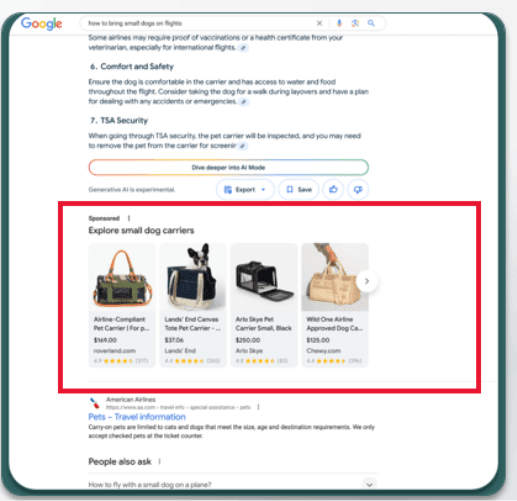
Ads can appear in three places around an AI Overview: above, below, or directly within the AI answer. Placement above and below is already available in all markets where AI Overviews are active, including Germany. Integration directly into the answer text is currently limited to English-language markets.
Important to understand: There is no separate opt-in for these placements. If you use the right campaign types and have relevant ads, you are automatically considered. Just as little can this placement be specifically excluded.
Google evaluates both the actual search query and the content of the AI-generated answer to decide whether an ad fits. This is a key difference from classic keyword logic: relevance is now measured in the context of the entire answer, not just the individual search term.
In Google AI Mode
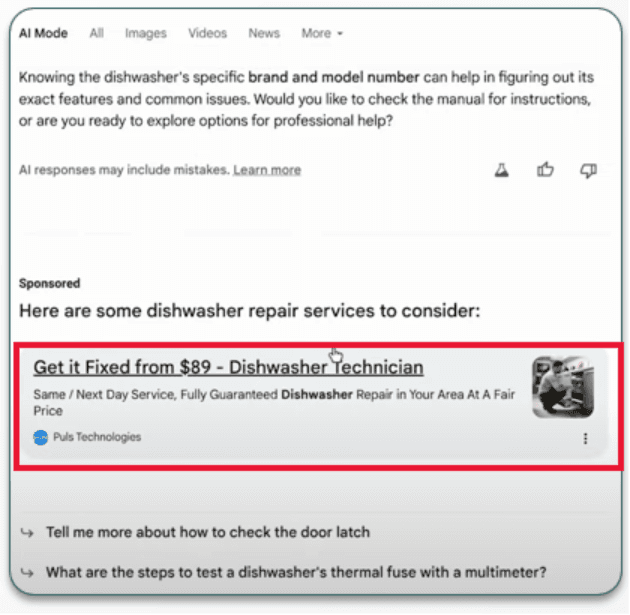
Tests are currently running here in the US. Ads appear there directly embedded in the conversational responses — not as separate blocks, but as an integrated part of the AI answer. This is an even tighter context than with AI Overviews. The global rollout, including for Germany, has been announced, but no specific date has been set yet.
Which campaign types are actually qualified?
This is the point where many advertisers get stuck. Not every campaign is automatically served in AI Overviews or AI Mode. Google has clearly defined which campaign types qualify:
Search Ads with Broad Match keywords
AI Max for Search
Performance Max (PMax)
Shopping Ads
Campaigns that work exclusively with Exact Match or Phrase Match are not qualified for these placements. This is a structural turning point: anyone who still relies on hyper-granular keyword structures today will, over time, lose impression share exactly at the moments when users are most ready to buy.
AI Max for Search: What is behind it and why is it so relevant right now?
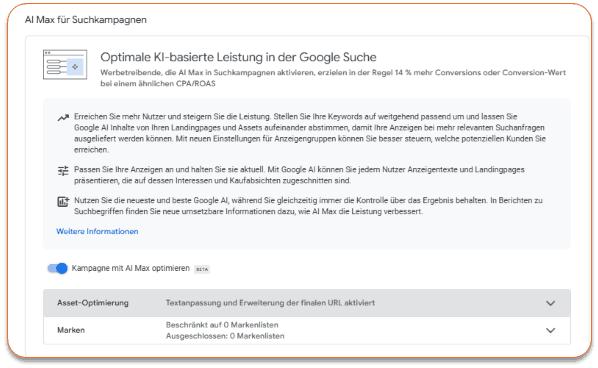
AI Max in Google Ads is not a new campaign type, but a feature package that can be integrated into existing search campaigns. Activated with one click in the campaign settings, it fundamentally changes the campaign logic.
Specifically, AI Max combines two approaches: first, the familiar Broad Match technology, which also matches search queries when the exact wording differs from the entered keywords. Second, so-called keywordless serving — similar to Dynamic Search Ads in the past, but much smarter. The AI independently recognizes which search queries an ad would be thematically relevant for, even without a stored keyword.
To this are added three other core features:
Automated text adaptation: Google generates new headlines and descriptions based on existing ad titles, descriptions, and landing page content — and selects in real time the combination that best fits the respective search query. Since February 2026, text guidelines have been available worldwide for all advertisers: there you can define which wording the AI may use and which it may not.
URL expansion: Users are automatically sent to the page on your website that best matches the search query — not necessarily the URL stored in the campaign. Certain pages can be excluded from the system.
Brand controls: Advertisers can define for which brands ads should appear and for which they should not. This is especially relevant for accounts that actively manage competitor or brand campaigns.
When does AI Max pay off — and when does it not (yet)?
AI Max shows its strengths above all in accounts that already have enough conversion data and target broad audiences. In e-commerce and with B2C products with high search volume, results are typically strongest.
In niche markets, with very explanation-heavy B2B products, or accounts with only a few daily conversions, the rollout should be more cautious. An A/B test with a 50/50 split between the existing campaign and the AI Max version is the most sensible first step here.
What applies in any case: the foundation has to be right. Clean conversion tracking, a data-driven attribution model, and clear conversion goals in the account are mandatory. Anyone activating AI Max without this foundation leaves the AI in charge without a map or compass.
Performance Max: Google’s preferred channel for AI Overviews
Performance Max is not new, but its role has shifted. Google increasingly sees PMax as the main format for serving in AI-driven surfaces. This is because PMax was built from the ground up for data-driven, cross-channel serving: it provides the AI with text, images, videos and audience signals, and leaves the optimal combination to it.
For advertisers, this means: Anyone who has already set up PMax properly and regularly maintains asset groups is well positioned for AI Overviews and the AI Mode. Anyone not yet using it should start now at the latest — with clear goals, enough assets and regular monitoring of search terms.
A good sign: PMax has become significantly more transparent in recent months. Negative keywords can now be added directly, and the channel reporting shows which channel (Search, YouTube, Display, Gmail, Discover) contributes what to performance — without additional scripts or workarounds.
What this means for campaign structure
Many accounts have grown historically: strict match type separation, single keyword ad groups, dozens of ad groups for minimal differences. That used to make sense to maintain control. Today, this structure works against the AI.
If you split data across too many campaigns, you give the algorithm too little material to learn from. Instead of quickly recognizing patterns and optimizing, it stalls.
The current approach that has proven effective in practice looks like this: topic-based campaigns with a manageable number of keywords, a combination of Exact and Broad Match, Smart Bidding as standard. Not maximally granular, but maximally data-dense.
That does not mean giving up control completely. Negative keywords, audience signals, text guidelines and regular review of search queries remain active levers.
The foundation: data quality decides
Here is a mistake that runs through almost all accounts: people discuss campaign types and features before the data foundation is right. But the rule is: Garbage in, garbage out. If you feed the AI bad data, you are only automating budget burn.
Server Side Tracking (SST) is the foundation. Classic browser tracking increasingly loses data due to ad blockers, cookie restrictions and iOS updates. Server Side Tracking bypasses these hurdles and, in practice, delivers at least 12% more usable data points — signals that Smart Bidding and AI Max urgently need for optimization.
In addition, advertisers should actively use the following data sources:
First-party data / customer lists: Existing and new customers can be evaluated differently in a targeted way via Customer Match lists. In the area of new customer acquisition, Smart Bidding can be prompted to weight new customers more heavily — with concrete effects on bid logic.
CRM data (offline conversions): Especially in B2B, it makes no sense to treat every lead equally. Anyone feeding back CRM data (e.g., from HubSpot or Salesforce) via offline conversions gives Google Ads the signal to distinguish between "poor" and "valuable" — and that is exactly the prerequisite for sustainably profitable growth.
Conclusion: Act now before the market does
Google Ads in 2026 is a data-driven system, not a manual tool. The question is no longer whether to use AI Max, AI Overviews and modern tracking structures — but when. Anyone who actively shapes the transformation now secures visibility at the moments that really matter.
As an experienced Google Ads agency, we guide you through exactly this process: from tracking infrastructure to campaign structure to AI Max and Performance Max. Get in touch now →
FAQ
Will my Google Ads be served automatically in AI Overviews?
Not automatically. Ads appear in AI Overviews when the ad matches both the search query and the content of the AI answer. Another requirement is that you use Broad Match, AI Max or Performance Max.
What does advertising in Google AI Mode cost more than classic Search Ads?
There is no separate pricing model for AI Mode ads. Google's auction system stays the same — placement is determined by relevance, quality score and bid.
Can I exclude my ads from AI Overviews?
No. Google currently does not offer a way to specifically disable these placements.
Do I get separate reporting for AI Overview ads?
Not yet in full. At present, ads in AI Overviews are counted as "Top Ads" and appear accordingly in standard reports. Dedicated segment reporting has been announced for the future, but is not yet available.
When will ads in Google AI Mode also come to Germany?
There is no official date yet. Ads in AI Mode are currently being tested in the US (as of March 2026). The international rollout has been announced.
Does AI Max also make sense for smaller accounts?
That depends on the individual case. In principle, AI Max needs a solid data foundation — meaning enough conversions, clean tracking and clear goals. For accounts with only a few daily conversions, we first recommend a controlled A/B test before the entire campaign is switched over.
Do I need to create new campaigns to appear in AI Overviews?
No. Existing campaigns qualify automatically, provided the right campaign types and match types are used.
What is the difference between AI Overviews and AI Mode?
AI Overviews are AI summaries within the normal Google search. AI Mode is a separate, conversational search interface for complex, multi-step queries — comparable to an AI chatbot directly in search.
Markus
Brook
Markus Beck is a Senior Online Marketing Manager and team lead for the entire PPC world at Internetwarriors. With his deep understanding of search engine algorithms and his extensive experience in online marketing, he helps clients improve their online presence and increase their revenue. At the same time, he is an important point of contact for his team and passionately shares his knowledge with the agency's trainees.
Comments on the post
no comments yet
Write a comment
Your email address will not be published. Required fields are marked with *
