

Blog Post
Search Engine Advertising (SEA)

Alexander
Frank
published on:

Contextual Advertising: How Context-Based Advertising Works
Table of Contents
In this article, we take a closer look at Contextual Advertising. We discuss the advantages of this form of advertising and highlight some providers and options that are particularly relevant for it.
If you missed the previous parts of the series, feel free to take a look there as well. We talk about why it is important to define the right company goals, and also about the advantages of setting up your online marketing channels more broadly.
Contextual Advertising
With stricter privacy laws and the resulting increasing restrictions on targeting, as well as the trend among many marketing platforms to deliver campaigns more automatically and more broadly, it is also becoming more important to reach the right target audience at the right time and thus avoid wasted reach as much as possible. But what options are there to engage your own target audience more effectively?
This is exactly where Contextual Advertising comes into play. With this form of ad placement, ads are not shown based on users' demographic data, preferences, and interests; instead, the algorithm primarily relies on the current context of the page - hence the name “Contextual” Advertising.
This means that websites are categorized based on various factors. These could, for example, include:
Product categories
Images
Text passages
Specific keywords in the body text.
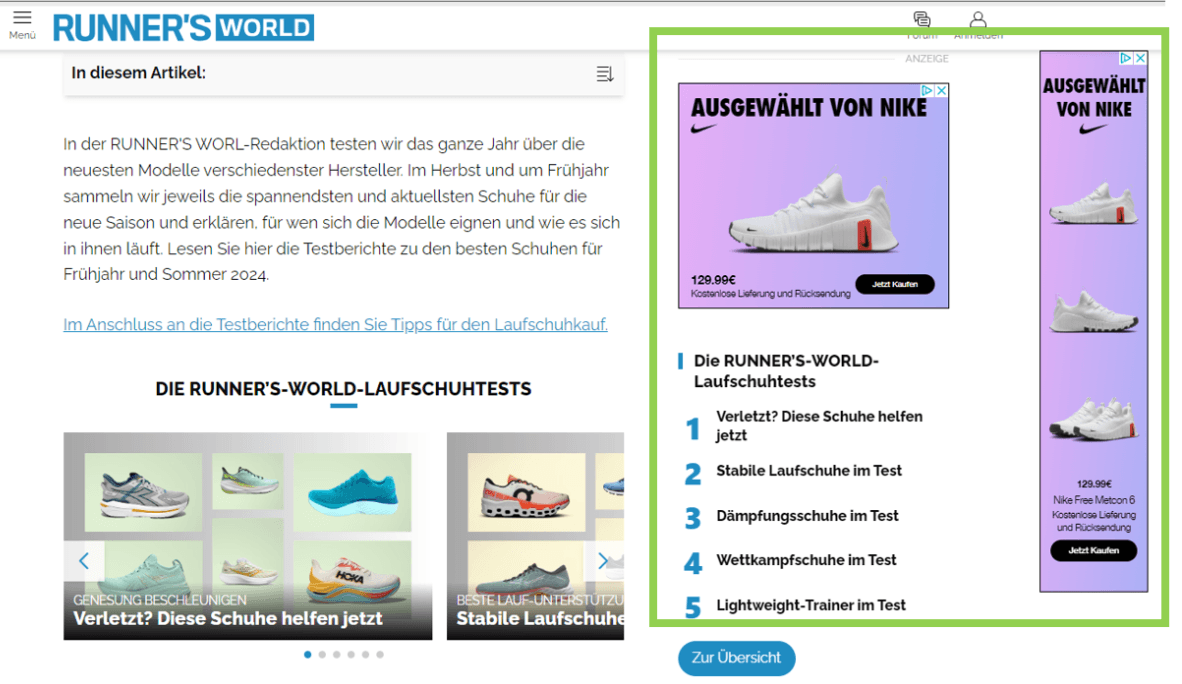
After successful categorization, ads that match the content of the page are then displayed. In the example above, we see an ad from NIKE that was placed in an article about the big running shoe test 2024. It can be assumed that people interested in this article also have a heightened interest in buying new running shoes in the near future. So there is a match between the served ad and purchase intent. Since the ad often fits almost seamlessly into the actual content of the website, this additionally reduces friction and increases coherence between advertising and content. Numerous studies already show that this has a positive effect on user perception and can increase willingness to buy.
As already mentioned, Contextual Advertising helps create as much relevance as possible for the target audience while interfering as little as possible with the user experience and, ideally, even improving it. In addition, it offers a good opportunity to position your own brand in a targeted and brand-safe way, thereby avoiding unnecessary wasted reach. Since it also completely forgoes the use of cookies, this form of advertising is significantly more future-proof and more robust against the ever-increasing restrictions on third-party cookies.
What is the right channel?
Unfortunately, the question of the right channel for Contextual Advertising cannot often be answered in general terms, as it depends on many factors. On the one hand, there are the classic providers, such as Google Ads or Microsoft Advertising, which enable contextual advertising. Here, targeting by keywords or specific placements is available. Experience shows, however, that Google interprets keywords very broadly, which can sometimes make this type of targeting quite imprecise. Advertising through placements works better. For example, a moving service could achieve above-average campaign results on sites dealing with apartment hunting, home buying, and similar topics.
Other providers have specialized almost exclusively in Contextual Advertising. The best known among them are probably Criteo and GumGum, which have developed more advanced algorithms for categorizing websites and can therefore usually ensure a significantly better match between content and ads. This is especially worthwhile when your product range is quite broad.
But what options are there if we offer a very “niche” service? Reddit, for example, offers the possibility of reaching people who have viewed or interacted with specific subreddits. Since Reddit is generally a platform with comparatively higher engagement rates, this can have a positive effect on ad perception and interaction. Although it is not possible to serve only specific subreddits here, there is still greater relevance for the target audience, given that interacting with a subreddit can already indicate a heightened interest.
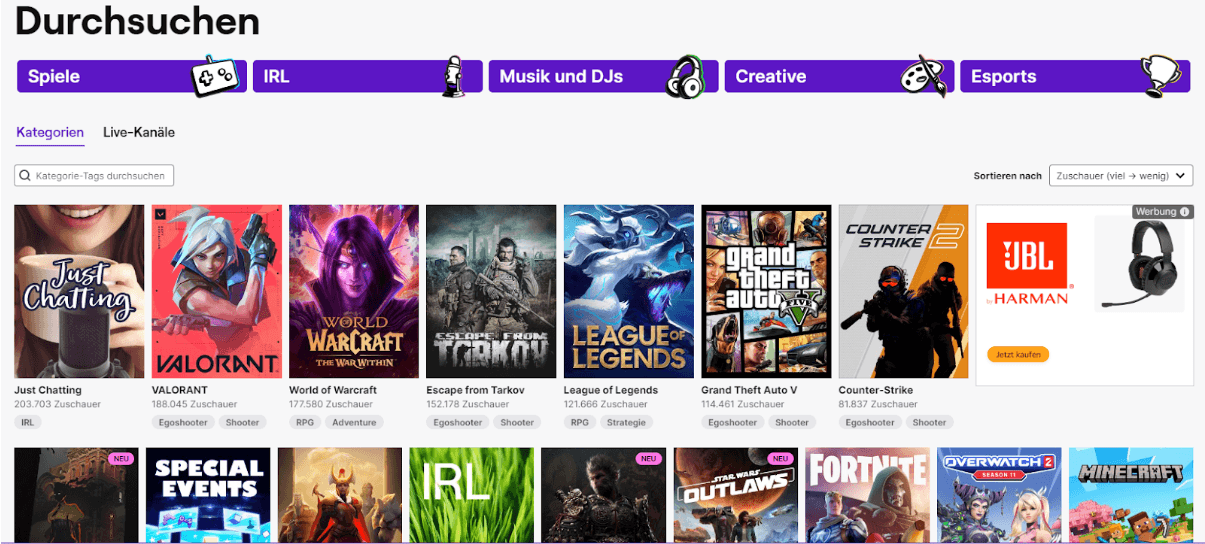
Companies that sell tech products or gaming accessories could also find Twitch to be a promising channel. Originally launched as a pure gaming platform, Twitch has since expanded its offering significantly, but for many tech enthusiasts the platform is still a very relevant channel in their entertainment routine. And who wouldn’t want a setup like their favorite streamer’s?
Often unfairly underestimated, (Digital) Out of Home advertising, also known as (D)OOH, is still often treated rather casually. What used to be a must-have in every company’s marketing mix in the form of poster advertising has lost a lot of popularity since the introduction of digital marketing, but has been on the rise again in recent years.
Gradually, more and more companies are recognizing the benefits of well-placed outdoor advertising, especially since the introduction of digital screens, which open up a whole new range of possibilities. Suddenly, it becomes possible to run highly targeted ads in a very dynamic way at specific locations or at relevant times of day, reaching exactly the right audience at that moment. That this approach can work was impressively demonstrated by McDonalds a few years ago.
Thank you for your attention! Hopefully this was insightful, and you were able to take something useful away from it! In the fourth part of our mini-series, we will take a closer look at the topic of competitive analysis.
Did we forget anything important, or do you still have questions about the topic? Then feel free to write them in the comments!
If you'd like to get in touch with us directly, feel free to take a look at our contact form. We'd be happy to help you place your brand even more effectively with Contextual Advertising so you can get the maximum out of your online marketing strategy - simple and without obligation!
Alexander
Frank
Alexander discovered his passion for online marketing in 2019. Since then, he has been intensely involved with all topics related to PPC, social media, and lead generation. His keen eye for numbers and the latest trends and developments also allows him to make well-informed and data-driven decisions that especially benefit his clients. Alexander is always open to lively discussions on the topic of online marketing.
Comments on the post
no comments yet
Write a comment
Your email address will not be published. Required fields are marked with *
