
DE
EN
All Categories
SEO
SEA
Social Media
Web Analytics
Growth Marketing
Artificial Intelligence
Success Stories
Inside internetwarriors
Agentic Commerce & Agentic Shopping 2026: Why AI Shopping Agents are Rewriting Commerce
Mar 30, 2026

Moritz
Klussmann
Category:
Artificial Intelligence

The world of online marketing is spinning faster today than ever before. While we've been fighting for clicks and conversions at internetwarriors since 2001, we're currently experiencing the most radical upheaval in our history. The trigger: Agentic Commerce . We are transitioning from mere information search to task-oriented execution. Today, a user no longer just asks for products; they instruct a AI shopping agent to autonomously handle the entire purchase process. In this article, I'll show you why the failure of OpenAI's "Instant Checkout" is not the end of the hype, but the starting point for a new technical infrastructure that you need to know as a retailer now. The OpenAI Pivot: From Shopping Cart to Discovery Platform In March 2026, OpenAI ended its "Instant Checkout," prompting one of the most discussed debates in e-commerce. Failure or strategy? We reveal what is really behind the pivot and what it means for retailers. What was Instant Checkout? In September 2025, OpenAI launched the Agentic Commerce Protocol (ACP) with Stripe, bringing "Instant Checkout" to ChatGPT. The vision: users find a product in the chat and buy it directly without leaving the platform. Etsy, Walmart, and Shopify were the first partners – Shopify president Harley Finkelstein called it a "new frontier" for online retail. Why did direct checkout fail? In early March 2026, OpenAI pulled the plug. What critics dismiss as the failure of Agentic Commerce is, upon closer inspection, a strategic pivot from which we can learn a lot. OpenAI underestimated the immense complexity of global commerce. Three critical factors made direct purchase completion in the chatbot impossible: The three technical killers: 1. Lack of real-time synchronization: The inventory data of millions of retailers could not be reconciled at the required speed – outdated prices and stock immediately shattered user trust. 2. Compliance hurdles: Systems were missing for automated calculation of regional taxes (in the US alone, thousands of local tax jurisdictions) and for compliance with local laws like the Price Indication Regulation (PAngV) in Europe. 3. Fraud prevention: Agent-based transactions require completely new security architectures to prevent automated abuse. Another factor that is rarely mentioned in reporting: the withdrawal comes immediately after Amazon's $50 billion investment in OpenAI. Amazon controls 40 percent of US e-commerce and is building its own AI shopping tool with Rufus . Whether coincidence or strategic calculus – the timing is remarkable. 🟢 Update: March 25, 2026 OpenAI has simultaneously launched a completely new shopping experience with the checkout withdrawal: visual product browsing, side-by-side price comparisons, and image upload for product searches. Seven major US retailers – including Target, Sephora, Nordstrom, and Best Buy – are already live via ACP. Walmart operates a dedicated In-ChatGPT app with loyalty integration and native Walmart payment. This is not a withdrawal – this is a pivot. The new Warrior reality: OpenAI is primarily focusing on Product Discovery through ACP. The checkout returns to the retailer – but the decision of which retailer gets the order is increasingly made by the agent. Agentic Shopping works – just not yet in the West Anyone who believes that the failure of Instant Checkout proves Agentic Shopping is just hype is making a categorical mistake. Alibaba's Qwen-App is already completing food orders, travel bookings, and product purchases entirely in a single conversation – and at scale. The decisive difference: Alibaba owns the AI model, the marketplace, the payment infrastructure, and the logistics all from one source. OpenAI attempted to replicate the same without owning this stack. It was structurally doomed to fail. Google UCP: The new operating system of commerce While OpenAI is correcting, Google is creating facts with the Universal Commerce Protocol (UCP) . Unlike closed systems, UCP is an open standard that allows AI agents to communicate directly with merchants' backends – from discovery through checkout to post-purchase management. For you as a retailer, this means: Your Google Merchant Center (GMC) becomes the critical interface for AI in e-commerce . Google has introduced new attributes to make your products machine-readable: · product_faq – questions and answers directly extractable from the feed for AI agents · product_use_cases – specific scenarios in which your product offers the best solution · native_commerce – a switch signaling whether your product is ready for autonomous checkout The advantage for Germany: Google Merchant Center and Google AI Mode are already active in DACH. Retailers who optimize their feed now secure a real time advantage. SEO alone is no longer enough: Welcome to the era of GEO Our analysis of German e-commerce shops shows a clear picture: A top ranking in traditional search does not guarantee visibility in AI responses. Over 60 percent of URLs linked in AI overviews do not rank in the top 50 of traditional Google search. The rules have changed. This is where Generative Engine Optimization (GEO) comes into play – the discipline of optimizing content not for human clicks but for extraction by AI systems. Feature Classic SEO Generative Engine Optimization (GEO) Target Group Human users AI agents & Large Language Models Primary KPI Click-through rate (CTR) & rankings Mention rate & citation authority Content Logic Keywords & readability Semantic depth & fact density Technical Basis Crawlability & loading speed Structured data & API connectivity Success Measurement Google Search Console (rankings) Brand mentions in LLM responses Warriors Insight: In Germany, AI overviews already appear in 33 percent of all search queries. If you don't opt for GEO now, you will become invisible to the "agent customer" before they even arrive at a website. Strategic Warriors Knowledge: Brand power and the 95:5 rule In the Agentic Web, it's not just the keyword that counts anymore, but the authority of your brand as an "entity" – how a Large Language Model knows, categorizes, and recommends your brand. The 95:5 rule in B2B Only 5 percent of your target group is currently ready to buy (In-Market). The remaining 95 percent need to be reached through thought leadership and trust building in the long term. AI agents prefer brands that are anchored as expert entities in the knowledge graphs of Large Language Models. Those who only optimize for transactional keywords lose the majority of their potential customers before they are ready to buy. Preferred Sources: The Democratization of the Algorithm Google now allows users to actively mark their preferred sources. These "Preferred Sources" receive a permanent visibility boost – regardless of algorithm updates. This fundamentally changes the game: Trust is the new currency. You must persuade users to actively choose your brand as trustworthy – not just ranking well. Checklist: Make your shop agent-ready now For German retailers, the groundwork begins today, even though fully autonomous Agentic Shopping in DACH is still 12–24 months away. Product data excellence in Merchant Center: Maintain GTINs, precise attributes, and new UCP fields (product_faq, product_use_cases). A flawed feed is the largest KI visibility obstacle you can control yourself. Technical infrastructure for AI agents: Implement an llms.txt file (the robots.txt for AI crawlers) and consistently use JSON-LD – specifically the Product, FAQPage, and Article schemas. These are the signals that AI agents prioritize. API-First strategy: Ensure that inventories and prices can be retrieved in milliseconds via interfaces. Outdated data was the main reason for OpenAI's checkout failure – and the same mistake will be costly for retailers once agents actively book. Semantic enrichment with the Query Fan-Out Principle: Answer the questions an AI asks when comparing products on behalf of a customer: For which use cases is the product optimal? What alternatives are there? What are common purchase barriers? This depth distinguishes cited from ignored content. GEO strategy and build brand authority: Ensure that your shop is perceived as an expert entity in relevant categories – in ChatGPT, Perplexity, and Google AI Mode. More on this in our GEO audit → Secure DACH compliance early: PAngV and GDPR apply to AI-mediated purchases as well. Price reductions must disclose the lowest price of the last 30 days as a reference – and this must be machine-readable. Clarify this early with your legal advisor. Conclusion: Become a leader of the new era Agentic Commerce is no longer a science fiction scenario – it's the technological reality of today, still in development, but unstoppable. What OpenAI buried with Instant Checkout is a specific business model: the chatbot as a transaction facilitator between retailer and customer. What lives on – and is accelerating – is the underlying logic: AI shopping agents take over discovery, filter options, prepare purchase decisions. This already happens, daily, for millions of users. The question for retailers is no longer whether , but if they are visible when the agent decides . The companies that are ahead in two years are not the ones with the biggest budget. They are the ones with the best data, the strongest GEO presence, and the clearest understanding of how Artificial Intelligence in e-commerce is used as a lever rather than a threat. Frequently Asked Questions about Agentic Commerce What is the difference between Agentic Commerce and traditional e-commerce? Traditional e-commerce follows the Search & Click principle: The user actively searches, compares manually, and buys themselves. Agentic Commerce follows the Ask & Done principle: An AI shopping agent takes over product search, price comparison, availability check, and – if authorized – the purchase completion fully autonomously. What is Agentic Shopping? Agentic Shopping is the practical manifestation of Agentic Commerce: The user formulates a concrete goal – such as "Order printer cartridge XYZ at the best price by tomorrow" – and an AI shopping agent carries out all steps independently: search, comparison, purchase. Why did OpenAI discontinue Instant Checkout? OpenAI faced three technical hurdles: lack of real-time inventory synchronization across millions of retailers, no infrastructure for tax collection, and no fraud prevention for agent-based transactions. OpenAI is now pivoting to Product Discovery – the checkout remains with the retailer. What is the difference between SEO and GEO? SEO (Search Engine Optimization) optimizes content for the Google search algorithm and for human users – the goal is the click. GEO (Generative Engine Optimization) optimizes for AI systems and Large Language Models that extract content and output as a direct answer – without the user clicking on a website. Both disciplines complement each other and build on each other. Is my shop legally safe for AI purchases in Germany? In the DACH region, you must pay particular attention to GDPR and PAngV (Price Indication Regulation). Price reductions must always disclose the lowest price of the last 30 days as a reference – also machine-readable for AI agents. Clarify this early with your legal advisor before you register for Agentic Commerce protocols. When is Agentic Commerce coming to Germany? ACP and the new ChatGPT shopping hub are currently US-first. However, Google Merchant Center and Google AI Mode are already active in DACH – AI overviews already appear in 33 percent of all German search queries. Experts predict that AI agents could reach a market share of 20-30 percent in European e-commerce in two to three years. The preparation starts now. Is your shop ready for AI shopping agents? We analyze your GEO visibility, your product feed, and show you where you are currently invisible to AI agents – and how you can change that. Request GEO analysis now → Sources & further links: CNBC, March 2026: “OpenAI revamps shopping experience in ChatGPT after struggling with Instant Checkout” – cnbc.com Forrester Research: ConsumerVoices Market Research Survey, March 2026 Gartner: Bob Hetu, Analyst, gegenüber CNBC, March 2026 The Information, March 2026: First report on the Instant Checkout withdrawal OpenAI Blog, March 2026: Official statement on Instant Checkout and new shopping experience Google: Universal Commerce Protocol – Announcement January 2026
Budget Killers in Your Account: Quickly Identify Unprofitable Campaigns and Optimize Google Ads
Mar 23, 2026

Karina
Nikolova
Category:
Search Engine Advertising
One of the main differences between SEA and SEO is time. While SEO measures need time to show growth and performance improvements, paid campaigns require quick actions as any delay costs money. Even if your campaigns appear to be set up correctly at first glance, you can’t rely on hope and a good gut feeling if they aren’t delivering profitable results. In the following article, I will demonstrate three signs that help you recognize unprofitable campaigns at first glance and what could be behind them. Additionally, I will show you specifically how you should optimize your Google Ads campaigns in these cases. However, before we get started, there are three points that can provide a quick explanation for poor performance. If your campaigns still perform poorly despite these factors, you should choose a different approach to improve the figures and reduce Google Ads CPCs . Your tracking isn't working It’s a commonly underestimated problem: Unexpected changes on your website, such as the creation of new landing pages or migration to other data platforms, can disrupt your tracking. This can result in your campaigns showing 0 conversions. Ideally, the Google Ads managers are informed in advance about such planned changes, but in reality, that’s not always the case. An example: Once, a client of mine removed a CPA button that we had measured as a soft conversion goal. My campaigns began to struggle significantly, and I had to quickly find a solution to reduce Google Ads costs. In the end, we couldn’t see any conversions because there was literally no conversion action on the website that could trigger conversions in Google Ads. Tip: Regularly check if your tracking is functioning correctly. Without working tracking, you cannot optimize your Google Ads. It’s still possible for conversions to be generated, but they won't appear in Google Ads, only in the backend. Once the tracking problems are resolved, your campaign might perform well again. Your campaign is still in the learning phase Paid campaigns need patience, even though we all want to see good results as quickly as possible. That would prove our expertise and help us further optimize and scale the Google Ads campaigns. However, new campaigns cannot always work wonders, as the algorithm needs time to learn and improve performance. The official learning phase usually lasts up to four weeks. Depending on the business model, this process can also be shorter because the quicker the campaign generates conversions, the faster the algorithm learns. However, this development is not always guaranteed. For instance, the average customer journey in the B2B sector generally takes more time. Additionally, it often includes several touchpoints before achieving the desired result. Tip: Be patient during the learning phase. Your main goal is not clear Unrealistic expectations usually lead to disappointments - not only in life but also in Google Ads. If marketing goals are vague, clear results will not follow either. If the goals are clear, but you don’t know which campaign types are suitable for them, the figures will also disappoint. For example, if you work with display or video ads, you should not automatically expect to receive many high-quality leads. Not because your setup is wrong, but because these campaign types pursue different goals. They are meant to increase the awareness of your product and cover the early phase of the customer journey. Moreover, the ad formats are tailored to this goal - think of skippable ads on YouTube. They are there to promote your brand and convey a message. However, it is not realistic to expect good leads from them, as they are likely to be skipped, with the customer taking no further action. If your shopping campaigns don’t deliver results for weeks, this is at least alarming. Tip: Define clear objectives for each phase of the funnel and choose the appropriate campaign types. Only then can you effectively optimize your Google Ads campaigns. There is a Budget-Killer in the House But let's go back to the three clear signs that a budget-killer is present in your account: Campaigns with traffic but no conversions Rising CPAs Decreasing ROAS If your goal is conversions and you see none or increasingly fewer, there’s a problem. Especially if your tracking is functioning and the learning phase is complete. If the campaign still does not deliver the desired conversions, this impacts not only your KPIs but also the performance of your automated bidding strategies. For instance, if you optimize for tCPA or tROAS, declining conversions will lead to a higher CPA, a lower ROAS, and overall restrictions on bidding strategies. Here is a list of factors that could explain the decline in conversions you are observing. These include: Landing page – Any change that worsens the user experience can negatively influence the conversion rate as well as the bounce rate. Competition - Especially in e-commerce, competition through lower prices can affect the number of conversions as well as the conversion rate. Seasonality - If your business experiences significant declines during certain periods, you should adjust your marketing strategy accordingly. Irrelevant Traffic - Ensure that your ads don’t appear for irrelevant search queries to reduce Google Ads costs for poor traffic. This often helps to lower Google Ads CPC. Faulty Targeting – A reasonable campaign setup is vital in Google Ads. However, despite optimal campaign setups, certain target groups or keywords may perform less well than expected. For this reason, you should quickly optimize the targeting of your Google Ads campaigns if the desired results are not there. Google Ads campaigns are not static. What works well today can perform poorly tomorrow. As a marketing manager, you should thoroughly understand the business model and goals, select the appropriate campaign types, set KPIs, and set realistic expectations. The rest lies in flexible and smart Google Ads optimization. Additionally, your task extends beyond Google Ads as overall performance is influenced by many other factors described above. For example, dramatic political or economic developments can have the same negative impact as a poorly optimized campaign. Your Google Ads expertise should go hand in hand with thorough market analysis so that you can see the bigger picture and take the right actions. If you need assistance with this or if you want to scale your existing campaigns, our SEA team is happy to advise you. Contact us now!
Identify and Properly Analyze AI Traffic in Google Analytics
Mar 9, 2026

Nadine
Wolff
Category:
SEO
Since Large Language Models (LLMs for short) have become a part of everyday life and users increasingly utilize AI tools like ChatGPT, Gemini, Claude, or Perplexity, a completely new source of traffic is emerging. For website operators and marketing managers, the question arises of how many users actually reach their website through links and recommendations of these LLMs and what portion this AI-generated traffic accounts for in total visitor numbers. This traffic, let's call it “AI Traffic”, is not automatically displayed in Google Analytics. In this article, I'll show you how to find, measure, and evaluate AI Traffic in GA4. You will also learn what conclusions you can draw from it for your action planning and why AI visibility will be just as relevant as traditional search engine rankings in the future. What exactly is AI Traffic and how is it composed? The term AI Traffic refers to all page visits that originate from AI systems and generative search engines. Here are some examples of where the traffic could come from: Traffic from ChatGPT/GPT Search Traffic from Perplexity Traffic from AI-integrated browsers (e.g., Microsoft Edge with the integrated Copilot) Copied links that users click on from AI answers AI Traffic can actively occur when users click on links from an AI answer. Additionally, there is passive traffic when AI systems crawl pages to prepare content for their models. Recognizing AI Traffic in GA4: The most important methods 1. Identifying referrers (e.g., ChatGPT Traffic) When a user clicks a link from an AI answer, the browser automatically sends a so-called referrer. This information indicates which page the user is coming from. In GA4, this information appears under “new generated traffic” as “Referral”, for example, with the source perplexity or claude. Figure 1: AI Traffic via a Referrer 2. UTM Tracking ChatGPT has been automatically appending “?utm_source=chatgpt.com” to links in its answers for a while. This means that this AI Traffic appears in Google Analytics not as a Referral but as a separate source marked with UTM—making it easier and cleaner to identify than pure Referral traffic. However, Perplexity or other AI systems do not necessarily do this. This traffic is often only recognizable through the referrer. Making AI Traffic visible in GA4 - Explorative data analysis The exploratory data analysis in GA4 offers the most flexible option to evaluate AI Traffic specifically. Unlike standard reports, you can freely combine your own dimensions, filters, and segments here. To do this, create a new empty data analysis, add a dimension, and optionally one or more metrics: Dimension --> Session – Source/Medium Metrics --> Sessions Figure 2: Explorative Data Analysis To see only traffic from AI platforms, now create a filter with a regular expression (Regex). This filter ensures that only sessions whose source is one of the mentioned AI platforms are displayed. Figure 3: Example of a Regex filtering various AI systems The result shows you – as in the example above – a detailed table by source and medium. It's noted that ChatGPT appears in two variants: once as “chatgpt.com / referral” and once with UTM marking as “chatgpt.com / (not set)”. This is because ChatGPT doesn't consistently append the UTM parameter to every link. Therefore, it's advisable to consider both entries together in evaluations. What you see in GA4 – and what it means Once you've isolated AI Traffic in GA4, you essentially have three different metrics available: Size & Development: How many sessions arise from AI platforms? How does this develop over time? A growing value indicates that your content is increasingly being recommended as a source by LLMs. This is, in turn, a direct signal of your AI visibility. Links: Which pages are being linked to? Which of your subpages appear as landing pages? This metric shows you which content LLMs deem relevant enough to recommend. These are your strongest pieces of content in the AI context. User behavior: The duration, bounce rate, and engagement rate of AI traffic compared to other channels provide insights into whether the linked content also meets user expectations. High bounce rates can indicate that the linked page doesn’t deliver what the AI answer promised. What you can deduce from the AI Traffic in GA4 The landing pages (with AI Traffic) are your direct feedback on which content LLMs deem worthy of citing. Look into what these pages have in common: Are they more explanatory guide articles? Detailed instructions? Definitions? These patterns show you which content format LLMs prefer – and you can specifically use that for new content! Identify content gaps Get an overview of which topics your AI traffic comes from and compare them with your entire content offering. Are there topics you get traffic for but have few or thin content pieces? These are your content gaps – areas where LLMs already see you as a relevant source, but you haven't yet realized the full potential. Optimize content specifically for LLMs (GEO) Generative Engine Optimization, or GEO for short, is the counterpart to classic SEO – but for AI systems. Specifically, it's about structuring content so that LLMs can easily process and cite it. This includes clear, precise answers to specific questions, well-structured sections with clear headings, and a trustworthy, source-based language. Pages that already receive AI traffic are your best starting point – they obviously work well, and targeted optimization can further increase their visibility in LLM answers. Conclusion: AI Traffic will be a strategic success factor Recognizing AI Traffic in GA4 is possible, but only with the right methods. Those who understand AI visibility and track it cleanly receive valuable insights into the relevance and sustainability of their own content. For companies, this means a new responsibility in content creation and technical optimization. If you need support with tracking, SEO/GEO, or AI content strategy, feel free to contact us. Our team helps you make AI visibility measurable and align your strategies based on data. Get in touch now! FAQ What is the difference between AI Traffic and Bot Traffic? Bot Traffic comes from traditional crawlers, while AI Traffic results from AI systems and real users in AI interfaces. Is AI Traffic automatically marked in GA4? Not entirely. Some systems are recognized, but much needs to be filtered out through segments or referrers. Which AI platforms should I track in GA4? The most important sources currently are ChatGPT, Perplexity, Claude, Gemini, and Microsoft Copilot. ChatGPT is usually the largest source because it automatically sets UTM parameters and is therefore the most easily identifiable in GA4. Is it worth evaluating AI Traffic if the volume is still low? A definite yes! Starting to measure and understand AI Traffic now gives you a head start before this channel becomes standard in the industry. Just like SEO in the early 2000s: starting early yields long-term benefits.
Optimizing content specifically for prompts using the Query Fan-Out principle
Feb 13, 2026

Julien
Moritz
Category:
SEO
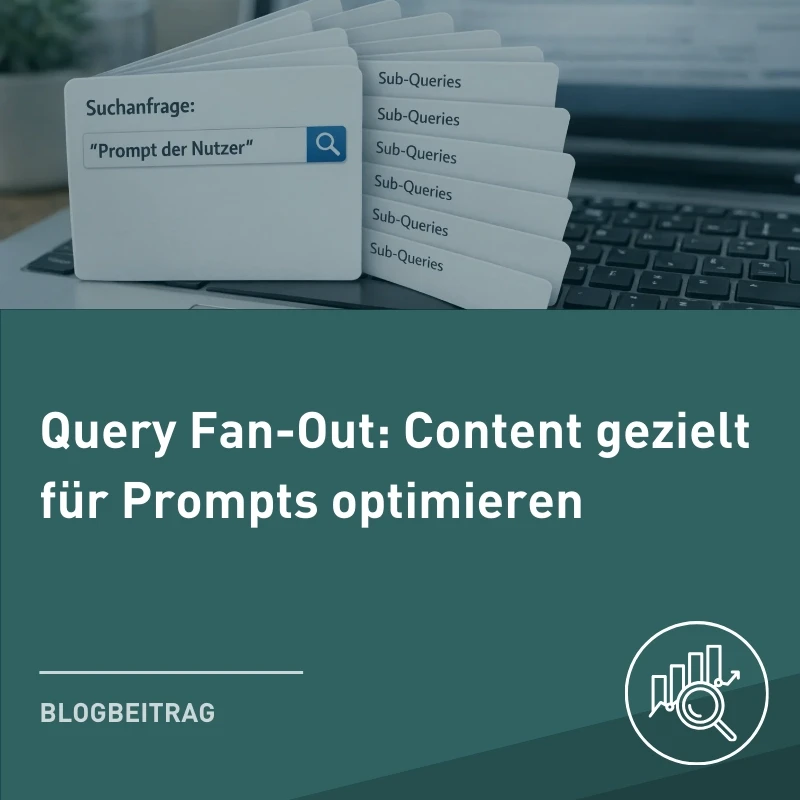
Large Language Models (LLMs) like ChatGPT, Claude, or Gemini are fundamentally changing how content is found, evaluated, and utilized. Visibility is no longer solely achieved through traditional search queries but increasingly through prompts that users input into AI systems. A frequently mentioned principle for optimizing one's content in this regard is the so-called Query Fan-Out principle. But what does this specifically mean for your content? In this article, you'll learn how ChatGPT & Co. decompose inquiries in the background and how you can structure your content so that it is relevant, comprehensible, and quotable for LLMs. Key Points at a Glance LLMs generate multiple search queries simultaneously from a prompt (Query Fan-Out). These queries often run parallel in both German and English. Content is evaluated based on topics, entities, terms, and synonyms. In just a few steps, you can analyze which queries ChatGPT uses yourself. We show you how here. Concrete requirements for your content structure can be derived from this. What is Query Fan-Out? Query Fan-Out describes the process where an LLM generates multiple sub-queries from a single prompt. A prompt is thus unfolded into multiple queries. This multitude of queries is called Fan-Out because a query fans out like a fan into many individual queries. In the background, the system sends various search queries simultaneously to the index (e.g., Bing or Google). It is only from the synthesis of selected results that the AI compiles the final answer. We will examine how you can easily investigate this yourself for a prompt in a step-by-step guide. Why is Query Fan-Out so important? Your content aims to be found. However, Large Language Models are increasingly used today. This changes the requirements for your content so that it continues to appear in Google search results but is also used by as many LLMs as possible for answer generation. The better your content matches the generated queries, the more likely it is to be used by LLMs as a source. Step-by-Step Guide: What Queries are Created by ChatGPT? With a sample prompt in ChatGPT, one can clearly see how these queries appear. You can easily recreate this for your own prompts and optimize your content accordingly. Step 1: Open Developer Tools Open ChatGPT in the browser Enter a prompt and submit it Right-click somewhere in the interface Select “Inspect” Step 2: Filter Network Tab & Search for Chat-ID Switch to the “Network” tab Filter by Fetch / XHR Copy the chat-ID from the last part of the URL Paste it into the search field Reload the page Step 3: Select Network Request Click on the network request with the chat-ID in the name Switch to the “Response” tab Step 4: Find Queries Search for the term “queries” Now you see specific search queries that ChatGPT uses for web search Mostly in German and English Step 5: Evaluation of Requests The following prompt was entered: “I want to mount my TV on the wall. What is the recommended seat distance for a 65-inch OLED TV? I'm looking for a high-quality and safe full-motion wall mount. Compare current models and suggest the best ones!” ChatGPT utilizes two sub-queries in the web search to find suitable content: 1. DE: “ pivotable wall mount 65 inch TV recommendations wall mount TV 65" pivotable” 1. EN: “ best full motion TV wall mount for 65 inch TVs review high quality” 2. DE: “Recommended seat distance 65 inch TV distance OLED TV seat distance” 2. EN: “what is recommended viewing distance for 65 inch TV” From these queries, ChatGPT searches for appropriate sources and subsequently generates the following answer, with source indication: Now you should carefully look at the queries and also the sources used. What types of content are cited? The example used clearly shows that there is an information cluster and a comparison cluster. Different sources are used for these clusters. To be optimally found for this prompt, you need an informative article on the topic “Recommended viewing distance to TV” . From ChatGPT's query, it can be derived that the subtopics: TV size in inches and display types (e.g., OLED) should be addressed. Additionally, the synonym TV viewing distance should appear in the content, preferably in an H2. The product selection comes from other articles. Thus, your products should appear in as many comparison articles (on external websites) on the topic “Best TV wall mount” as possible, so they can be presented here. Additionally, ChatGPT accesses manufacturer websites. With your own content on product and category pages , you can influence the answers of LLMs. Clearly consider what makes your product or service unique and how you stand out from competitors. Because exactly these advantages can bring users from the AI chat to your own website. Additionally, it can also be beneficial to publish your own comparison articles . Naturally, you should strongly present your own brand within these, but also mention competitors and their advantages. LLMs recognize that the information density in the English-speaking network is generally higher. Translating your own content can therefore be a great advantage and ensure greater visibility with ChatGPT and others. Strategies for Optimization for the Query Fan-Out Principle What does the Query Fan-Out principle mean for your own content? You need an SEO strategy that works even in the age of generative AI. For this, we have developed five tips that you can directly implement. 1. Comprehensive Topic Clusters Instead of Keyword Focus The Google Query Fan-Out behavior shows the desire to capture topics in their entirety. LLMs divide a prompt into multiple thematic clusters with varying intent, such as information, comparison, or product queries. Informative content should be built comprehensively . Content should not only answer "What" questions but also "How", "Why", and "What are the alternatives?" Use targeted synonyms and related entities. If you write about “TV wall mounts”, terms like "VESA", "Pivotable", and "OLED television" should be included. 2. Direct Answers Write precise definitions and direct answers to user questions at the beginning of your paragraphs . An AI looking for a quick answer to a sub-query will more likely cite text that provides a clear answer: “The ideal viewing distance for a 65-inch OLED TV is about 2.50 to 2.80 meters.” Avoid unnecessary filler sentences just to include keywords. Further detailed and extensive information considering secondary keywords can be placed afterward. 3. Structured Data LLMs work resource-efficiently and love structure. When an AI conducts a price comparison or technical analysis, it preferably accesses data marked up with Schema.org . Use structured data in JSON-LD format to make products, FAQs, and reviews machine-readable. 4. Internationally Visible Content Often, Large Language Models automatically generate English-language queries, even when prompts are written in German. Therefore, building internationally visible content is increasingly important, even if your target audience is German-speaking. You should provide your core content in English as well. 5. Building "External" Visibility Transactional inquiries like “Best price-performance TV wall mount 2026” are answered using comparison content and user reviews . To be visible with your brand in LLMs, you need to build recognition. Content partnerships with magazines or collaborations with influencers who publish independent reports and product comparisons are a strong lever. It’s not just about classic backlinks that provide authority but also about mentions of the brand in a relevant context on as many platforms as possible. This can be articles from magazines, competitors, online retailers as well as UGC content on YouTube, Reddit, etc. Conclusion: SEO & GEO United Query Fan-Out reveals how LLMs find and evaluate content. By structuring your content to answer multiple questions simultaneously, being thematically complete, and considering relevant entities as well as synonyms, you optimize not only for traditional search engines but deliberately for AI systems. This is where a new form of visibility is currently being created. Optimization for the Query Fan-Out principle is no longer a "nice-to-have", but the new foundation for digital visibility. By understanding how LLMs deconstruct queries, you can create content that is not only found but also cited as a trustworthy source. If you need assistance or want to optimize your content specifically for LLMs, our SEO / GEO team can gladly advise you. Contact us now!
ChatGPT for Ad Copy: Turning Strategic Decisions into Measurable Performance
Jan 30, 2026

Yasser
Teilab
Category:
Search Engine Advertising

Good ads rarely emerge from a sudden spark of inspiration or pure creative chaos. In the world of performance marketing , they are the result of a rigorous process: clear decisions, sound hypotheses, and the relentless willingness to test them in the market against the reality of data. At this point, ChatGPT for ad copy becomes either a highly effective precision tool or a mere text production machine that just creates digital noise. AI does not determine the success of a campaign; it merely exposes how structured your marketing thinking really is. In this guide, you'll learn how to transform ChatGPT from a "writing aid" into a strategic performance tool that elevates your Google Ads and Meta Ads to a new level. This strategic approach is exactly what we implement at internetwarriors daily in Google Ads and Meta Ads – data-driven, test-based, and scalable. Book an appointment with us now! The Paradox of AI Text Production: Why More Content Doesn't Automatically Mean More Success Ad copy has always been a test problem. Marketers formulate assumptions, launch them, and let the numbers decide. The real limit was never in tracking or analysis, but in operational capacity. Every new ad, every new "angle" took time in conception, coordination, and creation. ChatGPT has shattered this limit. A new entry or an alternative tonality can be developed in seconds today. But here's the trap: those who misuse ChatGPT only scale mediocrity. The shift in everyday work: • Previously: The bottleneck was writing (copywriting). • Today: The bottleneck is thinking (strategy & psychology). ChatGPT doesn't think strategically. It doesn't decide which message is relevant in the market. If ads didn't work before, ChatGPT won't solve this problem – it will only accelerate failure by producing more bad ads in a shorter time. Preparation: Ad Copy Starts Not in the Prompt but in the Focus Much of what is perceived as "generic" AI text is not due to the model but to weak briefing. Before you type the first prompt into the chat window, one central question must be answered: Why should the audience click right now? The Psychology of the Click People don't click on ads because a product is "innovative" or "market-leading." They click because they expect a transformation. ChatGPT is excellent at translating a well-defined idea into variations, but it is unsuitable for finding that idea itself. What you need to define before using ChatGPT: The specific pain point: What exact problem keeps your customer awake at night? (Not: "They need software," but: "They're afraid of data loss"). The functional benefit: What improves immediately? (Time savings, risk reduction, status gain). Objection handling: What thought prevents the customer from clicking? ("Too expensive," "Too complicated," "No time to switch") Thinking in "Angles": The Framework for High-Converting Ads Those who use ChatGPT for ad copy should stop asking for "texts" and start thinking in angles . An angle is a conscious decision for a psychological perspective. Angle Type Focus Example (Project Management Tool) Efficiency Time savings & focus "Gain back 5 hours per week." Safety Error avoidance & control "Never miss a deadline again." Simplicity Low barrier & usability "Set up in 2 minutes. No training required." Social Proof Trust & benchmarking "Why 500+ agencies have switched." The Rule: An angle always corresponds to exactly one hypothesis. Only when the angle is set do we let ChatGPT formulate the variations. Defining, testing, and systematically scaling angles is not a creative but a strategic problem. If you want to know how we translate such hypotheses into high-performing campaigns, find out more about our approach now! ChatGPT for Google Ads: Mastering Responsive Search Ads (RSA) In Google Ads, AI plays to its strengths especially well with Responsive Search Ads. This ad format thrives on the combination of different elements. The most common mistake? Creating 15 headlines that all say almost the same thing. The Building Block Principle Effective RSA copy is created when each headline serves a clear function. We use ChatGPT to specifically serve these functions: • Function A: Problem description. (e.g. "Tedious Excel lists?") • Function B: Benefit promise. (e.g. "Automatic reporting at the push of a button.") • Function C: Trust signal. (e.g. "2024 test winner.") • Function D: Call-to-action. (e.g. "Request demo now.") Strategic Prompt Tip for Google Ads: "Create a total of 10 headlines for a Google Search Ad for Product [X]. Important: Create 3 headlines that address a problem, 3 headlines that mention a benefit, and 4 headlines with a strong CTA. Each headline must be a maximum of 30 characters long. Avoid repetitions." Meta Ads: The Battle for the "Scroll Stop" In the meta environment (Facebook & Instagram), the attention span is minimal. The first sentence – the hook – decides success or failure. ChatGPT as Hook Generator Instead of generating entire ads, it's more effective to use ChatGPT solely for the development of openings. A strong hook must pull the user out of their passive scrolling trance. Three Hook Formats to Test with ChatGPT: The Provocative Question : "Did your team really know what was top priority this morning?" The "Statistical" Statement : "78% of all projects fail due to poor communication – here's how to prevent it." The "Negative Framing" : "Stop wasting time in meetings that could have been an email." Important : Even if ChatGPT provides the text, manual verification of advertising guidelines (especially concerning sensitive topics like finance or health) is indispensable. Practical Guide: How to Brief ChatGPT Like a Pro To get results that don't sound like a "robot," you need a structured briefing framework. At internetwarriors, we often use the following scheme: Step 1: Role Assignment Always start by giving the AI an identity. "You are an experienced performance marketer and conversion copywriter. Your goal is to write texts that not only inform but also trigger an action (click/purchase)." Step 2: Context Input Feed the AI with hard facts: • Target audience: Specific persona (e.g. "CEO of small agencies, 30-50 years old, stressed"). • Offer: What is the irresistible offer? • Objection: What is the customer's biggest concern? • Tone: (e.g. "Direct, professional, without marketing clichés"). Step 3: Iteration Never settle for the first result. Use commands like: • "Make it shorter and more concise." • "Remove all adjectives like 'revolutionary' or 'unique'." • "Reword Angle 2 for an audience that is very price-sensitive." The "Warriors Check": The 5 Most Common Mistakes in AI Ads To prevent your performance campaigns from sinking into mediocrity, avoid these mistakes: Too much trust in the facts: ChatGPT sometimes hallucinates. Always manually verify USPs and data. Missing brand voice: If the AI sounds too much like a "salesperson," you'll lose your target audience's trust. Adjust the tone. Ignoring platform logic: A text that works on LinkedIn will fail miserably on Instagram. Adapt the formats. No A/B testing: Many marketers use AI to find a perfect ad. The goal, however, should be to find five radically different approaches and test them against each other. Marketing buzzword bingo: Words like "holistic," "synergistic," or "innovative" are click killers. Instruct the AI to remove these words. Outlook: The Future of Ad Creation We are moving towards an era where AI will not only adapt text but also images and videos in real time for individual users. Yet even in this world, one constant remains: Strategy beats the tool. Those who learn today to use ChatGPT as a partner for hypothesis building and angle development will have an unbeatable advantage. It's not about writing faster – it's about learning faster what works in the market. Conclusion: ChatGPT is Your Lever, Not Your Replacement If ChatGPT has so far primarily served as a tool to "quickly create a text" in your setup, much of the potential remains untapped. The decisive lever lies in the systematic interlocking of psychological know-how, clean structure, and the speed of AI. This is exactly where we at internetwarriors come in. As specialists in Google Ads and Meta Ads, we help companies: • Strategically build ad copy processes. • Integrate AI meaningfully and data-drivenly into campaigns. • Develop scalable setups that are based not on chance, but on validated hypotheses. Do you want to use ChatGPT not just as a typewriter but as a real performance tool? We support you in sharpening your messages so that they are not only seen but convert. Contact us for a non-binding analysis of your current campaigns! This article was created with AI assistance – but curated with the strategic mind of a warrior.
2026 und das Zeitalter der Agentic Search - Wenn Kunden keine Menschen mehr sind
Jan 14, 2026

Axel
Zawierucha
Category:
Growth Marketing
Here you will find all parts of our blog series: Part 1 - Why "Zero-Sum" is a misconception and the search is just beginning | find it here Part 2 - The "December 2025 Core Update" and how to regain visibility | find it here Part 3 - Advertising in the Age of Conversation – Why keywords are no longer enough | find it here ————— Blog Series: The Transformation of Search 2026 (Part 4/4) Welcome to the future. Or better yet: Welcome to the present of 2026. In the previous parts, we analyzed the traffic crash and explored new advertising tools. To conclude this series, we venture a look at what is emerging: The "Agentic Web". The biggest change ahead is not how people search, but who searches. We are experiencing the transition from information gathering to task completion. "Preferred Sources": Democratization of the Algorithm Let's start with a technology that is already here and will change SEO forever: "Preferred Sources". In late 2025, Google deployed this feature globally. Users can now actively mark news sources and publishers (with a star) that they prefer. Why is this revolutionary? Until now, SEO was a technical battle against an anonymous algorithm. Now, brand loyalty becomes a direct ranking factor. If users mark your page as a "Preferred Source", your content receives a permanent boost in their feed – completely independent of what the next Core Update dictates. This means: Community > Keywords: A small, loyal fan base is more valuable than broad, volatile traffic. Trust as a metric: You must actively motivate your users to choose your brand as a preferred source. This is the new newsletter signup. "Live with Search": Seeing the World Through the Camera SEO has been text-based so far. With "Live with Search", it becomes multimodal. Users can now interact with Google in real-time via camera and voice. A user films a shelf at the hardware store and asks, "Which of these anchors will hold in drywall?" Thanks to the new Gemini Native Audio Model, Google responds smoothly, like a human advisor in your ear. The implication for brands: Their products must be visually identifiable. Packaging design becomes SEO. And: Your website must answer questions posed while viewing the product, not just while searching for it. "Agentic Search": From Searching to Doing The term of the year 2026 is "Agentic Search". An AI agent (Agent) is more than a chatbot. A chatbot gives information. An agent acts. Search 2024: "Show me flights to London." Agentic Search 2026: "Book me the cheapest flight to London on Friday, take my preferred aisle seat, and add it to my calendar." Experts predict that the market for AI agents will explode to over 50 billion dollars by 2030. For us at internetwarriors.de, this means a radical shift in "Search Everywhere Optimization" (SEO). If your "visitor" is a bot, it doesn't need a nice design. It needs APIs, clear schema.org structures, and flawless logic. We no longer optimize websites just for human eyes, but for machine actors. Gemini in Translate: The Global Competition Finally, the last bastion falls: The language barrier. With the integration of Gemini into Google Translate, translations become context-sensitive and culturally nuanced. A US shop can suddenly serve the German market as if it were locally established, thanks to real-time translation. For German companies, this means: Competition becomes global. But their opportunities also become global. Conclusion: The Year of Decision The transformation of search 2026 is not a threat to those who provide quality. Redundant information becomes extinct (December update). Transaction and expertise prevail (Liz Reid theory). Advertising becomes smart and context-based (AI Max). Brand loyalty beats algorithm (Preferred Sources). At internetwarriors , we are ready for this era. We help you not only to be found but to be chosen – by people and agents. Let’s discuss your strategy for 2026 together. Schedule an appointment now .
Werben im Zeitalter der Konversation – Warum Keywords nicht mehr genügen
Jan 13, 2026
Axel
Zawierucha
Category:
Growth Marketing
Here you will find all parts of our blog series: Part 1 - Why "Zero-Sum" is a misconception and the search is just beginning | find it here Part 2 - The "December 2025 Core Update" and how to regain visibility | find it here Part 4 - 2026 and the Age of Agentic Search - When customers are no longer human | find it here ————— Blog Series: The Transformation of Search 2026 (Part 3/4) In the first two parts of this series, we've analyzed the economic theory behind Google's transformation ("Expansionary Moment") and the brutal reality of December's update for SEOs. But while SEOs are still licking their wounds, SEA managers (Search Engine Advertising) need to reforge their weapons. The year 2026 marks the end of classic keyword dominance. With the introduction of "AI Max for Search" and the opening of "AI Mode" for advertising, Google has fundamentally changed the rules of monetization. Trying to bid exact keywords ("Exact Match") against an AI today is like fighting drones with bows and arrows. In this article, we deconstruct the new advertising infrastructure and show you how to run ads in a world where users no longer search but engage in conversations. AI Max: The "Intent Engine" Replaces the Keyword For a long time, "Performance Max" (PMax) was the panacea for Google's inventory. But there was a gap for pure search campaigns. This is now filled by "AI Max for Search," a tool that Google markets as a "One-Click Power-Up." The Problem with Keywords Imagine users searching: "I need a car for 3 kids and a dog that runs on electricity and costs under $50,000." Previously, you had to bid on combinations like "electric SUV," "affordable family car," or "7-seater." It was necessary to guess what users would enter. AI Max turns this principle on its head. It analyzes not the words (strings), but the intent. How AI Max Works AI Max uses your website and its assets as a foundation. When users make the above complex request, the AI understands the context ("family + space requirement + budget constraint"). It scans your landing page, finds your model "E-Family Van," dynamically generates a fitting headline (e.g., "The perfect E-Van for your family of 5"), and displays the ad – even if you have never booked the keyword "dog." The results speak clearly: Beta tests show a 27% increase in conversions with a similar CPA (Cost per Acquisition) compared to pure keyword campaigns. Strategic Advice: Keywords become mere "signals." Your landing page and your creative assets (images, text) become the real targeting. If your landing page does not answer the question, AI Max cannot generate an ad. The "AI Mode": Ads in the Conversation The "AI Mode" is Google's answer to ChatGPT and Perplexity – a purely conversational interface capable of handling complex, multi-step inquiries. The crucial question for advertisers has long been: Where is the space for advertising here? The answer is: Sponsored Responses . Integration Instead of Interruption Unlike the classic search where ads are often perceived as disruptions, Google integrates ads seamlessly into the dialogue in AI Mode. Scenario: Users plan a trip to Tokyo and ask the AI Mode about hotels near Shibuya Crossing with a pool. Advertising: Instead of a banner, your hotel appears as part of the response, marked as "Sponsored," including an image and direct booking link. Since inquiries in AI Mode are "2x to 3x longer" than in classic search, the algorithm receives significantly more context signals. This enables targeting with unprecedented precision. A user who asks so specifically is deep in the funnel. The click rate may decrease, but the conversion rate rises. The New Currency: Assets To participate in AI Max and AI Mode, you need "raw material." The AI assembles the ad in real time. This means for you: Visual Excellence: You need high-quality images and videos. AI Max prioritizes visual elements to create "Rich Cards" in the chat. Structured Data: Your product feed (Merchant Center) must be flawless. The AI needs to know if the shoe is "waterproof" to display it for the query "running shoes for rain." Broad Match + Smart Bidding: This is the technical prerequisite. "Exact Match" cuts you off from the new AI interfaces. You need to release the algorithm (Broad Match) but control it through the target (Smart Bidding on ROAS/CPA). Conclusion for Part 3 We are moving from a "Search Engine" to an "Answer Engine." Advertising must become the answer. Banner ads are dying out; helpful, context-sensitive product suggestions take over. Don't throw away your keyword lists, but treat them for what they are: relics from a time when we still communicated with machines in "telegraphic language." Need help transitioning to AI Max? The SEA team at internetwarriors audits your account and prepares it for 2026.
Das "December 2025 Core Update" und wie man die Sichtbarkeit zurückgewinnt
Jan 12, 2026
Axel
Zawierucha
Category:
Growth Marketing
Here you will find all parts of our blog series: Part 1 - Why "Zero-Sum" is a misconception and the search is just beginning | find it here Part 3 - Advertising in the age of conversation – Why keywords are no longer enough | find it here Part 4 - 2026 and the Age of Agentic Search - When customers are no longer people | find it here ————— Blog Series: The Transformation of Search 2026 (Part 2/4) While Liz Reid emphasized the economic stability of Google search in interviews, dramas were unfolding in server rooms and marketing departments worldwide. The "December 2025 Core Update" will go down in history as one of the most volatile and toughest updates. It was not merely a correction; it was a system change. In this second part, we analyze the forensic data of the update, explain why "Redundancy" is the new "Spam", and show you a way out of dependency with the new "Preferred Sources" feature. Holiday Havoc: The Timing of Terror The update began on December 11, 2025, at 9:25 AM PT and extended until January 1, 2026. For e-commerce and ad-funded publishers, this timing – in the middle of the busiest quarter – was the "Holiday Havoc". The impacts were brutal and immediately measurable: Traffic Collapse: Hundreds of webmasters reported declines in daily visitor numbers between 70% and 85% . Discover is dead (for many): Google Discover was particularly affected. A publisher documented a drop in impressions by 98% within days before the official announcement. Since Discover now accounts for up to two-thirds of traffic for many news sites, this was tantamount to a threat to existence. Volatility Index: The SISTRIX Update Radar recorded a value of 3.54 on the day of the announcement – a massive spike far beyond normal fluctuations. The "Second Wave": Why it hurt twice Our analyses at internetwarriors show an unusual pattern. After the initial crash on December 11, there was deceptive calm, followed by a "Second Wave" of volatility around December 20. We interpret this as a two-stage filtering process: Phase 1 (Content): The algorithm scanned for static quality features and especially for redundancy. Phase 2 (User Signals): In the second wave, the user data of the new AI Overviews was analyzed. Pages that ranked but didn't generate clicks or had high bounce rates compared to the AI response were downgraded retroactively. The new ranking poison: Redundancy Why were so many established sites hit? The answer lies in the nature of AI overviews. Previously, a page was valuable if it summarized information well. Today, the AI does that. The December update punished redundancy. If your page merely repeats facts already present in Google’s "Knowledge Graph" (e.g., "How tall is Liz Reid?"), your page is technically redundant. It doesn’t offer added value over AI. Google has now firmly integrated its "Helpful Content" signals into the core algorithm. "Helpful" today means: Does this page offer a perspective, experience, or data that AI cannot hallucinate or aggregate? The Glimmer of Hope: "Preferred Sources" But Google didn’t just take, Google also gave. Parallel to the update and volatility, Google rolled out the "Preferred Sources" feature globally. This is perhaps the most important strategic innovation for 2026. What is it? Users can mark their preferred news sources in search settings or directly in "Top Stories" (through a star). The Effect: Content from these sources gets a permanent ranking boost in the user's personal feed and appears in a separate section "From your sources". This fundamentally changes the SEO game. Until now, SEO was a battle for the algorithm. From now on, it is also a battle for brand loyalty. A small niche blog can outperform large publishers if it has a loyal community that actively marks it as a "Preferred Source". We see here a democratization of the algorithm: the users decide who ranks, not just the AI. Your Survival Strategy for Q1 2026 Based on this data, we recommend our clients the following immediate actions: Redundancy Audit: Check your content. If you have an article that ChatGPT could write just as well in 10 seconds, delete or revise it. Add exclusive data, expert opinions, or videos. The "Star" Campaign: Launch campaigns to encourage users to mark you as a "Preferred Source". Explain to users how it’s done. This is the new newsletter signup. Diversification: Do not rely solely on Google Discover. The 98% drop shows how volatile this channel is. The December update was painful, but it has cleansed the market. Whoever still stands now has substance. But how do you monetize this substance in a world where keywords are losing importance? In part 3 of our series, we dive deep into the new advertising world of AI Max and AI Mode , and show you how ads are placed when no one is searching anymore.
Warum "Zero-Sum" ein Irrtum ist und die Suche gerade erst beginnt
Jan 9, 2026
Axel
Zawierucha
Category:
Growth Marketing
Here you can find all parts of our blog series: Part 2 - The "December 2025 Core Update" and how to regain visibility | can be found here Part 3 - Advertising in the age of conversation – Why keywords are no longer enough | can be found here Part 4 - 2026 and the era of agentic search – When customers are no longer human | can be found here ————— Blog series: The Transformation of Search 2026 (Part 1/4) Looking back at the year 2025, we see a battlefield. It was the year when theoretical discussions about AI in marketing suddenly became serious. It was the year when publishers panicked, stock prices wavered, and Google's Vice President Liz Reid said a sentence in the Wall Street Journal that would go down in the history of digital marketing: "We are in an expansionary moment." For many of our clients at internetwarriors, however, it didn’t feel like expansion in December 2025, but rather contraction. Yet the data presents a more complex picture. In this first part of our four-part series at the start of 2026, we analyze the macroeconomic level of the "new search." We deconstruct Google's strategy and explain why the classic SEO thinking focused on "clicks" must give way to a new thinking in "transactions." The fear of the zero-sum game By the end of 2025, the SEO industry was dominated by a simple, fear-driven calculation: The "zero-sum game." The logic seemed irrefutable: If an AI (be it ChatGPT, Perplexity, or Google AI Overviews) provides the answer directly, users no longer click on the website. 1 AI answer = 1 lost click for the publisher Therefore: The ecosystem shrinks This fear fueled the volatility we saw at the end of the year. But in December 2025, Liz Reid, VP of Search at Google, countered this thesis in a much-discussed interview with the Wall Street Journal. Her core message: We view the cake as static when it is actually growing. The theory of the "expansionary moment" Reid argued that we are experiencing an "expansionary moment." Through AI's ability to process more complex queries ("Plan a 3-day trip to Paris with kids for under 500 euros"), induced demand is created. In the past, users would have broken down this complex question into ten separate searches – or not asked at all, knowing Google would fail. Today, they ask the question. The paradox Reid describes is crucial for your 2026 marketing strategy: "Making these things easier causes people to ask more questions... to get more help." Even if the click-through rate (CTR) per individual search decreases because AI provides the answer, the total search volume increases so significantly that the absolute traffic remains stable or even grows. Reid emphasizes: "Those two things end up balancing out." For website operators, this means: Traffic will not disappear, but it will shift. The simple questions ("How tall is the Eiffel Tower?") are lost to you. The complex questions ("Which hotel in Paris offers babysitting and is centrally located?") will surge. The "Shoe Paradox": Information vs. Transaction One of the most important strategic insights for 2026 is hidden in Reid's "shoe example." When asked about the threat to the business model, she replied dryly: "If the ads are for shoes, you might get an answer on AI overviews, but you still have to buy the shoes. None of the AIs substitute the need for the actual pair of shoes." This statement is invaluable. It draws a hard line through the internet: Information Arbitrage (At Risk): Websites that only aggregate information from others (e.g., "The 10 Best Running Shoes") will be replaced by AI. AI is the better aggregator. Transaction Origin (Safe): Websites that have the actual thing (the shoe, the hotel room, the service) are irreplaceable. For our clients at internetwarriors, this means: If your business model is based on capturing and redirecting traffic without offering your own added value, 2025 was your last good year. But if you own the product or expertise, your golden era now begins. The Stability of Advertising Revenue: A Peek into the Books Many analysts expected Google's advertising revenue to collapse as users clicked less. But the numbers show stability. Liz Reid confirmed that ad revenue in the environment of AI Overviews has remained "relatively stable." Why? Because the new search queries in AI mode (more about this in Part 3) are often 2 to 3 times longer than classic keywords.1 Longer queries mean more context. More context means more precise targeting. Users searching for "running shoes" might just be browsing. Users looking for "running shoes for a marathon under 3 hours in the rain" have their credit card ready. The clicks become fewer, but they become more valuable. We are moving from an economy of attention (traffic) to an economy of intent (intent). Conclusion and Outlook The year 2025 taught us that Google is willing to cannibalize its own core business to stay ahead in the AI race. For companies, this means: Don't panic over the loss of traffic from simple keywords. Focus on the complex questions and transactions. Yet, while the leadership at Google talks of expansion, the reality for many SEOs in December 2025 looked different. In the next part of this series, we analyze the "December 2025 Core Update" – an algorithmic bloodbath that enforced this new reality. Do you have questions about your traffic development in 2025? The internetwarriors team would be happy to analyze your data and help you capitalize on the new opportunities.
Google AI Mode: New Rules for Visibility – Why SEO Alone Is No Longer Enough (Empirical Study 11/2025)
Nov 24, 2025
Moritz
Klussmann
Category:
SEO
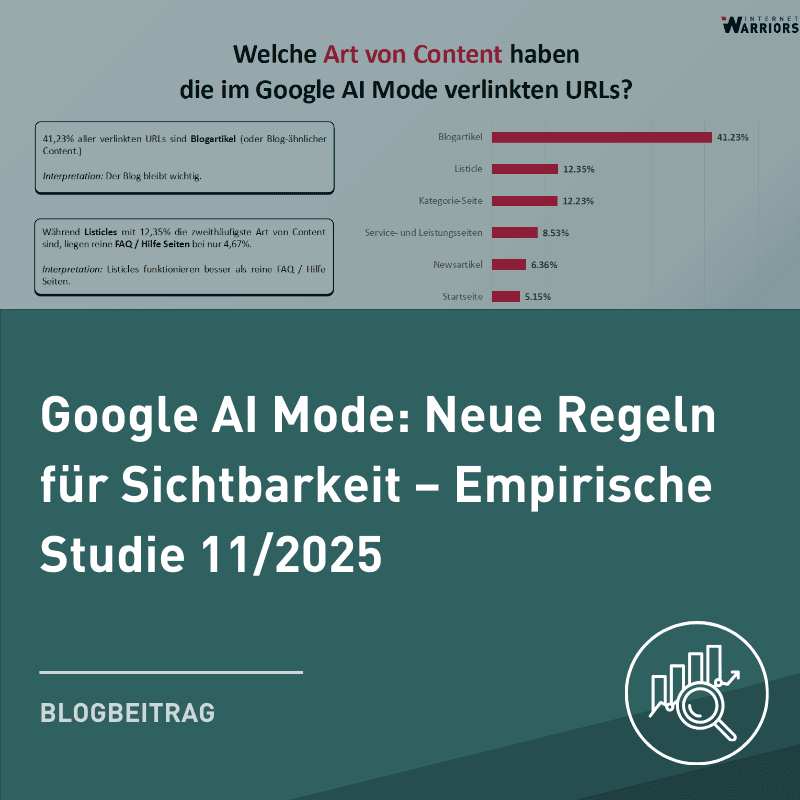
There are moments in digital marketing when the rules of the game are not just slightly adjusted but completely rewritten. We are in such a moment right now. Since October 2025, the Google AI Mode has been available in Germany, and it is Google's answer to ChatGPT. Many marketers and SEOs have been waiting for it, but the reality hits many harder than expected. Introduction: The SEO shake-up we saw coming For years, the mantra was: "Optimize for the top 3, and the traffic is yours." But our latest empirical study at internetwarriors paints a different picture. A picture that is unsettling for traditional SEO strategies but full of opportunities for adaptable companies. The most important finding upfront: A top ranking in the classic Google search is no longer a guarantee to appear in the Large Language Models (LLMs). In fact, our data analysis shows that over 60% of the sources the AI Mode cites do not even show up in the top 50 of organic search. What does this mean for your visibility on Google ? It means that we need to rethink SEO. In this article, we dive deep into our analysis of over 3,000 URLs and show you how you need to adjust your strategy to avoid becoming invisible in the age of AI Search . The Study: A Look Under the Hood of AI Before we get to the strategic implications, it is important to understand the data basis. We did not want to rely on gut feelings but create empirical facts. Our study setup: We conducted a comprehensive analysis that included the following parameters: Scope: 240 different prompts (search queries). Diversity: 12 different industries, from e-commerce and pharma to finance and energy. Data basis: A total of 3,109 URLs were identified and analyzed, which were output by Google AI as sources (citations). Objective: We wanted to know what types of websites are linked, which content formats win, and how strong the overlap with classic search is. The methods overview of our study This data basis provides us with the clearest view so far of how Google selects and presents information in AI Mode . The Shock for Classic SEO: The 60% Gap This is the point at which we have to be honest: The classic SEO playbook only helps to a limited extent in increasing visibility in AI Mode. Our quantitative analyses brought to light a statistic that must make every SEO manager sit up and take notice: "Over 60% of the citations in AI Mode are NOT found in the Google Top 50 results of the classic search." Let that sink in for a moment. Even if you've invested a tremendous amount of budget and time to rank for a keyword on page 1, 2, or 3, the AI ignores you in more than half of all cases in favor of other sources. It becomes even more drastic when we look at the absolute top: Only 21.97% of the URLs linked in AI Mode are also found in the top 10 results of the classic Google search. What Does This Mean for "Improving Google Rankings"? It means that the algorithms that determine organic rankings (backlinks, technical SEO, core web vitals) do not align with the selection criteria of the LLMs (Large Language Models). The AI looks for other signals. It seeks semantic relevance, information density, and context , not necessarily the domain with the highest authority score. Those who only focus on optimizing the classic Google ranking today are missing the future. We see a decoupling of the two search modes. Overlap of AI Mode links with the organic top 10 results Our data also shows interesting differences between the various AI engines. While Google AI Mode and Perplexity overlap by just under 30%, ChatGPT selects completely different sources (under 10% overlap). The "winner-takes-it-all" principle of the old SEO world, where position 1 wins everywhere, is over. Who Are the Winners in AI Mode? (Websites & Content) If the classic top rankings are no longer decisive, then who benefits? Our analysis of the website types provides clear answers on how you should align your AI content strategy . Brand Websites and E-Commerce: The Foundation Stands The good news for brands: Brand websites (44.26%) and e-commerce shops (10.57%) together account for over half of all linkings. This means that Google also gives preference to trustworthy brand sources in AI Mode. But—and that's a big but—it depends on which subpages are linked. Digital PR Is the New Link Building Noteworthy is the increase in news/journalism sites (10.19%) and comparison portals (10.29%). Together, they make up over 20% of the sources. Interpretation: The AI validates information through third parties. If your brand or product is mentioned in a reputable news article or an independent comparison portal, the probability massively increases that the AI will pick up this information and cite you as a source. Digital PR thus becomes more important than classic, technical link building. Forums Are (Still) Overrated Contrary to the hype around "Reddit-SEO," our data shows that forums and community sites account for less than 3% of the mentioned links. A strategy purely based on user-generated content falls short. Type of websites linked in AI Mode. Content Metamorphosis: Moving Away from Selling to Providing Orientation Perhaps the study's most important finding concerns the type of content . This is where companies need to rethink the fastest. Purely sales-driven texts are losing relevance. The AI understands search intent much more granularly. When users utilize AI Mode, they often look for summaries, explanations, or comparisons—not directly for a "buy" button. Our data speaks clearly: Blog articles dominate: 41.23% of all linked URLs are blog articles or blog-like content. Listicles work: At 12.35%, lists (e.g., "The 10 best...") are the second most common format. Help pages lose: Pure FAQ or help pages are only at 4.67%. Why Is This So? Listicles and well-structured blog articles offer the AI "ready-to-eat" information. They provide orientation and structure that the language model can easily extract and recombine. A pure product page often offers too little context. A dry FAQ page is often too specific and does not provide the comprehensive context the AI needs for a generated answer. Type of content The conclusion for your content strategy: Content that provides orientation wins. Companies must shift away from pure sales content and move towards informative, user-centered content that comprehensively answers questions. GEO (Generative Engine Optimization): The New Era of Optimization for Google We must stop saying just "SEO" when we actually mean visibility in AI systems. The technical term emerging here is GEO (Generative Engine Optimization) . Based on our study, concrete action recommendations for GEO can be derived: On-page GEO is a significant lever: Since brand websites are so strongly represented, you have control. Optimize your informational areas. Ensure your blog articles have clear structures, lists, and concise summaries. Informational before transactional: For prompts with an informative search intent, the chance of achieving good rankings in AI Mode is higher. Invest in high-level content that explains topics rather than just promoting products. Expand your PR work: Ensure you are present on news sites and in comparison portals. The AI trusts these sources. Your brand must be present where opinions are formed. Diversify your sources: Do not rely on your Google ranking saving you. Since over 60% of AI links come from "nowhere" (outside the top 50), you have the chance to occupy niches with high-specific, excellent content that are dominated by major players in classic SEO. Conclusion: Those Who Act Now Secure the Lead The integration of AI in search and the use of LLMs will continue to grow. We are only at the beginning of this development. The fact that AI Mode often chooses different sources than the classic algorithm is both frightening and freeing. It means that the cards are being reshuffled. Small players with excellent content can outdo giants that rely solely on their domain authority. Companies that react now and develop their strategy from pure SEO to a hybrid SEO/GEO strategy secure a decisive competitive advantage. Don’t wait until your traffic collapses. Use the insights from our study to make your content ready for the AI search engine . Do You Want to Dive Deeper into the Data? Our study includes many more details, industry breakdowns, and specific analyses on Perplexity and ChatGPT. Download the complete Google AI Mode study now and learn in detail how to optimize your SEO / GEO strategy for the future. Free download of the Google AI Mode study Transparency Note: This article is based on the empirical study "Google AI Mode: New Rules for Visibility" by internetwarriors, conducted in November 2025.
Show more posts
All Categories
SEO
SEA
Social Media
Web Analytics
Growth Marketing
Artificial Intelligence
Success Stories
Inside internetwarriors
Agentic Commerce & Agentic Shopping 2026: Why AI Shopping Agents are Rewriting Commerce
Mar 30, 2026
Moritz
Klussmann
Category:
Artificial Intelligence
The world of online marketing is spinning faster today than ever before. While we've been fighting for clicks and conversions at internetwarriors since 2001, we're currently experiencing the most radical upheaval in our history. The trigger: Agentic Commerce . We are transitioning from mere information search to task-oriented execution. Today, a user no longer just asks for products; they instruct a AI shopping agent to autonomously handle the entire purchase process. In this article, I'll show you why the failure of OpenAI's "Instant Checkout" is not the end of the hype, but the starting point for a new technical infrastructure that you need to know as a retailer now. The OpenAI Pivot: From Shopping Cart to Discovery Platform In March 2026, OpenAI ended its "Instant Checkout," prompting one of the most discussed debates in e-commerce. Failure or strategy? We reveal what is really behind the pivot and what it means for retailers. What was Instant Checkout? In September 2025, OpenAI launched the Agentic Commerce Protocol (ACP) with Stripe, bringing "Instant Checkout" to ChatGPT. The vision: users find a product in the chat and buy it directly without leaving the platform. Etsy, Walmart, and Shopify were the first partners – Shopify president Harley Finkelstein called it a "new frontier" for online retail. Why did direct checkout fail? In early March 2026, OpenAI pulled the plug. What critics dismiss as the failure of Agentic Commerce is, upon closer inspection, a strategic pivot from which we can learn a lot. OpenAI underestimated the immense complexity of global commerce. Three critical factors made direct purchase completion in the chatbot impossible: The three technical killers: 1. Lack of real-time synchronization: The inventory data of millions of retailers could not be reconciled at the required speed – outdated prices and stock immediately shattered user trust. 2. Compliance hurdles: Systems were missing for automated calculation of regional taxes (in the US alone, thousands of local tax jurisdictions) and for compliance with local laws like the Price Indication Regulation (PAngV) in Europe. 3. Fraud prevention: Agent-based transactions require completely new security architectures to prevent automated abuse. Another factor that is rarely mentioned in reporting: the withdrawal comes immediately after Amazon's $50 billion investment in OpenAI. Amazon controls 40 percent of US e-commerce and is building its own AI shopping tool with Rufus . Whether coincidence or strategic calculus – the timing is remarkable. 🟢 Update: March 25, 2026 OpenAI has simultaneously launched a completely new shopping experience with the checkout withdrawal: visual product browsing, side-by-side price comparisons, and image upload for product searches. Seven major US retailers – including Target, Sephora, Nordstrom, and Best Buy – are already live via ACP. Walmart operates a dedicated In-ChatGPT app with loyalty integration and native Walmart payment. This is not a withdrawal – this is a pivot. The new Warrior reality: OpenAI is primarily focusing on Product Discovery through ACP. The checkout returns to the retailer – but the decision of which retailer gets the order is increasingly made by the agent. Agentic Shopping works – just not yet in the West Anyone who believes that the failure of Instant Checkout proves Agentic Shopping is just hype is making a categorical mistake. Alibaba's Qwen-App is already completing food orders, travel bookings, and product purchases entirely in a single conversation – and at scale. The decisive difference: Alibaba owns the AI model, the marketplace, the payment infrastructure, and the logistics all from one source. OpenAI attempted to replicate the same without owning this stack. It was structurally doomed to fail. Google UCP: The new operating system of commerce While OpenAI is correcting, Google is creating facts with the Universal Commerce Protocol (UCP) . Unlike closed systems, UCP is an open standard that allows AI agents to communicate directly with merchants' backends – from discovery through checkout to post-purchase management. For you as a retailer, this means: Your Google Merchant Center (GMC) becomes the critical interface for AI in e-commerce . Google has introduced new attributes to make your products machine-readable: · product_faq – questions and answers directly extractable from the feed for AI agents · product_use_cases – specific scenarios in which your product offers the best solution · native_commerce – a switch signaling whether your product is ready for autonomous checkout The advantage for Germany: Google Merchant Center and Google AI Mode are already active in DACH. Retailers who optimize their feed now secure a real time advantage. SEO alone is no longer enough: Welcome to the era of GEO Our analysis of German e-commerce shops shows a clear picture: A top ranking in traditional search does not guarantee visibility in AI responses. Over 60 percent of URLs linked in AI overviews do not rank in the top 50 of traditional Google search. The rules have changed. This is where Generative Engine Optimization (GEO) comes into play – the discipline of optimizing content not for human clicks but for extraction by AI systems. Feature Classic SEO Generative Engine Optimization (GEO) Target Group Human users AI agents & Large Language Models Primary KPI Click-through rate (CTR) & rankings Mention rate & citation authority Content Logic Keywords & readability Semantic depth & fact density Technical Basis Crawlability & loading speed Structured data & API connectivity Success Measurement Google Search Console (rankings) Brand mentions in LLM responses Warriors Insight: In Germany, AI overviews already appear in 33 percent of all search queries. If you don't opt for GEO now, you will become invisible to the "agent customer" before they even arrive at a website. Strategic Warriors Knowledge: Brand power and the 95:5 rule In the Agentic Web, it's not just the keyword that counts anymore, but the authority of your brand as an "entity" – how a Large Language Model knows, categorizes, and recommends your brand. The 95:5 rule in B2B Only 5 percent of your target group is currently ready to buy (In-Market). The remaining 95 percent need to be reached through thought leadership and trust building in the long term. AI agents prefer brands that are anchored as expert entities in the knowledge graphs of Large Language Models. Those who only optimize for transactional keywords lose the majority of their potential customers before they are ready to buy. Preferred Sources: The Democratization of the Algorithm Google now allows users to actively mark their preferred sources. These "Preferred Sources" receive a permanent visibility boost – regardless of algorithm updates. This fundamentally changes the game: Trust is the new currency. You must persuade users to actively choose your brand as trustworthy – not just ranking well. Checklist: Make your shop agent-ready now For German retailers, the groundwork begins today, even though fully autonomous Agentic Shopping in DACH is still 12–24 months away. Product data excellence in Merchant Center: Maintain GTINs, precise attributes, and new UCP fields (product_faq, product_use_cases). A flawed feed is the largest KI visibility obstacle you can control yourself. Technical infrastructure for AI agents: Implement an llms.txt file (the robots.txt for AI crawlers) and consistently use JSON-LD – specifically the Product, FAQPage, and Article schemas. These are the signals that AI agents prioritize. API-First strategy: Ensure that inventories and prices can be retrieved in milliseconds via interfaces. Outdated data was the main reason for OpenAI's checkout failure – and the same mistake will be costly for retailers once agents actively book. Semantic enrichment with the Query Fan-Out Principle: Answer the questions an AI asks when comparing products on behalf of a customer: For which use cases is the product optimal? What alternatives are there? What are common purchase barriers? This depth distinguishes cited from ignored content. GEO strategy and build brand authority: Ensure that your shop is perceived as an expert entity in relevant categories – in ChatGPT, Perplexity, and Google AI Mode. More on this in our GEO audit → Secure DACH compliance early: PAngV and GDPR apply to AI-mediated purchases as well. Price reductions must disclose the lowest price of the last 30 days as a reference – and this must be machine-readable. Clarify this early with your legal advisor. Conclusion: Become a leader of the new era Agentic Commerce is no longer a science fiction scenario – it's the technological reality of today, still in development, but unstoppable. What OpenAI buried with Instant Checkout is a specific business model: the chatbot as a transaction facilitator between retailer and customer. What lives on – and is accelerating – is the underlying logic: AI shopping agents take over discovery, filter options, prepare purchase decisions. This already happens, daily, for millions of users. The question for retailers is no longer whether , but if they are visible when the agent decides . The companies that are ahead in two years are not the ones with the biggest budget. They are the ones with the best data, the strongest GEO presence, and the clearest understanding of how Artificial Intelligence in e-commerce is used as a lever rather than a threat. Frequently Asked Questions about Agentic Commerce What is the difference between Agentic Commerce and traditional e-commerce? Traditional e-commerce follows the Search & Click principle: The user actively searches, compares manually, and buys themselves. Agentic Commerce follows the Ask & Done principle: An AI shopping agent takes over product search, price comparison, availability check, and – if authorized – the purchase completion fully autonomously. What is Agentic Shopping? Agentic Shopping is the practical manifestation of Agentic Commerce: The user formulates a concrete goal – such as "Order printer cartridge XYZ at the best price by tomorrow" – and an AI shopping agent carries out all steps independently: search, comparison, purchase. Why did OpenAI discontinue Instant Checkout? OpenAI faced three technical hurdles: lack of real-time inventory synchronization across millions of retailers, no infrastructure for tax collection, and no fraud prevention for agent-based transactions. OpenAI is now pivoting to Product Discovery – the checkout remains with the retailer. What is the difference between SEO and GEO? SEO (Search Engine Optimization) optimizes content for the Google search algorithm and for human users – the goal is the click. GEO (Generative Engine Optimization) optimizes for AI systems and Large Language Models that extract content and output as a direct answer – without the user clicking on a website. Both disciplines complement each other and build on each other. Is my shop legally safe for AI purchases in Germany? In the DACH region, you must pay particular attention to GDPR and PAngV (Price Indication Regulation). Price reductions must always disclose the lowest price of the last 30 days as a reference – also machine-readable for AI agents. Clarify this early with your legal advisor before you register for Agentic Commerce protocols. When is Agentic Commerce coming to Germany? ACP and the new ChatGPT shopping hub are currently US-first. However, Google Merchant Center and Google AI Mode are already active in DACH – AI overviews already appear in 33 percent of all German search queries. Experts predict that AI agents could reach a market share of 20-30 percent in European e-commerce in two to three years. The preparation starts now. Is your shop ready for AI shopping agents? We analyze your GEO visibility, your product feed, and show you where you are currently invisible to AI agents – and how you can change that. Request GEO analysis now → Sources & further links: CNBC, March 2026: “OpenAI revamps shopping experience in ChatGPT after struggling with Instant Checkout” – cnbc.com Forrester Research: ConsumerVoices Market Research Survey, March 2026 Gartner: Bob Hetu, Analyst, gegenüber CNBC, March 2026 The Information, March 2026: First report on the Instant Checkout withdrawal OpenAI Blog, March 2026: Official statement on Instant Checkout and new shopping experience Google: Universal Commerce Protocol – Announcement January 2026
Budget Killers in Your Account: Quickly Identify Unprofitable Campaigns and Optimize Google Ads
Mar 23, 2026
Karina
Nikolova
Category:
Search Engine Advertising
One of the main differences between SEA and SEO is time. While SEO measures need time to show growth and performance improvements, paid campaigns require quick actions as any delay costs money. Even if your campaigns appear to be set up correctly at first glance, you can’t rely on hope and a good gut feeling if they aren’t delivering profitable results. In the following article, I will demonstrate three signs that help you recognize unprofitable campaigns at first glance and what could be behind them. Additionally, I will show you specifically how you should optimize your Google Ads campaigns in these cases. However, before we get started, there are three points that can provide a quick explanation for poor performance. If your campaigns still perform poorly despite these factors, you should choose a different approach to improve the figures and reduce Google Ads CPCs . Your tracking isn't working It’s a commonly underestimated problem: Unexpected changes on your website, such as the creation of new landing pages or migration to other data platforms, can disrupt your tracking. This can result in your campaigns showing 0 conversions. Ideally, the Google Ads managers are informed in advance about such planned changes, but in reality, that’s not always the case. An example: Once, a client of mine removed a CPA button that we had measured as a soft conversion goal. My campaigns began to struggle significantly, and I had to quickly find a solution to reduce Google Ads costs. In the end, we couldn’t see any conversions because there was literally no conversion action on the website that could trigger conversions in Google Ads. Tip: Regularly check if your tracking is functioning correctly. Without working tracking, you cannot optimize your Google Ads. It’s still possible for conversions to be generated, but they won't appear in Google Ads, only in the backend. Once the tracking problems are resolved, your campaign might perform well again. Your campaign is still in the learning phase Paid campaigns need patience, even though we all want to see good results as quickly as possible. That would prove our expertise and help us further optimize and scale the Google Ads campaigns. However, new campaigns cannot always work wonders, as the algorithm needs time to learn and improve performance. The official learning phase usually lasts up to four weeks. Depending on the business model, this process can also be shorter because the quicker the campaign generates conversions, the faster the algorithm learns. However, this development is not always guaranteed. For instance, the average customer journey in the B2B sector generally takes more time. Additionally, it often includes several touchpoints before achieving the desired result. Tip: Be patient during the learning phase. Your main goal is not clear Unrealistic expectations usually lead to disappointments - not only in life but also in Google Ads. If marketing goals are vague, clear results will not follow either. If the goals are clear, but you don’t know which campaign types are suitable for them, the figures will also disappoint. For example, if you work with display or video ads, you should not automatically expect to receive many high-quality leads. Not because your setup is wrong, but because these campaign types pursue different goals. They are meant to increase the awareness of your product and cover the early phase of the customer journey. Moreover, the ad formats are tailored to this goal - think of skippable ads on YouTube. They are there to promote your brand and convey a message. However, it is not realistic to expect good leads from them, as they are likely to be skipped, with the customer taking no further action. If your shopping campaigns don’t deliver results for weeks, this is at least alarming. Tip: Define clear objectives for each phase of the funnel and choose the appropriate campaign types. Only then can you effectively optimize your Google Ads campaigns. There is a Budget-Killer in the House But let's go back to the three clear signs that a budget-killer is present in your account: Campaigns with traffic but no conversions Rising CPAs Decreasing ROAS If your goal is conversions and you see none or increasingly fewer, there’s a problem. Especially if your tracking is functioning and the learning phase is complete. If the campaign still does not deliver the desired conversions, this impacts not only your KPIs but also the performance of your automated bidding strategies. For instance, if you optimize for tCPA or tROAS, declining conversions will lead to a higher CPA, a lower ROAS, and overall restrictions on bidding strategies. Here is a list of factors that could explain the decline in conversions you are observing. These include: Landing page – Any change that worsens the user experience can negatively influence the conversion rate as well as the bounce rate. Competition - Especially in e-commerce, competition through lower prices can affect the number of conversions as well as the conversion rate. Seasonality - If your business experiences significant declines during certain periods, you should adjust your marketing strategy accordingly. Irrelevant Traffic - Ensure that your ads don’t appear for irrelevant search queries to reduce Google Ads costs for poor traffic. This often helps to lower Google Ads CPC. Faulty Targeting – A reasonable campaign setup is vital in Google Ads. However, despite optimal campaign setups, certain target groups or keywords may perform less well than expected. For this reason, you should quickly optimize the targeting of your Google Ads campaigns if the desired results are not there. Google Ads campaigns are not static. What works well today can perform poorly tomorrow. As a marketing manager, you should thoroughly understand the business model and goals, select the appropriate campaign types, set KPIs, and set realistic expectations. The rest lies in flexible and smart Google Ads optimization. Additionally, your task extends beyond Google Ads as overall performance is influenced by many other factors described above. For example, dramatic political or economic developments can have the same negative impact as a poorly optimized campaign. Your Google Ads expertise should go hand in hand with thorough market analysis so that you can see the bigger picture and take the right actions. If you need assistance with this or if you want to scale your existing campaigns, our SEA team is happy to advise you. Contact us now!
Identify and Properly Analyze AI Traffic in Google Analytics
Mar 9, 2026
Nadine
Wolff
Category:
SEO
Since Large Language Models (LLMs for short) have become a part of everyday life and users increasingly utilize AI tools like ChatGPT, Gemini, Claude, or Perplexity, a completely new source of traffic is emerging. For website operators and marketing managers, the question arises of how many users actually reach their website through links and recommendations of these LLMs and what portion this AI-generated traffic accounts for in total visitor numbers. This traffic, let's call it “AI Traffic”, is not automatically displayed in Google Analytics. In this article, I'll show you how to find, measure, and evaluate AI Traffic in GA4. You will also learn what conclusions you can draw from it for your action planning and why AI visibility will be just as relevant as traditional search engine rankings in the future. What exactly is AI Traffic and how is it composed? The term AI Traffic refers to all page visits that originate from AI systems and generative search engines. Here are some examples of where the traffic could come from: Traffic from ChatGPT/GPT Search Traffic from Perplexity Traffic from AI-integrated browsers (e.g., Microsoft Edge with the integrated Copilot) Copied links that users click on from AI answers AI Traffic can actively occur when users click on links from an AI answer. Additionally, there is passive traffic when AI systems crawl pages to prepare content for their models. Recognizing AI Traffic in GA4: The most important methods 1. Identifying referrers (e.g., ChatGPT Traffic) When a user clicks a link from an AI answer, the browser automatically sends a so-called referrer. This information indicates which page the user is coming from. In GA4, this information appears under “new generated traffic” as “Referral”, for example, with the source perplexity or claude. Figure 1: AI Traffic via a Referrer 2. UTM Tracking ChatGPT has been automatically appending “?utm_source=chatgpt.com” to links in its answers for a while. This means that this AI Traffic appears in Google Analytics not as a Referral but as a separate source marked with UTM—making it easier and cleaner to identify than pure Referral traffic. However, Perplexity or other AI systems do not necessarily do this. This traffic is often only recognizable through the referrer. Making AI Traffic visible in GA4 - Explorative data analysis The exploratory data analysis in GA4 offers the most flexible option to evaluate AI Traffic specifically. Unlike standard reports, you can freely combine your own dimensions, filters, and segments here. To do this, create a new empty data analysis, add a dimension, and optionally one or more metrics: Dimension --> Session – Source/Medium Metrics --> Sessions Figure 2: Explorative Data Analysis To see only traffic from AI platforms, now create a filter with a regular expression (Regex). This filter ensures that only sessions whose source is one of the mentioned AI platforms are displayed. Figure 3: Example of a Regex filtering various AI systems The result shows you – as in the example above – a detailed table by source and medium. It's noted that ChatGPT appears in two variants: once as “chatgpt.com / referral” and once with UTM marking as “chatgpt.com / (not set)”. This is because ChatGPT doesn't consistently append the UTM parameter to every link. Therefore, it's advisable to consider both entries together in evaluations. What you see in GA4 – and what it means Once you've isolated AI Traffic in GA4, you essentially have three different metrics available: Size & Development: How many sessions arise from AI platforms? How does this develop over time? A growing value indicates that your content is increasingly being recommended as a source by LLMs. This is, in turn, a direct signal of your AI visibility. Links: Which pages are being linked to? Which of your subpages appear as landing pages? This metric shows you which content LLMs deem relevant enough to recommend. These are your strongest pieces of content in the AI context. User behavior: The duration, bounce rate, and engagement rate of AI traffic compared to other channels provide insights into whether the linked content also meets user expectations. High bounce rates can indicate that the linked page doesn’t deliver what the AI answer promised. What you can deduce from the AI Traffic in GA4 The landing pages (with AI Traffic) are your direct feedback on which content LLMs deem worthy of citing. Look into what these pages have in common: Are they more explanatory guide articles? Detailed instructions? Definitions? These patterns show you which content format LLMs prefer – and you can specifically use that for new content! Identify content gaps Get an overview of which topics your AI traffic comes from and compare them with your entire content offering. Are there topics you get traffic for but have few or thin content pieces? These are your content gaps – areas where LLMs already see you as a relevant source, but you haven't yet realized the full potential. Optimize content specifically for LLMs (GEO) Generative Engine Optimization, or GEO for short, is the counterpart to classic SEO – but for AI systems. Specifically, it's about structuring content so that LLMs can easily process and cite it. This includes clear, precise answers to specific questions, well-structured sections with clear headings, and a trustworthy, source-based language. Pages that already receive AI traffic are your best starting point – they obviously work well, and targeted optimization can further increase their visibility in LLM answers. Conclusion: AI Traffic will be a strategic success factor Recognizing AI Traffic in GA4 is possible, but only with the right methods. Those who understand AI visibility and track it cleanly receive valuable insights into the relevance and sustainability of their own content. For companies, this means a new responsibility in content creation and technical optimization. If you need support with tracking, SEO/GEO, or AI content strategy, feel free to contact us. Our team helps you make AI visibility measurable and align your strategies based on data. Get in touch now! FAQ What is the difference between AI Traffic and Bot Traffic? Bot Traffic comes from traditional crawlers, while AI Traffic results from AI systems and real users in AI interfaces. Is AI Traffic automatically marked in GA4? Not entirely. Some systems are recognized, but much needs to be filtered out through segments or referrers. Which AI platforms should I track in GA4? The most important sources currently are ChatGPT, Perplexity, Claude, Gemini, and Microsoft Copilot. ChatGPT is usually the largest source because it automatically sets UTM parameters and is therefore the most easily identifiable in GA4. Is it worth evaluating AI Traffic if the volume is still low? A definite yes! Starting to measure and understand AI Traffic now gives you a head start before this channel becomes standard in the industry. Just like SEO in the early 2000s: starting early yields long-term benefits.
Optimizing content specifically for prompts using the Query Fan-Out principle
Feb 13, 2026
Julien
Moritz
Category:
SEO
Large Language Models (LLMs) like ChatGPT, Claude, or Gemini are fundamentally changing how content is found, evaluated, and utilized. Visibility is no longer solely achieved through traditional search queries but increasingly through prompts that users input into AI systems. A frequently mentioned principle for optimizing one's content in this regard is the so-called Query Fan-Out principle. But what does this specifically mean for your content? In this article, you'll learn how ChatGPT & Co. decompose inquiries in the background and how you can structure your content so that it is relevant, comprehensible, and quotable for LLMs. Key Points at a Glance LLMs generate multiple search queries simultaneously from a prompt (Query Fan-Out). These queries often run parallel in both German and English. Content is evaluated based on topics, entities, terms, and synonyms. In just a few steps, you can analyze which queries ChatGPT uses yourself. We show you how here. Concrete requirements for your content structure can be derived from this. What is Query Fan-Out? Query Fan-Out describes the process where an LLM generates multiple sub-queries from a single prompt. A prompt is thus unfolded into multiple queries. This multitude of queries is called Fan-Out because a query fans out like a fan into many individual queries. In the background, the system sends various search queries simultaneously to the index (e.g., Bing or Google). It is only from the synthesis of selected results that the AI compiles the final answer. We will examine how you can easily investigate this yourself for a prompt in a step-by-step guide. Why is Query Fan-Out so important? Your content aims to be found. However, Large Language Models are increasingly used today. This changes the requirements for your content so that it continues to appear in Google search results but is also used by as many LLMs as possible for answer generation. The better your content matches the generated queries, the more likely it is to be used by LLMs as a source. Step-by-Step Guide: What Queries are Created by ChatGPT? With a sample prompt in ChatGPT, one can clearly see how these queries appear. You can easily recreate this for your own prompts and optimize your content accordingly. Step 1: Open Developer Tools Open ChatGPT in the browser Enter a prompt and submit it Right-click somewhere in the interface Select “Inspect” Step 2: Filter Network Tab & Search for Chat-ID Switch to the “Network” tab Filter by Fetch / XHR Copy the chat-ID from the last part of the URL Paste it into the search field Reload the page Step 3: Select Network Request Click on the network request with the chat-ID in the name Switch to the “Response” tab Step 4: Find Queries Search for the term “queries” Now you see specific search queries that ChatGPT uses for web search Mostly in German and English Step 5: Evaluation of Requests The following prompt was entered: “I want to mount my TV on the wall. What is the recommended seat distance for a 65-inch OLED TV? I'm looking for a high-quality and safe full-motion wall mount. Compare current models and suggest the best ones!” ChatGPT utilizes two sub-queries in the web search to find suitable content: 1. DE: “ pivotable wall mount 65 inch TV recommendations wall mount TV 65" pivotable” 1. EN: “ best full motion TV wall mount for 65 inch TVs review high quality” 2. DE: “Recommended seat distance 65 inch TV distance OLED TV seat distance” 2. EN: “what is recommended viewing distance for 65 inch TV” From these queries, ChatGPT searches for appropriate sources and subsequently generates the following answer, with source indication: Now you should carefully look at the queries and also the sources used. What types of content are cited? The example used clearly shows that there is an information cluster and a comparison cluster. Different sources are used for these clusters. To be optimally found for this prompt, you need an informative article on the topic “Recommended viewing distance to TV” . From ChatGPT's query, it can be derived that the subtopics: TV size in inches and display types (e.g., OLED) should be addressed. Additionally, the synonym TV viewing distance should appear in the content, preferably in an H2. The product selection comes from other articles. Thus, your products should appear in as many comparison articles (on external websites) on the topic “Best TV wall mount” as possible, so they can be presented here. Additionally, ChatGPT accesses manufacturer websites. With your own content on product and category pages , you can influence the answers of LLMs. Clearly consider what makes your product or service unique and how you stand out from competitors. Because exactly these advantages can bring users from the AI chat to your own website. Additionally, it can also be beneficial to publish your own comparison articles . Naturally, you should strongly present your own brand within these, but also mention competitors and their advantages. LLMs recognize that the information density in the English-speaking network is generally higher. Translating your own content can therefore be a great advantage and ensure greater visibility with ChatGPT and others. Strategies for Optimization for the Query Fan-Out Principle What does the Query Fan-Out principle mean for your own content? You need an SEO strategy that works even in the age of generative AI. For this, we have developed five tips that you can directly implement. 1. Comprehensive Topic Clusters Instead of Keyword Focus The Google Query Fan-Out behavior shows the desire to capture topics in their entirety. LLMs divide a prompt into multiple thematic clusters with varying intent, such as information, comparison, or product queries. Informative content should be built comprehensively . Content should not only answer "What" questions but also "How", "Why", and "What are the alternatives?" Use targeted synonyms and related entities. If you write about “TV wall mounts”, terms like "VESA", "Pivotable", and "OLED television" should be included. 2. Direct Answers Write precise definitions and direct answers to user questions at the beginning of your paragraphs . An AI looking for a quick answer to a sub-query will more likely cite text that provides a clear answer: “The ideal viewing distance for a 65-inch OLED TV is about 2.50 to 2.80 meters.” Avoid unnecessary filler sentences just to include keywords. Further detailed and extensive information considering secondary keywords can be placed afterward. 3. Structured Data LLMs work resource-efficiently and love structure. When an AI conducts a price comparison or technical analysis, it preferably accesses data marked up with Schema.org . Use structured data in JSON-LD format to make products, FAQs, and reviews machine-readable. 4. Internationally Visible Content Often, Large Language Models automatically generate English-language queries, even when prompts are written in German. Therefore, building internationally visible content is increasingly important, even if your target audience is German-speaking. You should provide your core content in English as well. 5. Building "External" Visibility Transactional inquiries like “Best price-performance TV wall mount 2026” are answered using comparison content and user reviews . To be visible with your brand in LLMs, you need to build recognition. Content partnerships with magazines or collaborations with influencers who publish independent reports and product comparisons are a strong lever. It’s not just about classic backlinks that provide authority but also about mentions of the brand in a relevant context on as many platforms as possible. This can be articles from magazines, competitors, online retailers as well as UGC content on YouTube, Reddit, etc. Conclusion: SEO & GEO United Query Fan-Out reveals how LLMs find and evaluate content. By structuring your content to answer multiple questions simultaneously, being thematically complete, and considering relevant entities as well as synonyms, you optimize not only for traditional search engines but deliberately for AI systems. This is where a new form of visibility is currently being created. Optimization for the Query Fan-Out principle is no longer a "nice-to-have", but the new foundation for digital visibility. By understanding how LLMs deconstruct queries, you can create content that is not only found but also cited as a trustworthy source. If you need assistance or want to optimize your content specifically for LLMs, our SEO / GEO team can gladly advise you. Contact us now!
ChatGPT for Ad Copy: Turning Strategic Decisions into Measurable Performance
Jan 30, 2026
Yasser
Teilab
Category:
Search Engine Advertising
Good ads rarely emerge from a sudden spark of inspiration or pure creative chaos. In the world of performance marketing , they are the result of a rigorous process: clear decisions, sound hypotheses, and the relentless willingness to test them in the market against the reality of data. At this point, ChatGPT for ad copy becomes either a highly effective precision tool or a mere text production machine that just creates digital noise. AI does not determine the success of a campaign; it merely exposes how structured your marketing thinking really is. In this guide, you'll learn how to transform ChatGPT from a "writing aid" into a strategic performance tool that elevates your Google Ads and Meta Ads to a new level. This strategic approach is exactly what we implement at internetwarriors daily in Google Ads and Meta Ads – data-driven, test-based, and scalable. Book an appointment with us now! The Paradox of AI Text Production: Why More Content Doesn't Automatically Mean More Success Ad copy has always been a test problem. Marketers formulate assumptions, launch them, and let the numbers decide. The real limit was never in tracking or analysis, but in operational capacity. Every new ad, every new "angle" took time in conception, coordination, and creation. ChatGPT has shattered this limit. A new entry or an alternative tonality can be developed in seconds today. But here's the trap: those who misuse ChatGPT only scale mediocrity. The shift in everyday work: • Previously: The bottleneck was writing (copywriting). • Today: The bottleneck is thinking (strategy & psychology). ChatGPT doesn't think strategically. It doesn't decide which message is relevant in the market. If ads didn't work before, ChatGPT won't solve this problem – it will only accelerate failure by producing more bad ads in a shorter time. Preparation: Ad Copy Starts Not in the Prompt but in the Focus Much of what is perceived as "generic" AI text is not due to the model but to weak briefing. Before you type the first prompt into the chat window, one central question must be answered: Why should the audience click right now? The Psychology of the Click People don't click on ads because a product is "innovative" or "market-leading." They click because they expect a transformation. ChatGPT is excellent at translating a well-defined idea into variations, but it is unsuitable for finding that idea itself. What you need to define before using ChatGPT: The specific pain point: What exact problem keeps your customer awake at night? (Not: "They need software," but: "They're afraid of data loss"). The functional benefit: What improves immediately? (Time savings, risk reduction, status gain). Objection handling: What thought prevents the customer from clicking? ("Too expensive," "Too complicated," "No time to switch") Thinking in "Angles": The Framework for High-Converting Ads Those who use ChatGPT for ad copy should stop asking for "texts" and start thinking in angles . An angle is a conscious decision for a psychological perspective. Angle Type Focus Example (Project Management Tool) Efficiency Time savings & focus "Gain back 5 hours per week." Safety Error avoidance & control "Never miss a deadline again." Simplicity Low barrier & usability "Set up in 2 minutes. No training required." Social Proof Trust & benchmarking "Why 500+ agencies have switched." The Rule: An angle always corresponds to exactly one hypothesis. Only when the angle is set do we let ChatGPT formulate the variations. Defining, testing, and systematically scaling angles is not a creative but a strategic problem. If you want to know how we translate such hypotheses into high-performing campaigns, find out more about our approach now! ChatGPT for Google Ads: Mastering Responsive Search Ads (RSA) In Google Ads, AI plays to its strengths especially well with Responsive Search Ads. This ad format thrives on the combination of different elements. The most common mistake? Creating 15 headlines that all say almost the same thing. The Building Block Principle Effective RSA copy is created when each headline serves a clear function. We use ChatGPT to specifically serve these functions: • Function A: Problem description. (e.g. "Tedious Excel lists?") • Function B: Benefit promise. (e.g. "Automatic reporting at the push of a button.") • Function C: Trust signal. (e.g. "2024 test winner.") • Function D: Call-to-action. (e.g. "Request demo now.") Strategic Prompt Tip for Google Ads: "Create a total of 10 headlines for a Google Search Ad for Product [X]. Important: Create 3 headlines that address a problem, 3 headlines that mention a benefit, and 4 headlines with a strong CTA. Each headline must be a maximum of 30 characters long. Avoid repetitions." Meta Ads: The Battle for the "Scroll Stop" In the meta environment (Facebook & Instagram), the attention span is minimal. The first sentence – the hook – decides success or failure. ChatGPT as Hook Generator Instead of generating entire ads, it's more effective to use ChatGPT solely for the development of openings. A strong hook must pull the user out of their passive scrolling trance. Three Hook Formats to Test with ChatGPT: The Provocative Question : "Did your team really know what was top priority this morning?" The "Statistical" Statement : "78% of all projects fail due to poor communication – here's how to prevent it." The "Negative Framing" : "Stop wasting time in meetings that could have been an email." Important : Even if ChatGPT provides the text, manual verification of advertising guidelines (especially concerning sensitive topics like finance or health) is indispensable. Practical Guide: How to Brief ChatGPT Like a Pro To get results that don't sound like a "robot," you need a structured briefing framework. At internetwarriors, we often use the following scheme: Step 1: Role Assignment Always start by giving the AI an identity. "You are an experienced performance marketer and conversion copywriter. Your goal is to write texts that not only inform but also trigger an action (click/purchase)." Step 2: Context Input Feed the AI with hard facts: • Target audience: Specific persona (e.g. "CEO of small agencies, 30-50 years old, stressed"). • Offer: What is the irresistible offer? • Objection: What is the customer's biggest concern? • Tone: (e.g. "Direct, professional, without marketing clichés"). Step 3: Iteration Never settle for the first result. Use commands like: • "Make it shorter and more concise." • "Remove all adjectives like 'revolutionary' or 'unique'." • "Reword Angle 2 for an audience that is very price-sensitive." The "Warriors Check": The 5 Most Common Mistakes in AI Ads To prevent your performance campaigns from sinking into mediocrity, avoid these mistakes: Too much trust in the facts: ChatGPT sometimes hallucinates. Always manually verify USPs and data. Missing brand voice: If the AI sounds too much like a "salesperson," you'll lose your target audience's trust. Adjust the tone. Ignoring platform logic: A text that works on LinkedIn will fail miserably on Instagram. Adapt the formats. No A/B testing: Many marketers use AI to find a perfect ad. The goal, however, should be to find five radically different approaches and test them against each other. Marketing buzzword bingo: Words like "holistic," "synergistic," or "innovative" are click killers. Instruct the AI to remove these words. Outlook: The Future of Ad Creation We are moving towards an era where AI will not only adapt text but also images and videos in real time for individual users. Yet even in this world, one constant remains: Strategy beats the tool. Those who learn today to use ChatGPT as a partner for hypothesis building and angle development will have an unbeatable advantage. It's not about writing faster – it's about learning faster what works in the market. Conclusion: ChatGPT is Your Lever, Not Your Replacement If ChatGPT has so far primarily served as a tool to "quickly create a text" in your setup, much of the potential remains untapped. The decisive lever lies in the systematic interlocking of psychological know-how, clean structure, and the speed of AI. This is exactly where we at internetwarriors come in. As specialists in Google Ads and Meta Ads, we help companies: • Strategically build ad copy processes. • Integrate AI meaningfully and data-drivenly into campaigns. • Develop scalable setups that are based not on chance, but on validated hypotheses. Do you want to use ChatGPT not just as a typewriter but as a real performance tool? We support you in sharpening your messages so that they are not only seen but convert. Contact us for a non-binding analysis of your current campaigns! This article was created with AI assistance – but curated with the strategic mind of a warrior.
2026 und das Zeitalter der Agentic Search - Wenn Kunden keine Menschen mehr sind
Jan 14, 2026
Axel
Zawierucha
Category:
Growth Marketing
Here you will find all parts of our blog series: Part 1 - Why "Zero-Sum" is a misconception and the search is just beginning | find it here Part 2 - The "December 2025 Core Update" and how to regain visibility | find it here Part 3 - Advertising in the Age of Conversation – Why keywords are no longer enough | find it here ————— Blog Series: The Transformation of Search 2026 (Part 4/4) Welcome to the future. Or better yet: Welcome to the present of 2026. In the previous parts, we analyzed the traffic crash and explored new advertising tools. To conclude this series, we venture a look at what is emerging: The "Agentic Web". The biggest change ahead is not how people search, but who searches. We are experiencing the transition from information gathering to task completion. "Preferred Sources": Democratization of the Algorithm Let's start with a technology that is already here and will change SEO forever: "Preferred Sources". In late 2025, Google deployed this feature globally. Users can now actively mark news sources and publishers (with a star) that they prefer. Why is this revolutionary? Until now, SEO was a technical battle against an anonymous algorithm. Now, brand loyalty becomes a direct ranking factor. If users mark your page as a "Preferred Source", your content receives a permanent boost in their feed – completely independent of what the next Core Update dictates. This means: Community > Keywords: A small, loyal fan base is more valuable than broad, volatile traffic. Trust as a metric: You must actively motivate your users to choose your brand as a preferred source. This is the new newsletter signup. "Live with Search": Seeing the World Through the Camera SEO has been text-based so far. With "Live with Search", it becomes multimodal. Users can now interact with Google in real-time via camera and voice. A user films a shelf at the hardware store and asks, "Which of these anchors will hold in drywall?" Thanks to the new Gemini Native Audio Model, Google responds smoothly, like a human advisor in your ear. The implication for brands: Their products must be visually identifiable. Packaging design becomes SEO. And: Your website must answer questions posed while viewing the product, not just while searching for it. "Agentic Search": From Searching to Doing The term of the year 2026 is "Agentic Search". An AI agent (Agent) is more than a chatbot. A chatbot gives information. An agent acts. Search 2024: "Show me flights to London." Agentic Search 2026: "Book me the cheapest flight to London on Friday, take my preferred aisle seat, and add it to my calendar." Experts predict that the market for AI agents will explode to over 50 billion dollars by 2030. For us at internetwarriors.de, this means a radical shift in "Search Everywhere Optimization" (SEO). If your "visitor" is a bot, it doesn't need a nice design. It needs APIs, clear schema.org structures, and flawless logic. We no longer optimize websites just for human eyes, but for machine actors. Gemini in Translate: The Global Competition Finally, the last bastion falls: The language barrier. With the integration of Gemini into Google Translate, translations become context-sensitive and culturally nuanced. A US shop can suddenly serve the German market as if it were locally established, thanks to real-time translation. For German companies, this means: Competition becomes global. But their opportunities also become global. Conclusion: The Year of Decision The transformation of search 2026 is not a threat to those who provide quality. Redundant information becomes extinct (December update). Transaction and expertise prevail (Liz Reid theory). Advertising becomes smart and context-based (AI Max). Brand loyalty beats algorithm (Preferred Sources). At internetwarriors , we are ready for this era. We help you not only to be found but to be chosen – by people and agents. Let’s discuss your strategy for 2026 together. Schedule an appointment now .
Werben im Zeitalter der Konversation – Warum Keywords nicht mehr genügen
Jan 13, 2026
Axel
Zawierucha
Category:
Growth Marketing
Here you will find all parts of our blog series: Part 1 - Why "Zero-Sum" is a misconception and the search is just beginning | find it here Part 2 - The "December 2025 Core Update" and how to regain visibility | find it here Part 4 - 2026 and the Age of Agentic Search - When customers are no longer human | find it here ————— Blog Series: The Transformation of Search 2026 (Part 3/4) In the first two parts of this series, we've analyzed the economic theory behind Google's transformation ("Expansionary Moment") and the brutal reality of December's update for SEOs. But while SEOs are still licking their wounds, SEA managers (Search Engine Advertising) need to reforge their weapons. The year 2026 marks the end of classic keyword dominance. With the introduction of "AI Max for Search" and the opening of "AI Mode" for advertising, Google has fundamentally changed the rules of monetization. Trying to bid exact keywords ("Exact Match") against an AI today is like fighting drones with bows and arrows. In this article, we deconstruct the new advertising infrastructure and show you how to run ads in a world where users no longer search but engage in conversations. AI Max: The "Intent Engine" Replaces the Keyword For a long time, "Performance Max" (PMax) was the panacea for Google's inventory. But there was a gap for pure search campaigns. This is now filled by "AI Max for Search," a tool that Google markets as a "One-Click Power-Up." The Problem with Keywords Imagine users searching: "I need a car for 3 kids and a dog that runs on electricity and costs under $50,000." Previously, you had to bid on combinations like "electric SUV," "affordable family car," or "7-seater." It was necessary to guess what users would enter. AI Max turns this principle on its head. It analyzes not the words (strings), but the intent. How AI Max Works AI Max uses your website and its assets as a foundation. When users make the above complex request, the AI understands the context ("family + space requirement + budget constraint"). It scans your landing page, finds your model "E-Family Van," dynamically generates a fitting headline (e.g., "The perfect E-Van for your family of 5"), and displays the ad – even if you have never booked the keyword "dog." The results speak clearly: Beta tests show a 27% increase in conversions with a similar CPA (Cost per Acquisition) compared to pure keyword campaigns. Strategic Advice: Keywords become mere "signals." Your landing page and your creative assets (images, text) become the real targeting. If your landing page does not answer the question, AI Max cannot generate an ad. The "AI Mode": Ads in the Conversation The "AI Mode" is Google's answer to ChatGPT and Perplexity – a purely conversational interface capable of handling complex, multi-step inquiries. The crucial question for advertisers has long been: Where is the space for advertising here? The answer is: Sponsored Responses . Integration Instead of Interruption Unlike the classic search where ads are often perceived as disruptions, Google integrates ads seamlessly into the dialogue in AI Mode. Scenario: Users plan a trip to Tokyo and ask the AI Mode about hotels near Shibuya Crossing with a pool. Advertising: Instead of a banner, your hotel appears as part of the response, marked as "Sponsored," including an image and direct booking link. Since inquiries in AI Mode are "2x to 3x longer" than in classic search, the algorithm receives significantly more context signals. This enables targeting with unprecedented precision. A user who asks so specifically is deep in the funnel. The click rate may decrease, but the conversion rate rises. The New Currency: Assets To participate in AI Max and AI Mode, you need "raw material." The AI assembles the ad in real time. This means for you: Visual Excellence: You need high-quality images and videos. AI Max prioritizes visual elements to create "Rich Cards" in the chat. Structured Data: Your product feed (Merchant Center) must be flawless. The AI needs to know if the shoe is "waterproof" to display it for the query "running shoes for rain." Broad Match + Smart Bidding: This is the technical prerequisite. "Exact Match" cuts you off from the new AI interfaces. You need to release the algorithm (Broad Match) but control it through the target (Smart Bidding on ROAS/CPA). Conclusion for Part 3 We are moving from a "Search Engine" to an "Answer Engine." Advertising must become the answer. Banner ads are dying out; helpful, context-sensitive product suggestions take over. Don't throw away your keyword lists, but treat them for what they are: relics from a time when we still communicated with machines in "telegraphic language." Need help transitioning to AI Max? The SEA team at internetwarriors audits your account and prepares it for 2026.
Das "December 2025 Core Update" und wie man die Sichtbarkeit zurückgewinnt
Jan 12, 2026
Axel
Zawierucha
Category:
Growth Marketing
Here you will find all parts of our blog series: Part 1 - Why "Zero-Sum" is a misconception and the search is just beginning | find it here Part 3 - Advertising in the age of conversation – Why keywords are no longer enough | find it here Part 4 - 2026 and the Age of Agentic Search - When customers are no longer people | find it here ————— Blog Series: The Transformation of Search 2026 (Part 2/4) While Liz Reid emphasized the economic stability of Google search in interviews, dramas were unfolding in server rooms and marketing departments worldwide. The "December 2025 Core Update" will go down in history as one of the most volatile and toughest updates. It was not merely a correction; it was a system change. In this second part, we analyze the forensic data of the update, explain why "Redundancy" is the new "Spam", and show you a way out of dependency with the new "Preferred Sources" feature. Holiday Havoc: The Timing of Terror The update began on December 11, 2025, at 9:25 AM PT and extended until January 1, 2026. For e-commerce and ad-funded publishers, this timing – in the middle of the busiest quarter – was the "Holiday Havoc". The impacts were brutal and immediately measurable: Traffic Collapse: Hundreds of webmasters reported declines in daily visitor numbers between 70% and 85% . Discover is dead (for many): Google Discover was particularly affected. A publisher documented a drop in impressions by 98% within days before the official announcement. Since Discover now accounts for up to two-thirds of traffic for many news sites, this was tantamount to a threat to existence. Volatility Index: The SISTRIX Update Radar recorded a value of 3.54 on the day of the announcement – a massive spike far beyond normal fluctuations. The "Second Wave": Why it hurt twice Our analyses at internetwarriors show an unusual pattern. After the initial crash on December 11, there was deceptive calm, followed by a "Second Wave" of volatility around December 20. We interpret this as a two-stage filtering process: Phase 1 (Content): The algorithm scanned for static quality features and especially for redundancy. Phase 2 (User Signals): In the second wave, the user data of the new AI Overviews was analyzed. Pages that ranked but didn't generate clicks or had high bounce rates compared to the AI response were downgraded retroactively. The new ranking poison: Redundancy Why were so many established sites hit? The answer lies in the nature of AI overviews. Previously, a page was valuable if it summarized information well. Today, the AI does that. The December update punished redundancy. If your page merely repeats facts already present in Google’s "Knowledge Graph" (e.g., "How tall is Liz Reid?"), your page is technically redundant. It doesn’t offer added value over AI. Google has now firmly integrated its "Helpful Content" signals into the core algorithm. "Helpful" today means: Does this page offer a perspective, experience, or data that AI cannot hallucinate or aggregate? The Glimmer of Hope: "Preferred Sources" But Google didn’t just take, Google also gave. Parallel to the update and volatility, Google rolled out the "Preferred Sources" feature globally. This is perhaps the most important strategic innovation for 2026. What is it? Users can mark their preferred news sources in search settings or directly in "Top Stories" (through a star). The Effect: Content from these sources gets a permanent ranking boost in the user's personal feed and appears in a separate section "From your sources". This fundamentally changes the SEO game. Until now, SEO was a battle for the algorithm. From now on, it is also a battle for brand loyalty. A small niche blog can outperform large publishers if it has a loyal community that actively marks it as a "Preferred Source". We see here a democratization of the algorithm: the users decide who ranks, not just the AI. Your Survival Strategy for Q1 2026 Based on this data, we recommend our clients the following immediate actions: Redundancy Audit: Check your content. If you have an article that ChatGPT could write just as well in 10 seconds, delete or revise it. Add exclusive data, expert opinions, or videos. The "Star" Campaign: Launch campaigns to encourage users to mark you as a "Preferred Source". Explain to users how it’s done. This is the new newsletter signup. Diversification: Do not rely solely on Google Discover. The 98% drop shows how volatile this channel is. The December update was painful, but it has cleansed the market. Whoever still stands now has substance. But how do you monetize this substance in a world where keywords are losing importance? In part 3 of our series, we dive deep into the new advertising world of AI Max and AI Mode , and show you how ads are placed when no one is searching anymore.
Warum "Zero-Sum" ein Irrtum ist und die Suche gerade erst beginnt
Jan 9, 2026
Axel
Zawierucha
Category:
Growth Marketing
Here you can find all parts of our blog series: Part 2 - The "December 2025 Core Update" and how to regain visibility | can be found here Part 3 - Advertising in the age of conversation – Why keywords are no longer enough | can be found here Part 4 - 2026 and the era of agentic search – When customers are no longer human | can be found here ————— Blog series: The Transformation of Search 2026 (Part 1/4) Looking back at the year 2025, we see a battlefield. It was the year when theoretical discussions about AI in marketing suddenly became serious. It was the year when publishers panicked, stock prices wavered, and Google's Vice President Liz Reid said a sentence in the Wall Street Journal that would go down in the history of digital marketing: "We are in an expansionary moment." For many of our clients at internetwarriors, however, it didn’t feel like expansion in December 2025, but rather contraction. Yet the data presents a more complex picture. In this first part of our four-part series at the start of 2026, we analyze the macroeconomic level of the "new search." We deconstruct Google's strategy and explain why the classic SEO thinking focused on "clicks" must give way to a new thinking in "transactions." The fear of the zero-sum game By the end of 2025, the SEO industry was dominated by a simple, fear-driven calculation: The "zero-sum game." The logic seemed irrefutable: If an AI (be it ChatGPT, Perplexity, or Google AI Overviews) provides the answer directly, users no longer click on the website. 1 AI answer = 1 lost click for the publisher Therefore: The ecosystem shrinks This fear fueled the volatility we saw at the end of the year. But in December 2025, Liz Reid, VP of Search at Google, countered this thesis in a much-discussed interview with the Wall Street Journal. Her core message: We view the cake as static when it is actually growing. The theory of the "expansionary moment" Reid argued that we are experiencing an "expansionary moment." Through AI's ability to process more complex queries ("Plan a 3-day trip to Paris with kids for under 500 euros"), induced demand is created. In the past, users would have broken down this complex question into ten separate searches – or not asked at all, knowing Google would fail. Today, they ask the question. The paradox Reid describes is crucial for your 2026 marketing strategy: "Making these things easier causes people to ask more questions... to get more help." Even if the click-through rate (CTR) per individual search decreases because AI provides the answer, the total search volume increases so significantly that the absolute traffic remains stable or even grows. Reid emphasizes: "Those two things end up balancing out." For website operators, this means: Traffic will not disappear, but it will shift. The simple questions ("How tall is the Eiffel Tower?") are lost to you. The complex questions ("Which hotel in Paris offers babysitting and is centrally located?") will surge. The "Shoe Paradox": Information vs. Transaction One of the most important strategic insights for 2026 is hidden in Reid's "shoe example." When asked about the threat to the business model, she replied dryly: "If the ads are for shoes, you might get an answer on AI overviews, but you still have to buy the shoes. None of the AIs substitute the need for the actual pair of shoes." This statement is invaluable. It draws a hard line through the internet: Information Arbitrage (At Risk): Websites that only aggregate information from others (e.g., "The 10 Best Running Shoes") will be replaced by AI. AI is the better aggregator. Transaction Origin (Safe): Websites that have the actual thing (the shoe, the hotel room, the service) are irreplaceable. For our clients at internetwarriors, this means: If your business model is based on capturing and redirecting traffic without offering your own added value, 2025 was your last good year. But if you own the product or expertise, your golden era now begins. The Stability of Advertising Revenue: A Peek into the Books Many analysts expected Google's advertising revenue to collapse as users clicked less. But the numbers show stability. Liz Reid confirmed that ad revenue in the environment of AI Overviews has remained "relatively stable." Why? Because the new search queries in AI mode (more about this in Part 3) are often 2 to 3 times longer than classic keywords.1 Longer queries mean more context. More context means more precise targeting. Users searching for "running shoes" might just be browsing. Users looking for "running shoes for a marathon under 3 hours in the rain" have their credit card ready. The clicks become fewer, but they become more valuable. We are moving from an economy of attention (traffic) to an economy of intent (intent). Conclusion and Outlook The year 2025 taught us that Google is willing to cannibalize its own core business to stay ahead in the AI race. For companies, this means: Don't panic over the loss of traffic from simple keywords. Focus on the complex questions and transactions. Yet, while the leadership at Google talks of expansion, the reality for many SEOs in December 2025 looked different. In the next part of this series, we analyze the "December 2025 Core Update" – an algorithmic bloodbath that enforced this new reality. Do you have questions about your traffic development in 2025? The internetwarriors team would be happy to analyze your data and help you capitalize on the new opportunities.
Google AI Mode: New Rules for Visibility – Why SEO Alone Is No Longer Enough (Empirical Study 11/2025)
Nov 24, 2025
Moritz
Klussmann
Category:
SEO
There are moments in digital marketing when the rules of the game are not just slightly adjusted but completely rewritten. We are in such a moment right now. Since October 2025, the Google AI Mode has been available in Germany, and it is Google's answer to ChatGPT. Many marketers and SEOs have been waiting for it, but the reality hits many harder than expected. Introduction: The SEO shake-up we saw coming For years, the mantra was: "Optimize for the top 3, and the traffic is yours." But our latest empirical study at internetwarriors paints a different picture. A picture that is unsettling for traditional SEO strategies but full of opportunities for adaptable companies. The most important finding upfront: A top ranking in the classic Google search is no longer a guarantee to appear in the Large Language Models (LLMs). In fact, our data analysis shows that over 60% of the sources the AI Mode cites do not even show up in the top 50 of organic search. What does this mean for your visibility on Google ? It means that we need to rethink SEO. In this article, we dive deep into our analysis of over 3,000 URLs and show you how you need to adjust your strategy to avoid becoming invisible in the age of AI Search . The Study: A Look Under the Hood of AI Before we get to the strategic implications, it is important to understand the data basis. We did not want to rely on gut feelings but create empirical facts. Our study setup: We conducted a comprehensive analysis that included the following parameters: Scope: 240 different prompts (search queries). Diversity: 12 different industries, from e-commerce and pharma to finance and energy. Data basis: A total of 3,109 URLs were identified and analyzed, which were output by Google AI as sources (citations). Objective: We wanted to know what types of websites are linked, which content formats win, and how strong the overlap with classic search is. The methods overview of our study This data basis provides us with the clearest view so far of how Google selects and presents information in AI Mode . The Shock for Classic SEO: The 60% Gap This is the point at which we have to be honest: The classic SEO playbook only helps to a limited extent in increasing visibility in AI Mode. Our quantitative analyses brought to light a statistic that must make every SEO manager sit up and take notice: "Over 60% of the citations in AI Mode are NOT found in the Google Top 50 results of the classic search." Let that sink in for a moment. Even if you've invested a tremendous amount of budget and time to rank for a keyword on page 1, 2, or 3, the AI ignores you in more than half of all cases in favor of other sources. It becomes even more drastic when we look at the absolute top: Only 21.97% of the URLs linked in AI Mode are also found in the top 10 results of the classic Google search. What Does This Mean for "Improving Google Rankings"? It means that the algorithms that determine organic rankings (backlinks, technical SEO, core web vitals) do not align with the selection criteria of the LLMs (Large Language Models). The AI looks for other signals. It seeks semantic relevance, information density, and context , not necessarily the domain with the highest authority score. Those who only focus on optimizing the classic Google ranking today are missing the future. We see a decoupling of the two search modes. Overlap of AI Mode links with the organic top 10 results Our data also shows interesting differences between the various AI engines. While Google AI Mode and Perplexity overlap by just under 30%, ChatGPT selects completely different sources (under 10% overlap). The "winner-takes-it-all" principle of the old SEO world, where position 1 wins everywhere, is over. Who Are the Winners in AI Mode? (Websites & Content) If the classic top rankings are no longer decisive, then who benefits? Our analysis of the website types provides clear answers on how you should align your AI content strategy . Brand Websites and E-Commerce: The Foundation Stands The good news for brands: Brand websites (44.26%) and e-commerce shops (10.57%) together account for over half of all linkings. This means that Google also gives preference to trustworthy brand sources in AI Mode. But—and that's a big but—it depends on which subpages are linked. Digital PR Is the New Link Building Noteworthy is the increase in news/journalism sites (10.19%) and comparison portals (10.29%). Together, they make up over 20% of the sources. Interpretation: The AI validates information through third parties. If your brand or product is mentioned in a reputable news article or an independent comparison portal, the probability massively increases that the AI will pick up this information and cite you as a source. Digital PR thus becomes more important than classic, technical link building. Forums Are (Still) Overrated Contrary to the hype around "Reddit-SEO," our data shows that forums and community sites account for less than 3% of the mentioned links. A strategy purely based on user-generated content falls short. Type of websites linked in AI Mode. Content Metamorphosis: Moving Away from Selling to Providing Orientation Perhaps the study's most important finding concerns the type of content . This is where companies need to rethink the fastest. Purely sales-driven texts are losing relevance. The AI understands search intent much more granularly. When users utilize AI Mode, they often look for summaries, explanations, or comparisons—not directly for a "buy" button. Our data speaks clearly: Blog articles dominate: 41.23% of all linked URLs are blog articles or blog-like content. Listicles work: At 12.35%, lists (e.g., "The 10 best...") are the second most common format. Help pages lose: Pure FAQ or help pages are only at 4.67%. Why Is This So? Listicles and well-structured blog articles offer the AI "ready-to-eat" information. They provide orientation and structure that the language model can easily extract and recombine. A pure product page often offers too little context. A dry FAQ page is often too specific and does not provide the comprehensive context the AI needs for a generated answer. Type of content The conclusion for your content strategy: Content that provides orientation wins. Companies must shift away from pure sales content and move towards informative, user-centered content that comprehensively answers questions. GEO (Generative Engine Optimization): The New Era of Optimization for Google We must stop saying just "SEO" when we actually mean visibility in AI systems. The technical term emerging here is GEO (Generative Engine Optimization) . Based on our study, concrete action recommendations for GEO can be derived: On-page GEO is a significant lever: Since brand websites are so strongly represented, you have control. Optimize your informational areas. Ensure your blog articles have clear structures, lists, and concise summaries. Informational before transactional: For prompts with an informative search intent, the chance of achieving good rankings in AI Mode is higher. Invest in high-level content that explains topics rather than just promoting products. Expand your PR work: Ensure you are present on news sites and in comparison portals. The AI trusts these sources. Your brand must be present where opinions are formed. Diversify your sources: Do not rely on your Google ranking saving you. Since over 60% of AI links come from "nowhere" (outside the top 50), you have the chance to occupy niches with high-specific, excellent content that are dominated by major players in classic SEO. Conclusion: Those Who Act Now Secure the Lead The integration of AI in search and the use of LLMs will continue to grow. We are only at the beginning of this development. The fact that AI Mode often chooses different sources than the classic algorithm is both frightening and freeing. It means that the cards are being reshuffled. Small players with excellent content can outdo giants that rely solely on their domain authority. Companies that react now and develop their strategy from pure SEO to a hybrid SEO/GEO strategy secure a decisive competitive advantage. Don’t wait until your traffic collapses. Use the insights from our study to make your content ready for the AI search engine . Do You Want to Dive Deeper into the Data? Our study includes many more details, industry breakdowns, and specific analyses on Perplexity and ChatGPT. Download the complete Google AI Mode study now and learn in detail how to optimize your SEO / GEO strategy for the future. Free download of the Google AI Mode study Transparency Note: This article is based on the empirical study "Google AI Mode: New Rules for Visibility" by internetwarriors, conducted in November 2025.
Show more posts

Blog posts
In our blog, we regularly share the latest trends, proven tactics, and practical tips drawn from extensive experience. As experts in online marketing, we are committed to your success when it comes to effective search engine optimization, targeted social media marketing, or tailored performance strategies.


Blog posts
In our blog, we regularly share the latest trends, proven tactics, and practical tips drawn from extensive experience. As experts in online marketing, we are committed to your success when it comes to effective search engine optimization, targeted social media marketing, or tailored performance strategies.

Blog posts
In our blog, we regularly share the latest trends, proven tactics, and practical tips drawn from extensive experience. As experts in online marketing, we are committed to your success when it comes to effective search engine optimization, targeted social media marketing, or tailored performance strategies.
All Categories
SEO
SEA
Social Media
Web Analytics
Growth Marketing
Artificial Intelligence
Inside internetwarriors
Agentic Commerce & Agentic Shopping 2026: Why AI Shopping Agents are Rewriting Commerce
Mar 30, 2026
Moritz
Klussmann
Category:
Artificial Intelligence
The world of online marketing is spinning faster today than ever before. While we've been fighting for clicks and conversions at internetwarriors since 2001, we're currently experiencing the most radical upheaval in our history. The trigger: Agentic Commerce . We are transitioning from mere information search to task-oriented execution. Today, a user no longer just asks for products; they instruct a AI shopping agent to autonomously handle the entire purchase process. In this article, I'll show you why the failure of OpenAI's "Instant Checkout" is not the end of the hype, but the starting point for a new technical infrastructure that you need to know as a retailer now. The OpenAI Pivot: From Shopping Cart to Discovery Platform In March 2026, OpenAI ended its "Instant Checkout," prompting one of the most discussed debates in e-commerce. Failure or strategy? We reveal what is really behind the pivot and what it means for retailers. What was Instant Checkout? In September 2025, OpenAI launched the Agentic Commerce Protocol (ACP) with Stripe, bringing "Instant Checkout" to ChatGPT. The vision: users find a product in the chat and buy it directly without leaving the platform. Etsy, Walmart, and Shopify were the first partners – Shopify president Harley Finkelstein called it a "new frontier" for online retail. Why did direct checkout fail? In early March 2026, OpenAI pulled the plug. What critics dismiss as the failure of Agentic Commerce is, upon closer inspection, a strategic pivot from which we can learn a lot. OpenAI underestimated the immense complexity of global commerce. Three critical factors made direct purchase completion in the chatbot impossible: The three technical killers: 1. Lack of real-time synchronization: The inventory data of millions of retailers could not be reconciled at the required speed – outdated prices and stock immediately shattered user trust. 2. Compliance hurdles: Systems were missing for automated calculation of regional taxes (in the US alone, thousands of local tax jurisdictions) and for compliance with local laws like the Price Indication Regulation (PAngV) in Europe. 3. Fraud prevention: Agent-based transactions require completely new security architectures to prevent automated abuse. Another factor that is rarely mentioned in reporting: the withdrawal comes immediately after Amazon's $50 billion investment in OpenAI. Amazon controls 40 percent of US e-commerce and is building its own AI shopping tool with Rufus . Whether coincidence or strategic calculus – the timing is remarkable. 🟢 Update: March 25, 2026 OpenAI has simultaneously launched a completely new shopping experience with the checkout withdrawal: visual product browsing, side-by-side price comparisons, and image upload for product searches. Seven major US retailers – including Target, Sephora, Nordstrom, and Best Buy – are already live via ACP. Walmart operates a dedicated In-ChatGPT app with loyalty integration and native Walmart payment. This is not a withdrawal – this is a pivot. The new Warrior reality: OpenAI is primarily focusing on Product Discovery through ACP. The checkout returns to the retailer – but the decision of which retailer gets the order is increasingly made by the agent. Agentic Shopping works – just not yet in the West Anyone who believes that the failure of Instant Checkout proves Agentic Shopping is just hype is making a categorical mistake. Alibaba's Qwen-App is already completing food orders, travel bookings, and product purchases entirely in a single conversation – and at scale. The decisive difference: Alibaba owns the AI model, the marketplace, the payment infrastructure, and the logistics all from one source. OpenAI attempted to replicate the same without owning this stack. It was structurally doomed to fail. Google UCP: The new operating system of commerce While OpenAI is correcting, Google is creating facts with the Universal Commerce Protocol (UCP) . Unlike closed systems, UCP is an open standard that allows AI agents to communicate directly with merchants' backends – from discovery through checkout to post-purchase management. For you as a retailer, this means: Your Google Merchant Center (GMC) becomes the critical interface for AI in e-commerce . Google has introduced new attributes to make your products machine-readable: · product_faq – questions and answers directly extractable from the feed for AI agents · product_use_cases – specific scenarios in which your product offers the best solution · native_commerce – a switch signaling whether your product is ready for autonomous checkout The advantage for Germany: Google Merchant Center and Google AI Mode are already active in DACH. Retailers who optimize their feed now secure a real time advantage. SEO alone is no longer enough: Welcome to the era of GEO Our analysis of German e-commerce shops shows a clear picture: A top ranking in traditional search does not guarantee visibility in AI responses. Over 60 percent of URLs linked in AI overviews do not rank in the top 50 of traditional Google search. The rules have changed. This is where Generative Engine Optimization (GEO) comes into play – the discipline of optimizing content not for human clicks but for extraction by AI systems. Feature Classic SEO Generative Engine Optimization (GEO) Target Group Human users AI agents & Large Language Models Primary KPI Click-through rate (CTR) & rankings Mention rate & citation authority Content Logic Keywords & readability Semantic depth & fact density Technical Basis Crawlability & loading speed Structured data & API connectivity Success Measurement Google Search Console (rankings) Brand mentions in LLM responses Warriors Insight: In Germany, AI overviews already appear in 33 percent of all search queries. If you don't opt for GEO now, you will become invisible to the "agent customer" before they even arrive at a website. Strategic Warriors Knowledge: Brand power and the 95:5 rule In the Agentic Web, it's not just the keyword that counts anymore, but the authority of your brand as an "entity" – how a Large Language Model knows, categorizes, and recommends your brand. The 95:5 rule in B2B Only 5 percent of your target group is currently ready to buy (In-Market). The remaining 95 percent need to be reached through thought leadership and trust building in the long term. AI agents prefer brands that are anchored as expert entities in the knowledge graphs of Large Language Models. Those who only optimize for transactional keywords lose the majority of their potential customers before they are ready to buy. Preferred Sources: The Democratization of the Algorithm Google now allows users to actively mark their preferred sources. These "Preferred Sources" receive a permanent visibility boost – regardless of algorithm updates. This fundamentally changes the game: Trust is the new currency. You must persuade users to actively choose your brand as trustworthy – not just ranking well. Checklist: Make your shop agent-ready now For German retailers, the groundwork begins today, even though fully autonomous Agentic Shopping in DACH is still 12–24 months away. Product data excellence in Merchant Center: Maintain GTINs, precise attributes, and new UCP fields (product_faq, product_use_cases). A flawed feed is the largest KI visibility obstacle you can control yourself. Technical infrastructure for AI agents: Implement an llms.txt file (the robots.txt for AI crawlers) and consistently use JSON-LD – specifically the Product, FAQPage, and Article schemas. These are the signals that AI agents prioritize. API-First strategy: Ensure that inventories and prices can be retrieved in milliseconds via interfaces. Outdated data was the main reason for OpenAI's checkout failure – and the same mistake will be costly for retailers once agents actively book. Semantic enrichment with the Query Fan-Out Principle: Answer the questions an AI asks when comparing products on behalf of a customer: For which use cases is the product optimal? What alternatives are there? What are common purchase barriers? This depth distinguishes cited from ignored content. GEO strategy and build brand authority: Ensure that your shop is perceived as an expert entity in relevant categories – in ChatGPT, Perplexity, and Google AI Mode. More on this in our GEO audit → Secure DACH compliance early: PAngV and GDPR apply to AI-mediated purchases as well. Price reductions must disclose the lowest price of the last 30 days as a reference – and this must be machine-readable. Clarify this early with your legal advisor. Conclusion: Become a leader of the new era Agentic Commerce is no longer a science fiction scenario – it's the technological reality of today, still in development, but unstoppable. What OpenAI buried with Instant Checkout is a specific business model: the chatbot as a transaction facilitator between retailer and customer. What lives on – and is accelerating – is the underlying logic: AI shopping agents take over discovery, filter options, prepare purchase decisions. This already happens, daily, for millions of users. The question for retailers is no longer whether , but if they are visible when the agent decides . The companies that are ahead in two years are not the ones with the biggest budget. They are the ones with the best data, the strongest GEO presence, and the clearest understanding of how Artificial Intelligence in e-commerce is used as a lever rather than a threat. Frequently Asked Questions about Agentic Commerce What is the difference between Agentic Commerce and traditional e-commerce? Traditional e-commerce follows the Search & Click principle: The user actively searches, compares manually, and buys themselves. Agentic Commerce follows the Ask & Done principle: An AI shopping agent takes over product search, price comparison, availability check, and – if authorized – the purchase completion fully autonomously. What is Agentic Shopping? Agentic Shopping is the practical manifestation of Agentic Commerce: The user formulates a concrete goal – such as "Order printer cartridge XYZ at the best price by tomorrow" – and an AI shopping agent carries out all steps independently: search, comparison, purchase. Why did OpenAI discontinue Instant Checkout? OpenAI faced three technical hurdles: lack of real-time inventory synchronization across millions of retailers, no infrastructure for tax collection, and no fraud prevention for agent-based transactions. OpenAI is now pivoting to Product Discovery – the checkout remains with the retailer. What is the difference between SEO and GEO? SEO (Search Engine Optimization) optimizes content for the Google search algorithm and for human users – the goal is the click. GEO (Generative Engine Optimization) optimizes for AI systems and Large Language Models that extract content and output as a direct answer – without the user clicking on a website. Both disciplines complement each other and build on each other. Is my shop legally safe for AI purchases in Germany? In the DACH region, you must pay particular attention to GDPR and PAngV (Price Indication Regulation). Price reductions must always disclose the lowest price of the last 30 days as a reference – also machine-readable for AI agents. Clarify this early with your legal advisor before you register for Agentic Commerce protocols. When is Agentic Commerce coming to Germany? ACP and the new ChatGPT shopping hub are currently US-first. However, Google Merchant Center and Google AI Mode are already active in DACH – AI overviews already appear in 33 percent of all German search queries. Experts predict that AI agents could reach a market share of 20-30 percent in European e-commerce in two to three years. The preparation starts now. Is your shop ready for AI shopping agents? We analyze your GEO visibility, your product feed, and show you where you are currently invisible to AI agents – and how you can change that. Request GEO analysis now → Sources & further links: CNBC, March 2026: “OpenAI revamps shopping experience in ChatGPT after struggling with Instant Checkout” – cnbc.com Forrester Research: ConsumerVoices Market Research Survey, March 2026 Gartner: Bob Hetu, Analyst, gegenüber CNBC, March 2026 The Information, March 2026: First report on the Instant Checkout withdrawal OpenAI Blog, March 2026: Official statement on Instant Checkout and new shopping experience Google: Universal Commerce Protocol – Announcement January 2026

Budget Killers in Your Account: Quickly Identify Unprofitable Campaigns and Optimize Google Ads
Mar 23, 2026
Karina
Nikolova
Category:
Search Engine Advertising
One of the main differences between SEA and SEO is time. While SEO measures need time to show growth and performance improvements, paid campaigns require quick actions as any delay costs money. Even if your campaigns appear to be set up correctly at first glance, you can’t rely on hope and a good gut feeling if they aren’t delivering profitable results. In the following article, I will demonstrate three signs that help you recognize unprofitable campaigns at first glance and what could be behind them. Additionally, I will show you specifically how you should optimize your Google Ads campaigns in these cases. However, before we get started, there are three points that can provide a quick explanation for poor performance. If your campaigns still perform poorly despite these factors, you should choose a different approach to improve the figures and reduce Google Ads CPCs . Your tracking isn't working It’s a commonly underestimated problem: Unexpected changes on your website, such as the creation of new landing pages or migration to other data platforms, can disrupt your tracking. This can result in your campaigns showing 0 conversions. Ideally, the Google Ads managers are informed in advance about such planned changes, but in reality, that’s not always the case. An example: Once, a client of mine removed a CPA button that we had measured as a soft conversion goal. My campaigns began to struggle significantly, and I had to quickly find a solution to reduce Google Ads costs. In the end, we couldn’t see any conversions because there was literally no conversion action on the website that could trigger conversions in Google Ads. Tip: Regularly check if your tracking is functioning correctly. Without working tracking, you cannot optimize your Google Ads. It’s still possible for conversions to be generated, but they won't appear in Google Ads, only in the backend. Once the tracking problems are resolved, your campaign might perform well again. Your campaign is still in the learning phase Paid campaigns need patience, even though we all want to see good results as quickly as possible. That would prove our expertise and help us further optimize and scale the Google Ads campaigns. However, new campaigns cannot always work wonders, as the algorithm needs time to learn and improve performance. The official learning phase usually lasts up to four weeks. Depending on the business model, this process can also be shorter because the quicker the campaign generates conversions, the faster the algorithm learns. However, this development is not always guaranteed. For instance, the average customer journey in the B2B sector generally takes more time. Additionally, it often includes several touchpoints before achieving the desired result. Tip: Be patient during the learning phase. Your main goal is not clear Unrealistic expectations usually lead to disappointments - not only in life but also in Google Ads. If marketing goals are vague, clear results will not follow either. If the goals are clear, but you don’t know which campaign types are suitable for them, the figures will also disappoint. For example, if you work with display or video ads, you should not automatically expect to receive many high-quality leads. Not because your setup is wrong, but because these campaign types pursue different goals. They are meant to increase the awareness of your product and cover the early phase of the customer journey. Moreover, the ad formats are tailored to this goal - think of skippable ads on YouTube. They are there to promote your brand and convey a message. However, it is not realistic to expect good leads from them, as they are likely to be skipped, with the customer taking no further action. If your shopping campaigns don’t deliver results for weeks, this is at least alarming. Tip: Define clear objectives for each phase of the funnel and choose the appropriate campaign types. Only then can you effectively optimize your Google Ads campaigns. There is a Budget-Killer in the House But let's go back to the three clear signs that a budget-killer is present in your account: Campaigns with traffic but no conversions Rising CPAs Decreasing ROAS If your goal is conversions and you see none or increasingly fewer, there’s a problem. Especially if your tracking is functioning and the learning phase is complete. If the campaign still does not deliver the desired conversions, this impacts not only your KPIs but also the performance of your automated bidding strategies. For instance, if you optimize for tCPA or tROAS, declining conversions will lead to a higher CPA, a lower ROAS, and overall restrictions on bidding strategies. Here is a list of factors that could explain the decline in conversions you are observing. These include: Landing page – Any change that worsens the user experience can negatively influence the conversion rate as well as the bounce rate. Competition - Especially in e-commerce, competition through lower prices can affect the number of conversions as well as the conversion rate. Seasonality - If your business experiences significant declines during certain periods, you should adjust your marketing strategy accordingly. Irrelevant Traffic - Ensure that your ads don’t appear for irrelevant search queries to reduce Google Ads costs for poor traffic. This often helps to lower Google Ads CPC. Faulty Targeting – A reasonable campaign setup is vital in Google Ads. However, despite optimal campaign setups, certain target groups or keywords may perform less well than expected. For this reason, you should quickly optimize the targeting of your Google Ads campaigns if the desired results are not there. Google Ads campaigns are not static. What works well today can perform poorly tomorrow. As a marketing manager, you should thoroughly understand the business model and goals, select the appropriate campaign types, set KPIs, and set realistic expectations. The rest lies in flexible and smart Google Ads optimization. Additionally, your task extends beyond Google Ads as overall performance is influenced by many other factors described above. For example, dramatic political or economic developments can have the same negative impact as a poorly optimized campaign. Your Google Ads expertise should go hand in hand with thorough market analysis so that you can see the bigger picture and take the right actions. If you need assistance with this or if you want to scale your existing campaigns, our SEA team is happy to advise you. Contact us now!
Identify and Properly Analyze AI Traffic in Google Analytics
Mar 9, 2026
Nadine
Wolff
Category:
SEO
Since Large Language Models (LLMs for short) have become a part of everyday life and users increasingly utilize AI tools like ChatGPT, Gemini, Claude, or Perplexity, a completely new source of traffic is emerging. For website operators and marketing managers, the question arises of how many users actually reach their website through links and recommendations of these LLMs and what portion this AI-generated traffic accounts for in total visitor numbers. This traffic, let's call it “AI Traffic”, is not automatically displayed in Google Analytics. In this article, I'll show you how to find, measure, and evaluate AI Traffic in GA4. You will also learn what conclusions you can draw from it for your action planning and why AI visibility will be just as relevant as traditional search engine rankings in the future. What exactly is AI Traffic and how is it composed? The term AI Traffic refers to all page visits that originate from AI systems and generative search engines. Here are some examples of where the traffic could come from: Traffic from ChatGPT/GPT Search Traffic from Perplexity Traffic from AI-integrated browsers (e.g., Microsoft Edge with the integrated Copilot) Copied links that users click on from AI answers AI Traffic can actively occur when users click on links from an AI answer. Additionally, there is passive traffic when AI systems crawl pages to prepare content for their models. Recognizing AI Traffic in GA4: The most important methods 1. Identifying referrers (e.g., ChatGPT Traffic) When a user clicks a link from an AI answer, the browser automatically sends a so-called referrer. This information indicates which page the user is coming from. In GA4, this information appears under “new generated traffic” as “Referral”, for example, with the source perplexity or claude. Figure 1: AI Traffic via a Referrer 2. UTM Tracking ChatGPT has been automatically appending “?utm_source=chatgpt.com” to links in its answers for a while. This means that this AI Traffic appears in Google Analytics not as a Referral but as a separate source marked with UTM—making it easier and cleaner to identify than pure Referral traffic. However, Perplexity or other AI systems do not necessarily do this. This traffic is often only recognizable through the referrer. Making AI Traffic visible in GA4 - Explorative data analysis The exploratory data analysis in GA4 offers the most flexible option to evaluate AI Traffic specifically. Unlike standard reports, you can freely combine your own dimensions, filters, and segments here. To do this, create a new empty data analysis, add a dimension, and optionally one or more metrics: Dimension --> Session – Source/Medium Metrics --> Sessions Figure 2: Explorative Data Analysis To see only traffic from AI platforms, now create a filter with a regular expression (Regex). This filter ensures that only sessions whose source is one of the mentioned AI platforms are displayed. Figure 3: Example of a Regex filtering various AI systems The result shows you – as in the example above – a detailed table by source and medium. It's noted that ChatGPT appears in two variants: once as “chatgpt.com / referral” and once with UTM marking as “chatgpt.com / (not set)”. This is because ChatGPT doesn't consistently append the UTM parameter to every link. Therefore, it's advisable to consider both entries together in evaluations. What you see in GA4 – and what it means Once you've isolated AI Traffic in GA4, you essentially have three different metrics available: Size & Development: How many sessions arise from AI platforms? How does this develop over time? A growing value indicates that your content is increasingly being recommended as a source by LLMs. This is, in turn, a direct signal of your AI visibility. Links: Which pages are being linked to? Which of your subpages appear as landing pages? This metric shows you which content LLMs deem relevant enough to recommend. These are your strongest pieces of content in the AI context. User behavior: The duration, bounce rate, and engagement rate of AI traffic compared to other channels provide insights into whether the linked content also meets user expectations. High bounce rates can indicate that the linked page doesn’t deliver what the AI answer promised. What you can deduce from the AI Traffic in GA4 The landing pages (with AI Traffic) are your direct feedback on which content LLMs deem worthy of citing. Look into what these pages have in common: Are they more explanatory guide articles? Detailed instructions? Definitions? These patterns show you which content format LLMs prefer – and you can specifically use that for new content! Identify content gaps Get an overview of which topics your AI traffic comes from and compare them with your entire content offering. Are there topics you get traffic for but have few or thin content pieces? These are your content gaps – areas where LLMs already see you as a relevant source, but you haven't yet realized the full potential. Optimize content specifically for LLMs (GEO) Generative Engine Optimization, or GEO for short, is the counterpart to classic SEO – but for AI systems. Specifically, it's about structuring content so that LLMs can easily process and cite it. This includes clear, precise answers to specific questions, well-structured sections with clear headings, and a trustworthy, source-based language. Pages that already receive AI traffic are your best starting point – they obviously work well, and targeted optimization can further increase their visibility in LLM answers. Conclusion: AI Traffic will be a strategic success factor Recognizing AI Traffic in GA4 is possible, but only with the right methods. Those who understand AI visibility and track it cleanly receive valuable insights into the relevance and sustainability of their own content. For companies, this means a new responsibility in content creation and technical optimization. If you need support with tracking, SEO/GEO, or AI content strategy, feel free to contact us. Our team helps you make AI visibility measurable and align your strategies based on data. Get in touch now! FAQ What is the difference between AI Traffic and Bot Traffic? Bot Traffic comes from traditional crawlers, while AI Traffic results from AI systems and real users in AI interfaces. Is AI Traffic automatically marked in GA4? Not entirely. Some systems are recognized, but much needs to be filtered out through segments or referrers. Which AI platforms should I track in GA4? The most important sources currently are ChatGPT, Perplexity, Claude, Gemini, and Microsoft Copilot. ChatGPT is usually the largest source because it automatically sets UTM parameters and is therefore the most easily identifiable in GA4. Is it worth evaluating AI Traffic if the volume is still low? A definite yes! Starting to measure and understand AI Traffic now gives you a head start before this channel becomes standard in the industry. Just like SEO in the early 2000s: starting early yields long-term benefits.
Optimizing content specifically for prompts using the Query Fan-Out principle
Feb 13, 2026
Julien
Moritz
Category:
SEO
Large Language Models (LLMs) like ChatGPT, Claude, or Gemini are fundamentally changing how content is found, evaluated, and utilized. Visibility is no longer solely achieved through traditional search queries but increasingly through prompts that users input into AI systems. A frequently mentioned principle for optimizing one's content in this regard is the so-called Query Fan-Out principle. But what does this specifically mean for your content? In this article, you'll learn how ChatGPT & Co. decompose inquiries in the background and how you can structure your content so that it is relevant, comprehensible, and quotable for LLMs. Key Points at a Glance LLMs generate multiple search queries simultaneously from a prompt (Query Fan-Out). These queries often run parallel in both German and English. Content is evaluated based on topics, entities, terms, and synonyms. In just a few steps, you can analyze which queries ChatGPT uses yourself. We show you how here. Concrete requirements for your content structure can be derived from this. What is Query Fan-Out? Query Fan-Out describes the process where an LLM generates multiple sub-queries from a single prompt. A prompt is thus unfolded into multiple queries. This multitude of queries is called Fan-Out because a query fans out like a fan into many individual queries. In the background, the system sends various search queries simultaneously to the index (e.g., Bing or Google). It is only from the synthesis of selected results that the AI compiles the final answer. We will examine how you can easily investigate this yourself for a prompt in a step-by-step guide. Why is Query Fan-Out so important? Your content aims to be found. However, Large Language Models are increasingly used today. This changes the requirements for your content so that it continues to appear in Google search results but is also used by as many LLMs as possible for answer generation. The better your content matches the generated queries, the more likely it is to be used by LLMs as a source. Step-by-Step Guide: What Queries are Created by ChatGPT? With a sample prompt in ChatGPT, one can clearly see how these queries appear. You can easily recreate this for your own prompts and optimize your content accordingly. Step 1: Open Developer Tools Open ChatGPT in the browser Enter a prompt and submit it Right-click somewhere in the interface Select “Inspect” Step 2: Filter Network Tab & Search for Chat-ID Switch to the “Network” tab Filter by Fetch / XHR Copy the chat-ID from the last part of the URL Paste it into the search field Reload the page Step 3: Select Network Request Click on the network request with the chat-ID in the name Switch to the “Response” tab Step 4: Find Queries Search for the term “queries” Now you see specific search queries that ChatGPT uses for web search Mostly in German and English Step 5: Evaluation of Requests The following prompt was entered: “I want to mount my TV on the wall. What is the recommended seat distance for a 65-inch OLED TV? I'm looking for a high-quality and safe full-motion wall mount. Compare current models and suggest the best ones!” ChatGPT utilizes two sub-queries in the web search to find suitable content: 1. DE: “ pivotable wall mount 65 inch TV recommendations wall mount TV 65" pivotable” 1. EN: “ best full motion TV wall mount for 65 inch TVs review high quality” 2. DE: “Recommended seat distance 65 inch TV distance OLED TV seat distance” 2. EN: “what is recommended viewing distance for 65 inch TV” From these queries, ChatGPT searches for appropriate sources and subsequently generates the following answer, with source indication: Now you should carefully look at the queries and also the sources used. What types of content are cited? The example used clearly shows that there is an information cluster and a comparison cluster. Different sources are used for these clusters. To be optimally found for this prompt, you need an informative article on the topic “Recommended viewing distance to TV” . From ChatGPT's query, it can be derived that the subtopics: TV size in inches and display types (e.g., OLED) should be addressed. Additionally, the synonym TV viewing distance should appear in the content, preferably in an H2. The product selection comes from other articles. Thus, your products should appear in as many comparison articles (on external websites) on the topic “Best TV wall mount” as possible, so they can be presented here. Additionally, ChatGPT accesses manufacturer websites. With your own content on product and category pages , you can influence the answers of LLMs. Clearly consider what makes your product or service unique and how you stand out from competitors. Because exactly these advantages can bring users from the AI chat to your own website. Additionally, it can also be beneficial to publish your own comparison articles . Naturally, you should strongly present your own brand within these, but also mention competitors and their advantages. LLMs recognize that the information density in the English-speaking network is generally higher. Translating your own content can therefore be a great advantage and ensure greater visibility with ChatGPT and others. Strategies for Optimization for the Query Fan-Out Principle What does the Query Fan-Out principle mean for your own content? You need an SEO strategy that works even in the age of generative AI. For this, we have developed five tips that you can directly implement. 1. Comprehensive Topic Clusters Instead of Keyword Focus The Google Query Fan-Out behavior shows the desire to capture topics in their entirety. LLMs divide a prompt into multiple thematic clusters with varying intent, such as information, comparison, or product queries. Informative content should be built comprehensively . Content should not only answer "What" questions but also "How", "Why", and "What are the alternatives?" Use targeted synonyms and related entities. If you write about “TV wall mounts”, terms like "VESA", "Pivotable", and "OLED television" should be included. 2. Direct Answers Write precise definitions and direct answers to user questions at the beginning of your paragraphs . An AI looking for a quick answer to a sub-query will more likely cite text that provides a clear answer: “The ideal viewing distance for a 65-inch OLED TV is about 2.50 to 2.80 meters.” Avoid unnecessary filler sentences just to include keywords. Further detailed and extensive information considering secondary keywords can be placed afterward. 3. Structured Data LLMs work resource-efficiently and love structure. When an AI conducts a price comparison or technical analysis, it preferably accesses data marked up with Schema.org . Use structured data in JSON-LD format to make products, FAQs, and reviews machine-readable. 4. Internationally Visible Content Often, Large Language Models automatically generate English-language queries, even when prompts are written in German. Therefore, building internationally visible content is increasingly important, even if your target audience is German-speaking. You should provide your core content in English as well. 5. Building "External" Visibility Transactional inquiries like “Best price-performance TV wall mount 2026” are answered using comparison content and user reviews . To be visible with your brand in LLMs, you need to build recognition. Content partnerships with magazines or collaborations with influencers who publish independent reports and product comparisons are a strong lever. It’s not just about classic backlinks that provide authority but also about mentions of the brand in a relevant context on as many platforms as possible. This can be articles from magazines, competitors, online retailers as well as UGC content on YouTube, Reddit, etc. Conclusion: SEO & GEO United Query Fan-Out reveals how LLMs find and evaluate content. By structuring your content to answer multiple questions simultaneously, being thematically complete, and considering relevant entities as well as synonyms, you optimize not only for traditional search engines but deliberately for AI systems. This is where a new form of visibility is currently being created. Optimization for the Query Fan-Out principle is no longer a "nice-to-have", but the new foundation for digital visibility. By understanding how LLMs deconstruct queries, you can create content that is not only found but also cited as a trustworthy source. If you need assistance or want to optimize your content specifically for LLMs, our SEO / GEO team can gladly advise you. Contact us now!
ChatGPT for Ad Copy: Turning Strategic Decisions into Measurable Performance
Jan 30, 2026
Yasser
Teilab
Category:
Search Engine Advertising
Good ads rarely emerge from a sudden spark of inspiration or pure creative chaos. In the world of performance marketing , they are the result of a rigorous process: clear decisions, sound hypotheses, and the relentless willingness to test them in the market against the reality of data. At this point, ChatGPT for ad copy becomes either a highly effective precision tool or a mere text production machine that just creates digital noise. AI does not determine the success of a campaign; it merely exposes how structured your marketing thinking really is. In this guide, you'll learn how to transform ChatGPT from a "writing aid" into a strategic performance tool that elevates your Google Ads and Meta Ads to a new level. This strategic approach is exactly what we implement at internetwarriors daily in Google Ads and Meta Ads – data-driven, test-based, and scalable. Book an appointment with us now! The Paradox of AI Text Production: Why More Content Doesn't Automatically Mean More Success Ad copy has always been a test problem. Marketers formulate assumptions, launch them, and let the numbers decide. The real limit was never in tracking or analysis, but in operational capacity. Every new ad, every new "angle" took time in conception, coordination, and creation. ChatGPT has shattered this limit. A new entry or an alternative tonality can be developed in seconds today. But here's the trap: those who misuse ChatGPT only scale mediocrity. The shift in everyday work: • Previously: The bottleneck was writing (copywriting). • Today: The bottleneck is thinking (strategy & psychology). ChatGPT doesn't think strategically. It doesn't decide which message is relevant in the market. If ads didn't work before, ChatGPT won't solve this problem – it will only accelerate failure by producing more bad ads in a shorter time. Preparation: Ad Copy Starts Not in the Prompt but in the Focus Much of what is perceived as "generic" AI text is not due to the model but to weak briefing. Before you type the first prompt into the chat window, one central question must be answered: Why should the audience click right now? The Psychology of the Click People don't click on ads because a product is "innovative" or "market-leading." They click because they expect a transformation. ChatGPT is excellent at translating a well-defined idea into variations, but it is unsuitable for finding that idea itself. What you need to define before using ChatGPT: The specific pain point: What exact problem keeps your customer awake at night? (Not: "They need software," but: "They're afraid of data loss"). The functional benefit: What improves immediately? (Time savings, risk reduction, status gain). Objection handling: What thought prevents the customer from clicking? ("Too expensive," "Too complicated," "No time to switch") Thinking in "Angles": The Framework for High-Converting Ads Those who use ChatGPT for ad copy should stop asking for "texts" and start thinking in angles . An angle is a conscious decision for a psychological perspective. Angle Type Focus Example (Project Management Tool) Efficiency Time savings & focus "Gain back 5 hours per week." Safety Error avoidance & control "Never miss a deadline again." Simplicity Low barrier & usability "Set up in 2 minutes. No training required." Social Proof Trust & benchmarking "Why 500+ agencies have switched." The Rule: An angle always corresponds to exactly one hypothesis. Only when the angle is set do we let ChatGPT formulate the variations. Defining, testing, and systematically scaling angles is not a creative but a strategic problem. If you want to know how we translate such hypotheses into high-performing campaigns, find out more about our approach now! ChatGPT for Google Ads: Mastering Responsive Search Ads (RSA) In Google Ads, AI plays to its strengths especially well with Responsive Search Ads. This ad format thrives on the combination of different elements. The most common mistake? Creating 15 headlines that all say almost the same thing. The Building Block Principle Effective RSA copy is created when each headline serves a clear function. We use ChatGPT to specifically serve these functions: • Function A: Problem description. (e.g. "Tedious Excel lists?") • Function B: Benefit promise. (e.g. "Automatic reporting at the push of a button.") • Function C: Trust signal. (e.g. "2024 test winner.") • Function D: Call-to-action. (e.g. "Request demo now.") Strategic Prompt Tip for Google Ads: "Create a total of 10 headlines for a Google Search Ad for Product [X]. Important: Create 3 headlines that address a problem, 3 headlines that mention a benefit, and 4 headlines with a strong CTA. Each headline must be a maximum of 30 characters long. Avoid repetitions." Meta Ads: The Battle for the "Scroll Stop" In the meta environment (Facebook & Instagram), the attention span is minimal. The first sentence – the hook – decides success or failure. ChatGPT as Hook Generator Instead of generating entire ads, it's more effective to use ChatGPT solely for the development of openings. A strong hook must pull the user out of their passive scrolling trance. Three Hook Formats to Test with ChatGPT: The Provocative Question : "Did your team really know what was top priority this morning?" The "Statistical" Statement : "78% of all projects fail due to poor communication – here's how to prevent it." The "Negative Framing" : "Stop wasting time in meetings that could have been an email." Important : Even if ChatGPT provides the text, manual verification of advertising guidelines (especially concerning sensitive topics like finance or health) is indispensable. Practical Guide: How to Brief ChatGPT Like a Pro To get results that don't sound like a "robot," you need a structured briefing framework. At internetwarriors, we often use the following scheme: Step 1: Role Assignment Always start by giving the AI an identity. "You are an experienced performance marketer and conversion copywriter. Your goal is to write texts that not only inform but also trigger an action (click/purchase)." Step 2: Context Input Feed the AI with hard facts: • Target audience: Specific persona (e.g. "CEO of small agencies, 30-50 years old, stressed"). • Offer: What is the irresistible offer? • Objection: What is the customer's biggest concern? • Tone: (e.g. "Direct, professional, without marketing clichés"). Step 3: Iteration Never settle for the first result. Use commands like: • "Make it shorter and more concise." • "Remove all adjectives like 'revolutionary' or 'unique'." • "Reword Angle 2 for an audience that is very price-sensitive." The "Warriors Check": The 5 Most Common Mistakes in AI Ads To prevent your performance campaigns from sinking into mediocrity, avoid these mistakes: Too much trust in the facts: ChatGPT sometimes hallucinates. Always manually verify USPs and data. Missing brand voice: If the AI sounds too much like a "salesperson," you'll lose your target audience's trust. Adjust the tone. Ignoring platform logic: A text that works on LinkedIn will fail miserably on Instagram. Adapt the formats. No A/B testing: Many marketers use AI to find a perfect ad. The goal, however, should be to find five radically different approaches and test them against each other. Marketing buzzword bingo: Words like "holistic," "synergistic," or "innovative" are click killers. Instruct the AI to remove these words. Outlook: The Future of Ad Creation We are moving towards an era where AI will not only adapt text but also images and videos in real time for individual users. Yet even in this world, one constant remains: Strategy beats the tool. Those who learn today to use ChatGPT as a partner for hypothesis building and angle development will have an unbeatable advantage. It's not about writing faster – it's about learning faster what works in the market. Conclusion: ChatGPT is Your Lever, Not Your Replacement If ChatGPT has so far primarily served as a tool to "quickly create a text" in your setup, much of the potential remains untapped. The decisive lever lies in the systematic interlocking of psychological know-how, clean structure, and the speed of AI. This is exactly where we at internetwarriors come in. As specialists in Google Ads and Meta Ads, we help companies: • Strategically build ad copy processes. • Integrate AI meaningfully and data-drivenly into campaigns. • Develop scalable setups that are based not on chance, but on validated hypotheses. Do you want to use ChatGPT not just as a typewriter but as a real performance tool? We support you in sharpening your messages so that they are not only seen but convert. Contact us for a non-binding analysis of your current campaigns! This article was created with AI assistance – but curated with the strategic mind of a warrior.
2026 und das Zeitalter der Agentic Search - Wenn Kunden keine Menschen mehr sind
Jan 14, 2026
Axel
Zawierucha
Category:
Growth Marketing
Here you will find all parts of our blog series: Part 1 - Why "Zero-Sum" is a misconception and the search is just beginning | find it here Part 2 - The "December 2025 Core Update" and how to regain visibility | find it here Part 3 - Advertising in the Age of Conversation – Why keywords are no longer enough | find it here ————— Blog Series: The Transformation of Search 2026 (Part 4/4) Welcome to the future. Or better yet: Welcome to the present of 2026. In the previous parts, we analyzed the traffic crash and explored new advertising tools. To conclude this series, we venture a look at what is emerging: The "Agentic Web". The biggest change ahead is not how people search, but who searches. We are experiencing the transition from information gathering to task completion. "Preferred Sources": Democratization of the Algorithm Let's start with a technology that is already here and will change SEO forever: "Preferred Sources". In late 2025, Google deployed this feature globally. Users can now actively mark news sources and publishers (with a star) that they prefer. Why is this revolutionary? Until now, SEO was a technical battle against an anonymous algorithm. Now, brand loyalty becomes a direct ranking factor. If users mark your page as a "Preferred Source", your content receives a permanent boost in their feed – completely independent of what the next Core Update dictates. This means: Community > Keywords: A small, loyal fan base is more valuable than broad, volatile traffic. Trust as a metric: You must actively motivate your users to choose your brand as a preferred source. This is the new newsletter signup. "Live with Search": Seeing the World Through the Camera SEO has been text-based so far. With "Live with Search", it becomes multimodal. Users can now interact with Google in real-time via camera and voice. A user films a shelf at the hardware store and asks, "Which of these anchors will hold in drywall?" Thanks to the new Gemini Native Audio Model, Google responds smoothly, like a human advisor in your ear. The implication for brands: Their products must be visually identifiable. Packaging design becomes SEO. And: Your website must answer questions posed while viewing the product, not just while searching for it. "Agentic Search": From Searching to Doing The term of the year 2026 is "Agentic Search". An AI agent (Agent) is more than a chatbot. A chatbot gives information. An agent acts. Search 2024: "Show me flights to London." Agentic Search 2026: "Book me the cheapest flight to London on Friday, take my preferred aisle seat, and add it to my calendar." Experts predict that the market for AI agents will explode to over 50 billion dollars by 2030. For us at internetwarriors.de, this means a radical shift in "Search Everywhere Optimization" (SEO). If your "visitor" is a bot, it doesn't need a nice design. It needs APIs, clear schema.org structures, and flawless logic. We no longer optimize websites just for human eyes, but for machine actors. Gemini in Translate: The Global Competition Finally, the last bastion falls: The language barrier. With the integration of Gemini into Google Translate, translations become context-sensitive and culturally nuanced. A US shop can suddenly serve the German market as if it were locally established, thanks to real-time translation. For German companies, this means: Competition becomes global. But their opportunities also become global. Conclusion: The Year of Decision The transformation of search 2026 is not a threat to those who provide quality. Redundant information becomes extinct (December update). Transaction and expertise prevail (Liz Reid theory). Advertising becomes smart and context-based (AI Max). Brand loyalty beats algorithm (Preferred Sources). At internetwarriors , we are ready for this era. We help you not only to be found but to be chosen – by people and agents. Let’s discuss your strategy for 2026 together. Schedule an appointment now .
Werben im Zeitalter der Konversation – Warum Keywords nicht mehr genügen
Jan 13, 2026
Axel
Zawierucha
Category:
Growth Marketing
Here you will find all parts of our blog series: Part 1 - Why "Zero-Sum" is a misconception and the search is just beginning | find it here Part 2 - The "December 2025 Core Update" and how to regain visibility | find it here Part 4 - 2026 and the Age of Agentic Search - When customers are no longer human | find it here ————— Blog Series: The Transformation of Search 2026 (Part 3/4) In the first two parts of this series, we've analyzed the economic theory behind Google's transformation ("Expansionary Moment") and the brutal reality of December's update for SEOs. But while SEOs are still licking their wounds, SEA managers (Search Engine Advertising) need to reforge their weapons. The year 2026 marks the end of classic keyword dominance. With the introduction of "AI Max for Search" and the opening of "AI Mode" for advertising, Google has fundamentally changed the rules of monetization. Trying to bid exact keywords ("Exact Match") against an AI today is like fighting drones with bows and arrows. In this article, we deconstruct the new advertising infrastructure and show you how to run ads in a world where users no longer search but engage in conversations. AI Max: The "Intent Engine" Replaces the Keyword For a long time, "Performance Max" (PMax) was the panacea for Google's inventory. But there was a gap for pure search campaigns. This is now filled by "AI Max for Search," a tool that Google markets as a "One-Click Power-Up." The Problem with Keywords Imagine users searching: "I need a car for 3 kids and a dog that runs on electricity and costs under $50,000." Previously, you had to bid on combinations like "electric SUV," "affordable family car," or "7-seater." It was necessary to guess what users would enter. AI Max turns this principle on its head. It analyzes not the words (strings), but the intent. How AI Max Works AI Max uses your website and its assets as a foundation. When users make the above complex request, the AI understands the context ("family + space requirement + budget constraint"). It scans your landing page, finds your model "E-Family Van," dynamically generates a fitting headline (e.g., "The perfect E-Van for your family of 5"), and displays the ad – even if you have never booked the keyword "dog." The results speak clearly: Beta tests show a 27% increase in conversions with a similar CPA (Cost per Acquisition) compared to pure keyword campaigns. Strategic Advice: Keywords become mere "signals." Your landing page and your creative assets (images, text) become the real targeting. If your landing page does not answer the question, AI Max cannot generate an ad. The "AI Mode": Ads in the Conversation The "AI Mode" is Google's answer to ChatGPT and Perplexity – a purely conversational interface capable of handling complex, multi-step inquiries. The crucial question for advertisers has long been: Where is the space for advertising here? The answer is: Sponsored Responses . Integration Instead of Interruption Unlike the classic search where ads are often perceived as disruptions, Google integrates ads seamlessly into the dialogue in AI Mode. Scenario: Users plan a trip to Tokyo and ask the AI Mode about hotels near Shibuya Crossing with a pool. Advertising: Instead of a banner, your hotel appears as part of the response, marked as "Sponsored," including an image and direct booking link. Since inquiries in AI Mode are "2x to 3x longer" than in classic search, the algorithm receives significantly more context signals. This enables targeting with unprecedented precision. A user who asks so specifically is deep in the funnel. The click rate may decrease, but the conversion rate rises. The New Currency: Assets To participate in AI Max and AI Mode, you need "raw material." The AI assembles the ad in real time. This means for you: Visual Excellence: You need high-quality images and videos. AI Max prioritizes visual elements to create "Rich Cards" in the chat. Structured Data: Your product feed (Merchant Center) must be flawless. The AI needs to know if the shoe is "waterproof" to display it for the query "running shoes for rain." Broad Match + Smart Bidding: This is the technical prerequisite. "Exact Match" cuts you off from the new AI interfaces. You need to release the algorithm (Broad Match) but control it through the target (Smart Bidding on ROAS/CPA). Conclusion for Part 3 We are moving from a "Search Engine" to an "Answer Engine." Advertising must become the answer. Banner ads are dying out; helpful, context-sensitive product suggestions take over. Don't throw away your keyword lists, but treat them for what they are: relics from a time when we still communicated with machines in "telegraphic language." Need help transitioning to AI Max? The SEA team at internetwarriors audits your account and prepares it for 2026.
Das "December 2025 Core Update" und wie man die Sichtbarkeit zurückgewinnt
Jan 12, 2026
Axel
Zawierucha
Category:
Growth Marketing
Here you will find all parts of our blog series: Part 1 - Why "Zero-Sum" is a misconception and the search is just beginning | find it here Part 3 - Advertising in the age of conversation – Why keywords are no longer enough | find it here Part 4 - 2026 and the Age of Agentic Search - When customers are no longer people | find it here ————— Blog Series: The Transformation of Search 2026 (Part 2/4) While Liz Reid emphasized the economic stability of Google search in interviews, dramas were unfolding in server rooms and marketing departments worldwide. The "December 2025 Core Update" will go down in history as one of the most volatile and toughest updates. It was not merely a correction; it was a system change. In this second part, we analyze the forensic data of the update, explain why "Redundancy" is the new "Spam", and show you a way out of dependency with the new "Preferred Sources" feature. Holiday Havoc: The Timing of Terror The update began on December 11, 2025, at 9:25 AM PT and extended until January 1, 2026. For e-commerce and ad-funded publishers, this timing – in the middle of the busiest quarter – was the "Holiday Havoc". The impacts were brutal and immediately measurable: Traffic Collapse: Hundreds of webmasters reported declines in daily visitor numbers between 70% and 85% . Discover is dead (for many): Google Discover was particularly affected. A publisher documented a drop in impressions by 98% within days before the official announcement. Since Discover now accounts for up to two-thirds of traffic for many news sites, this was tantamount to a threat to existence. Volatility Index: The SISTRIX Update Radar recorded a value of 3.54 on the day of the announcement – a massive spike far beyond normal fluctuations. The "Second Wave": Why it hurt twice Our analyses at internetwarriors show an unusual pattern. After the initial crash on December 11, there was deceptive calm, followed by a "Second Wave" of volatility around December 20. We interpret this as a two-stage filtering process: Phase 1 (Content): The algorithm scanned for static quality features and especially for redundancy. Phase 2 (User Signals): In the second wave, the user data of the new AI Overviews was analyzed. Pages that ranked but didn't generate clicks or had high bounce rates compared to the AI response were downgraded retroactively. The new ranking poison: Redundancy Why were so many established sites hit? The answer lies in the nature of AI overviews. Previously, a page was valuable if it summarized information well. Today, the AI does that. The December update punished redundancy. If your page merely repeats facts already present in Google’s "Knowledge Graph" (e.g., "How tall is Liz Reid?"), your page is technically redundant. It doesn’t offer added value over AI. Google has now firmly integrated its "Helpful Content" signals into the core algorithm. "Helpful" today means: Does this page offer a perspective, experience, or data that AI cannot hallucinate or aggregate? The Glimmer of Hope: "Preferred Sources" But Google didn’t just take, Google also gave. Parallel to the update and volatility, Google rolled out the "Preferred Sources" feature globally. This is perhaps the most important strategic innovation for 2026. What is it? Users can mark their preferred news sources in search settings or directly in "Top Stories" (through a star). The Effect: Content from these sources gets a permanent ranking boost in the user's personal feed and appears in a separate section "From your sources". This fundamentally changes the SEO game. Until now, SEO was a battle for the algorithm. From now on, it is also a battle for brand loyalty. A small niche blog can outperform large publishers if it has a loyal community that actively marks it as a "Preferred Source". We see here a democratization of the algorithm: the users decide who ranks, not just the AI. Your Survival Strategy for Q1 2026 Based on this data, we recommend our clients the following immediate actions: Redundancy Audit: Check your content. If you have an article that ChatGPT could write just as well in 10 seconds, delete or revise it. Add exclusive data, expert opinions, or videos. The "Star" Campaign: Launch campaigns to encourage users to mark you as a "Preferred Source". Explain to users how it’s done. This is the new newsletter signup. Diversification: Do not rely solely on Google Discover. The 98% drop shows how volatile this channel is. The December update was painful, but it has cleansed the market. Whoever still stands now has substance. But how do you monetize this substance in a world where keywords are losing importance? In part 3 of our series, we dive deep into the new advertising world of AI Max and AI Mode , and show you how ads are placed when no one is searching anymore.
Warum "Zero-Sum" ein Irrtum ist und die Suche gerade erst beginnt
Jan 9, 2026
Axel
Zawierucha
Category:
Growth Marketing
Here you can find all parts of our blog series: Part 2 - The "December 2025 Core Update" and how to regain visibility | can be found here Part 3 - Advertising in the age of conversation – Why keywords are no longer enough | can be found here Part 4 - 2026 and the era of agentic search – When customers are no longer human | can be found here ————— Blog series: The Transformation of Search 2026 (Part 1/4) Looking back at the year 2025, we see a battlefield. It was the year when theoretical discussions about AI in marketing suddenly became serious. It was the year when publishers panicked, stock prices wavered, and Google's Vice President Liz Reid said a sentence in the Wall Street Journal that would go down in the history of digital marketing: "We are in an expansionary moment." For many of our clients at internetwarriors, however, it didn’t feel like expansion in December 2025, but rather contraction. Yet the data presents a more complex picture. In this first part of our four-part series at the start of 2026, we analyze the macroeconomic level of the "new search." We deconstruct Google's strategy and explain why the classic SEO thinking focused on "clicks" must give way to a new thinking in "transactions." The fear of the zero-sum game By the end of 2025, the SEO industry was dominated by a simple, fear-driven calculation: The "zero-sum game." The logic seemed irrefutable: If an AI (be it ChatGPT, Perplexity, or Google AI Overviews) provides the answer directly, users no longer click on the website. 1 AI answer = 1 lost click for the publisher Therefore: The ecosystem shrinks This fear fueled the volatility we saw at the end of the year. But in December 2025, Liz Reid, VP of Search at Google, countered this thesis in a much-discussed interview with the Wall Street Journal. Her core message: We view the cake as static when it is actually growing. The theory of the "expansionary moment" Reid argued that we are experiencing an "expansionary moment." Through AI's ability to process more complex queries ("Plan a 3-day trip to Paris with kids for under 500 euros"), induced demand is created. In the past, users would have broken down this complex question into ten separate searches – or not asked at all, knowing Google would fail. Today, they ask the question. The paradox Reid describes is crucial for your 2026 marketing strategy: "Making these things easier causes people to ask more questions... to get more help." Even if the click-through rate (CTR) per individual search decreases because AI provides the answer, the total search volume increases so significantly that the absolute traffic remains stable or even grows. Reid emphasizes: "Those two things end up balancing out." For website operators, this means: Traffic will not disappear, but it will shift. The simple questions ("How tall is the Eiffel Tower?") are lost to you. The complex questions ("Which hotel in Paris offers babysitting and is centrally located?") will surge. The "Shoe Paradox": Information vs. Transaction One of the most important strategic insights for 2026 is hidden in Reid's "shoe example." When asked about the threat to the business model, she replied dryly: "If the ads are for shoes, you might get an answer on AI overviews, but you still have to buy the shoes. None of the AIs substitute the need for the actual pair of shoes." This statement is invaluable. It draws a hard line through the internet: Information Arbitrage (At Risk): Websites that only aggregate information from others (e.g., "The 10 Best Running Shoes") will be replaced by AI. AI is the better aggregator. Transaction Origin (Safe): Websites that have the actual thing (the shoe, the hotel room, the service) are irreplaceable. For our clients at internetwarriors, this means: If your business model is based on capturing and redirecting traffic without offering your own added value, 2025 was your last good year. But if you own the product or expertise, your golden era now begins. The Stability of Advertising Revenue: A Peek into the Books Many analysts expected Google's advertising revenue to collapse as users clicked less. But the numbers show stability. Liz Reid confirmed that ad revenue in the environment of AI Overviews has remained "relatively stable." Why? Because the new search queries in AI mode (more about this in Part 3) are often 2 to 3 times longer than classic keywords.1 Longer queries mean more context. More context means more precise targeting. Users searching for "running shoes" might just be browsing. Users looking for "running shoes for a marathon under 3 hours in the rain" have their credit card ready. The clicks become fewer, but they become more valuable. We are moving from an economy of attention (traffic) to an economy of intent (intent). Conclusion and Outlook The year 2025 taught us that Google is willing to cannibalize its own core business to stay ahead in the AI race. For companies, this means: Don't panic over the loss of traffic from simple keywords. Focus on the complex questions and transactions. Yet, while the leadership at Google talks of expansion, the reality for many SEOs in December 2025 looked different. In the next part of this series, we analyze the "December 2025 Core Update" – an algorithmic bloodbath that enforced this new reality. Do you have questions about your traffic development in 2025? The internetwarriors team would be happy to analyze your data and help you capitalize on the new opportunities.
Google AI Mode: New Rules for Visibility – Why SEO Alone Is No Longer Enough (Empirical Study 11/2025)
Nov 24, 2025
Moritz
Klussmann
Category:
SEO
There are moments in digital marketing when the rules of the game are not just slightly adjusted but completely rewritten. We are in such a moment right now. Since October 2025, the Google AI Mode has been available in Germany, and it is Google's answer to ChatGPT. Many marketers and SEOs have been waiting for it, but the reality hits many harder than expected. Introduction: The SEO shake-up we saw coming For years, the mantra was: "Optimize for the top 3, and the traffic is yours." But our latest empirical study at internetwarriors paints a different picture. A picture that is unsettling for traditional SEO strategies but full of opportunities for adaptable companies. The most important finding upfront: A top ranking in the classic Google search is no longer a guarantee to appear in the Large Language Models (LLMs). In fact, our data analysis shows that over 60% of the sources the AI Mode cites do not even show up in the top 50 of organic search. What does this mean for your visibility on Google ? It means that we need to rethink SEO. In this article, we dive deep into our analysis of over 3,000 URLs and show you how you need to adjust your strategy to avoid becoming invisible in the age of AI Search . The Study: A Look Under the Hood of AI Before we get to the strategic implications, it is important to understand the data basis. We did not want to rely on gut feelings but create empirical facts. Our study setup: We conducted a comprehensive analysis that included the following parameters: Scope: 240 different prompts (search queries). Diversity: 12 different industries, from e-commerce and pharma to finance and energy. Data basis: A total of 3,109 URLs were identified and analyzed, which were output by Google AI as sources (citations). Objective: We wanted to know what types of websites are linked, which content formats win, and how strong the overlap with classic search is. The methods overview of our study This data basis provides us with the clearest view so far of how Google selects and presents information in AI Mode . The Shock for Classic SEO: The 60% Gap This is the point at which we have to be honest: The classic SEO playbook only helps to a limited extent in increasing visibility in AI Mode. Our quantitative analyses brought to light a statistic that must make every SEO manager sit up and take notice: "Over 60% of the citations in AI Mode are NOT found in the Google Top 50 results of the classic search." Let that sink in for a moment. Even if you've invested a tremendous amount of budget and time to rank for a keyword on page 1, 2, or 3, the AI ignores you in more than half of all cases in favor of other sources. It becomes even more drastic when we look at the absolute top: Only 21.97% of the URLs linked in AI Mode are also found in the top 10 results of the classic Google search. What Does This Mean for "Improving Google Rankings"? It means that the algorithms that determine organic rankings (backlinks, technical SEO, core web vitals) do not align with the selection criteria of the LLMs (Large Language Models). The AI looks for other signals. It seeks semantic relevance, information density, and context , not necessarily the domain with the highest authority score. Those who only focus on optimizing the classic Google ranking today are missing the future. We see a decoupling of the two search modes. Overlap of AI Mode links with the organic top 10 results Our data also shows interesting differences between the various AI engines. While Google AI Mode and Perplexity overlap by just under 30%, ChatGPT selects completely different sources (under 10% overlap). The "winner-takes-it-all" principle of the old SEO world, where position 1 wins everywhere, is over. Who Are the Winners in AI Mode? (Websites & Content) If the classic top rankings are no longer decisive, then who benefits? Our analysis of the website types provides clear answers on how you should align your AI content strategy . Brand Websites and E-Commerce: The Foundation Stands The good news for brands: Brand websites (44.26%) and e-commerce shops (10.57%) together account for over half of all linkings. This means that Google also gives preference to trustworthy brand sources in AI Mode. But—and that's a big but—it depends on which subpages are linked. Digital PR Is the New Link Building Noteworthy is the increase in news/journalism sites (10.19%) and comparison portals (10.29%). Together, they make up over 20% of the sources. Interpretation: The AI validates information through third parties. If your brand or product is mentioned in a reputable news article or an independent comparison portal, the probability massively increases that the AI will pick up this information and cite you as a source. Digital PR thus becomes more important than classic, technical link building. Forums Are (Still) Overrated Contrary to the hype around "Reddit-SEO," our data shows that forums and community sites account for less than 3% of the mentioned links. A strategy purely based on user-generated content falls short. Type of websites linked in AI Mode. Content Metamorphosis: Moving Away from Selling to Providing Orientation Perhaps the study's most important finding concerns the type of content . This is where companies need to rethink the fastest. Purely sales-driven texts are losing relevance. The AI understands search intent much more granularly. When users utilize AI Mode, they often look for summaries, explanations, or comparisons—not directly for a "buy" button. Our data speaks clearly: Blog articles dominate: 41.23% of all linked URLs are blog articles or blog-like content. Listicles work: At 12.35%, lists (e.g., "The 10 best...") are the second most common format. Help pages lose: Pure FAQ or help pages are only at 4.67%. Why Is This So? Listicles and well-structured blog articles offer the AI "ready-to-eat" information. They provide orientation and structure that the language model can easily extract and recombine. A pure product page often offers too little context. A dry FAQ page is often too specific and does not provide the comprehensive context the AI needs for a generated answer. Type of content The conclusion for your content strategy: Content that provides orientation wins. Companies must shift away from pure sales content and move towards informative, user-centered content that comprehensively answers questions. GEO (Generative Engine Optimization): The New Era of Optimization for Google We must stop saying just "SEO" when we actually mean visibility in AI systems. The technical term emerging here is GEO (Generative Engine Optimization) . Based on our study, concrete action recommendations for GEO can be derived: On-page GEO is a significant lever: Since brand websites are so strongly represented, you have control. Optimize your informational areas. Ensure your blog articles have clear structures, lists, and concise summaries. Informational before transactional: For prompts with an informative search intent, the chance of achieving good rankings in AI Mode is higher. Invest in high-level content that explains topics rather than just promoting products. Expand your PR work: Ensure you are present on news sites and in comparison portals. The AI trusts these sources. Your brand must be present where opinions are formed. Diversify your sources: Do not rely on your Google ranking saving you. Since over 60% of AI links come from "nowhere" (outside the top 50), you have the chance to occupy niches with high-specific, excellent content that are dominated by major players in classic SEO. Conclusion: Those Who Act Now Secure the Lead The integration of AI in search and the use of LLMs will continue to grow. We are only at the beginning of this development. The fact that AI Mode often chooses different sources than the classic algorithm is both frightening and freeing. It means that the cards are being reshuffled. Small players with excellent content can outdo giants that rely solely on their domain authority. Companies that react now and develop their strategy from pure SEO to a hybrid SEO/GEO strategy secure a decisive competitive advantage. Don’t wait until your traffic collapses. Use the insights from our study to make your content ready for the AI search engine . Do You Want to Dive Deeper into the Data? Our study includes many more details, industry breakdowns, and specific analyses on Perplexity and ChatGPT. Download the complete Google AI Mode study now and learn in detail how to optimize your SEO / GEO strategy for the future. Free download of the Google AI Mode study Transparency Note: This article is based on the empirical study "Google AI Mode: New Rules for Visibility" by internetwarriors, conducted in November 2025.
Show more posts

Address
Bülowstraße 66
Aufgang D3
10783 Berlin
Legal Information
Address
Bülowstraße 66
Aufgang D3
10783 Berlin
Legal Information
Address
Bülowstraße 66
Aufgang D3
10783 Berlin
Legal Information